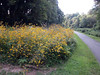
It’s been several weeks since I had the chance to walk home from work. So I was unprepared for the sight of this fine cloud of Black-eyed Susans in the Purple Beech/Ridge Heights meadow.
Tag: photo
Prince George’s wetlands
Last Saturday’s field trips took us to two freshwater wetlands in southern P.G. County, one well-known among naturalists, the other decidedly off the beaten path.
We met M-NCPPC ranger Chris Garrett at Suitland Bog. Chris is an accomplished trip leader who knows his park and what’s important to see, how to move the group along, and when to just take a moment and look and listen.
The park lies in the watershed of Henson Creek, a small trib of the Potomac. It’s actively managed: one of Chris’s great challenges is preventing the bog (technically it’s a fen, as much of the water comes from seeps) from drying out under the pressure of encroaching maples and willows. And there is Microstegium at the doorstep.
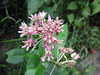
Several of the orchids on the plant list printed in the park brochure are probably extirpated, but Chris was able to point out Green Wood Orchis (Platanthera clavellata). He also found for us Ten-Angled Pipewort (Eriocaulon decangulare), the tiny Spatulate-leaved Sundew (Drosera intermedia), Halberd-leaved Greenbrier (Smilax pseudochina), and Red Milkweed (Asclepias rubra). We also got good looks at Netted Chain Fern (Woodwardia areolata), this time in fruit—alas, my snapshots were not satisfactory.
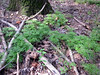
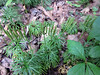
On the slopes leading down to the bog (sorry, fen), a Common Wood-Nymph (Cercyonis pegala) was on the wing (a first for me), and Chris showed us a fine patch of Lycopodium, including patches with sporangia.
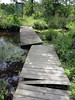
Chris and the class moved south to Cheltenham Wetlands Park, a 200-odd acre tract next door to a Homeland Security facility. The park is sometimes likened to a better-known park across the river as “Huntley Meadows Park without the people,” or the amenities, for that matter. There is no visitor center, parking is on the outside of a locked gate, and those fellows from DHS might give you the stink-eye. The budget for keeping the boardwalks in trim is also lacking.
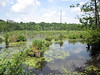
But it’s a charming little wetland, all the same. Stories differ as to how the water showed up in the wetland to begin with. The property was once home to an array of radio antennas (like HMP) (you can see remnants of the supporting poles here and there) and was managed by the U.S. Navy. One story is that a brass hat ordered the low spots to be dredged to support bass fishing; another is that the access road to the radio antennas formed a dike that retained water from periodic floods of Piscataway Creek.
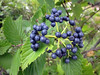
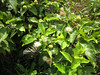
Bird life at late morning was stil jumping: I counted 18 species heard or seen. Swallowtails of various sorts were numerous, and the Eastern Kingbird we saw was likely snacking on them. Arrowwood Viburnum (Viburnum dentatum) was in fruit, and Buttonbush (Cephalanthus occidentalis) flowers were starting to mature. The destination plant for this scrub-shrub swamp is Common Bladderwort, with its itty-bitty yellow flowers emerging from the water above a haze of fine brown roots below the surface.
Battle Creek Cypress Swamp
We took a look at a freshwater swamp for our next wetlands field trip, co-led by Charles County staffer Katie Bradley. Battle Creek Cypress Swamp is known around the area as being one of the northernmost places where Bald Cypress (Taxodium distichum) can be found in large numbers. It’s suspected that the cypresses did well in this spot, rather than getting crowded out by shade-tolerant understory species, because farmers once grazed cattle here.
Much of the soggy spots were just that, with no standing or running water, but Battle Creek itself still showed some flow, as it made its way south to the Patuxent.
Katie also took us upland into a nice managed meadow along the access road (Grays Road) that I hadn’t seen on my previous visit.
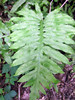
Down in the bottomlands, we found Netted Chain Fern (Woodwardia areolata). I’m starting to get a handle on this one, and how it differs from Sensitive Fern. Both are lovers of boggy spots, and both have the non-fernlike wings along the rachis. This note from Flora of Virginia helps a lot:
When fruiting structures are not present, Woodwardia areolata is sometimes confused with Onocolea, but in W. areolata, the pinnae tend to be alternate (tending to be opposite in Onocolea) and acute or acuminate (vs. obtuse), with finely serrulate margins (vs. entire) (p. 156)
The fine serrations and the alternate pinnae are fairly clear in the above image. But I still need to be patient and spend more time looking for sori.
Jug Bay Natural Area
Our first wetlands class field trip went to the Prince George’s side of Jug Bay on the Patuxent River. Greg Kearns of the park staff ran us up the river in a powered pontoon boat; he described the changes, good and bad, that he’s seen in the tidal wetlands over this 30-year career.

The re-establishment of Annual Wild Rice (Zizania aquatica) is due a decade of hard work by Kearns and his team: planting, spraying invasive Phragmites, building fences to exclude non-migratory Canada Goose (Branta canadensis), and other management activities regarding the geese (some call ’em flying cows). And the work has paid off. At left, the yellow-green band of veg in the midground, between the Spatterdock (Nuphar sp.) in the foreground and the gray-green Phragmites in the background, is Wild Rice. At right, you can see some of it coming into flower. This plant is a congener of the wild rice we eat, Z. palustris, harvested from the upper Midwest and Canada.
After the boat trip, a handful of us wandered down to the observation tower. We were surprised to find several good examples of Baldcypress (Taxodium distichum), especially since the feature of next week’s trip to Battle Creek Cypress Swamp is this same tree. Here’s an example that appears to be doing quite well.
Oh, yeah, and the place is crazy full of Osprey (Pandion haliaetus).
Decline of the West: 1
First it was the lights coming on at Wrigley Field, then the closing of Tower Records and Ollsson’s Books, and then the end of the zone system for D.C. taxicabs. We endured. But this blow is too much to take: the Metropolitan Museum of Art has discontinued its colorful admission buttons, replacing them with paper tickets, stickers—and advertising. A spokesman for the museum says that the the new paraphernalia will save the organization two cents apiece. Bah!
And Godzilla here was working on collecting a full set, hoping to score a free admission when his color came up again.
At the park: 61
Paul and I checked all the boxes last week and counted eggs for the remaining three nests. Swamp Rose (Rosa palustris) was in bloom, attended by various pollinators and other hangers-on.
The Hooded Mergansers continue to be more successful in our 16 boxes. We saw 7 clutches that were primarily merg, yielding 103 eggs, hatching 92. The Wood Ducks produced 6 clutches, laying 72 eggs but only hatching 48. Of the 13 total clutches, there were eggs of the other species in 4 of them. Our combined species total of 140 ducklings is the maximum over the 30-odd years that we have data for.
The two boxes that were relocated in preparation for the construction project (#77 and #6) were both successful. Box #13 had eggs
laid in it over a period of about 6 weeks, from 1 March to 13 April. In the end, 11 of the 14 eggs hatched.
Patuxent Research Refuge
I had a little time before my scheduled meeting at Patuxent Research Refuge/National Wildlife Visitor Center, up the B-W Parkway in the general vicinity of Laurel, and I needed some more field notebook work, so I took a quick loop along the Fire Road and Laurel Trails. The trails here are picture book walks in the woods, very friendly for school trips (of which I am sure there are many in season): duff and pine needles and pea gravel, a little wet in the low spots. And apparently more or less deer-free.
The plants here on the Coastal Plain reflect an acidic soil: some lingering Kalmia latifolia blooms, but mainly fruit; blueberries dominating the herbaceous and understory layers in many places.
The Goose Pond is a tranquil spot, at least looking in the opposite direction from the water control structure.
At the park: 60
There’s always something new to see at Huntley Meadows Park. Today I visited with a group led by Jane Huff for my general biology class. I rarely spend much time on the boardwalk in June, so I don’t get to see Buttonbush (Cephalanthus occidentalis) in fruit. Today I saw the buttons.
Water Pennywort (Hydrocotyle americana) is such a common emergent that I’ve never stopped to really look at it. This image is perhaps more atmospheric than diagnostic, but I like it.
Classmate Tom took one look at the watermarked plant that so bedeviled me last month (and for which I had no good photo) and said, “Here’s Sweet Cicely.” So we can put a name it, Osmorhiza claytonii.
We watched the usual noisy tussle between smaller birds and a Red-shouldered Hawk. But what I hadn’t seen before was an extended interaction between a male Red-winged Blackbird and a Great Egret that, according to the blackbird, was too much in his space. (This was down at the remnants of beaver dam just below the tower, the place that I remember for a tree that used to be there in which I saw one of my first Orchard Orioles.) The blackbird vocalized and flew at the egret, occasionally striking it. The egret seemed to shrug this off, moving a few strides away, but the blackbird persisted, continuing to harass. The blackbird was so insistent that he coaxed a croak out of the egret. Eventually the egret flew off down Barnyard Run. A few minutes later, we saw a second brief fight farther across the main pond—very difficult to say whether these were the same two birds.
Lots of Great Spangled Fritillaries (Speyeria cybele) flying and feeding on the Swamp Milkweed (Asclepias incarnata) that is coming into bloom. We saw one of these butterflies puddling on the remains of some goose poop on the boardwalk.
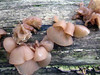
The really interesting find was this jelly mushroom that we came across along the informal trail along Barnyard Run. It keys out to Auricularia auricula, and is apparently edible. An Asian species is called “Cloud Ears;” it is dried and used to flavor soups. Go figure.
Dark Hollow Falls
A return to a section of Shenandoah National Park that I had visited not too long ago. This time I spent a lot more time trying to puzzle out plants (even though there were many that I passed by), so I covered the 3 miles out the horse trail, down the fire road, and back up from Dark Hollow Falls in a lazy 3:35. I was struck by the way some of the steeper slopes were dominated by ferns in the herbaceous layer.
I found several small patches of Houstonia caerulea. One of the common names for this wildflower is Quaker Ladies, and it’s appropriate, because the blooms come together in one place, but each flower retains its uniqueness.
My attaboy comes from working out this Wild Pink (Silene carolinensis), of which I found only a few instances. The flower is actually a little pinker than in the image: my optics aren’t quite up to the task of rendering this color.
Several mystery plants that I took snapshots of—maybe I can figure out one or two later.
I heard and saw a few American Redstarts (Setophaga ruticilla). Or “yellowstarts,” if one is to judge from the colors of the female.
Meadowside Park and Nature Center
Another Saturday, another field trip: this time for class, at Meadowside Park and Nature Center in Montgomery County, led by Jane Huff. Meadowside is one of the “green fingers” of the country, following the valley of the North Branch of Rock Creek. From my end of town, the best way to get there is via the distinctly off-the-beaten-track Avery Road, connecting to the lateral Muncaster Mill Road. The park is a nice size, and offers both upland and riverine habitat.
I saw two new butterflies, a Red-banded Hairstreak (Calycopis cecrops) that classmate Tom found, and several Zabulon Skippers (Poanes zabulon), the first of which I found. The group may also have found a Peck’s Skipper, but I didn’t get a good look for myself.

We walked down to the pond, passing an interesting stand of Sassafras (Sassafras albidum) (probably clonal) and a drift of Forget-Me-Nots (Myosotis sp.). (We didn’t linger to key them out between the native and introduced species.)
At the reconstructed cabin site, there is a garden plot. We found this Black Swallowtail (Papilio polyxenes) caterpillar there, munching on some Common Rue (Ruta graveolens). The black-white-yellow coloration suggests a Danaus butterfly like a Monarch, but the swallowtail lacks “horns” and the colors are spots, not stripes.
We saw lots of crane flies (Tipulidae), including one pair intent on making more crane flies. Dr. Huff turned over a far-gone rotting log to reveal an Eastern Brown Snake (Storeria dekayi). We saw lots of recent windthrow: 100-foot tall Tuliptrees snapped off two-thirds of the way up. Dr. Huff suggested an association between waxwings and junipers that I would like to follow up on.
Some nice galls on the leaves of a Black Gum (Nyssa sylvatica).
Best bird of the trip was a House Wren (Troglodytes aedon) hanging out around the martin house near the pond. Best plant of the trip was Green Dragon (Arisaema dracontium), a Jack-in-the-Pulpit congener found in one clump next to the creek. Its field marks are the long orange extension of the spadix, and the 5 to 15 leaflets.
At the park: 59
I took a walk through the park “on my own,” as it were, unencumbered by monitoring duties but looking to make some field notes as homework for my current class. I was halfway there before I missed my point-and-shoot, so I had to make do with my tablet for images.
I haven’t been down the Cedar Trail for a couple of years or so, and I don’t spend much time this later in the season, so I found several puzzlers. The stretch of the trail that I used to think of as “Woodpecker Alley,” with lots of dead trees, is filling in with Sweetgum and lots of other green things.
I keyed out Rattlesnake Weed (Hieracium venosum), a yellow-flowered composite without noticeable disk flowers, petals pinked like a member of Caryophyllaceae, and minimal stem leaves like Goodyera.
I snapped some images of a mystery plant, already in fruit with 5 siliques, and with watermarked leaves like a waterleaf. Still working on that one.
The Snapping Turtles (Chelydra serpentina) were all over the place, at least eight in the main pond. And one, about 50 meters from anything wet at all, crossing the Cedar Trail, very interested in the cavity at the base of an uprooted tree.
I looped through the woods up to the tower, exchanged some information and pleasantries with a couple of guys from the Shenandoah Valley, and headed back to the car on the boardwalk. Right at the wetland’s edge, I came across this Thamnophis sp. snake, either an Eastern Ribbon Snake or Eastern Garter Snake. The image that I acquired doesn’t quite show the detail of the stripes needed to separate these two species, at least to my eye.
Enroute: 4
Fraser Preserve
I broke from my usual Saturday gig to take a walk through the Fraser Preserve in the northern tip of the county, bordering on the river. Fraser is jointly managed by the Nature Conservancy and Calvary Baptist Church; one of its missions is making nature study available to inner city children. The walk was led by Conservancy volunteers, and a couple of staff were also on hand.
The plant life here is rather similar to what I’ve been shown on other class trips along the Potomac, at Carderock and Turkey Run, for instance.
Birds were mostly heard but not seen, as the canopy begins to leaf in. Some of the showiest spring bloomers are gone or nearly so (like Mertensia virginica), but we did find some Golden Ragwort (Packera aurea) coming in. We had stopped to look at a patch of bluebells and I found this single Toadshade (Trillium sessile) just opening up.

I looked at this lushly growing carrotty thing, not yet in flower, and I had read the flyer for the walk that highlighted some of the property’s specialties. So I asked Ed Clark, who was co-leading, “Is this what I think it is?” and he confirmed that it was Poison Hemlock (Conium maculatum). This non-native is highly toxic if ingested; it has noxious weed status in eight states. The purple spots on the stems that give it its specific epithet don’t read well in my images.
Spring butterflies of southern Maryland
Unseasonably cool, breezy weather greeted us on Sunday for a foray to southern Maryland looking for spring butterflies. Stephanie Mason and Dick Smith took us to two sites on the Coastal Plain. The weather checked the activity of the butterflies, but we found lots of other things to look at.
Our first stop was at Calvert Cliffs State Park. The playground near the parking lot is guarded by a fierce dragon made of recycled tires.
We found a spread-wing skipper, most likely Juvenal’s Duskywing (Erynnis juvenalis), according to Dick, given the time of the year; a hairstreak, a battered Henry’s Elfin (Callophrys henrici); and an azure (Celastrina sp.).
The oaks in this sandy, acid-soil habitat are tricky to ID this time of year. Working from bark, leaves, and acorn cups, we found evidence of Chestnut Oak (Quercus prinus) as well as Swamp Chestnut Oak (Q. michauxii). The understory is well-populated with American Holly (Ilex opaca) and Mountain Laurel (Kalmia latifolia).
We watched three 4-inch-long, yellow-brown elvers (Anguilla sp.) wriggling in the current of a small, shallow brook.
There is a spring hunting season for Wild Turkey (Meleagris gallopavo) in parts of the park (which might explain why we didn’t see any). Back at the parking lot for lunch, a good half dozen of us spent 10 minutes looking for a steadily-singing Pine Warbler (Dendroica pinus) that would not budge from its concealment near the top of a pine. This has not been the first time I’ve chased a bird like this: I’m inclined to consider lack of visibility a field mark for Pine Warbler.
We moved on to the Glendening Nature Reserve of Jug Bay Wetland Sanctuary, and the butterfly action picked up a bit. Several Eastern Tailed-Blues (Everes comyntas) and American Coppers (Lycaena phlaeas) were found. And flitting about its host Juniperus virginiana, Juniper Hairstreaks (Callophrys gryneus). Whereas the elfin basks with its wings held perpendicular to the ground and the duskywings spread their wings parallel, the Juniper basks in a tree “rolled over” with both wings folded together, nearly parallel to the ground and angled to face the sun.
It’s only the new growth of a Virginia Pine (Pinus virginiana), but it’s the only close-focus image that I succeeded at for the trip.
This little patch of prickly pear (Opuntia sp.) was a bit of a surprise.
The big mystery for this stop was a series of burrows, ranging from 1 to 2 cm in diameter, some of them ringed with a little wall of twigs and beech scales. Ben measured one of the burrows to be 10 inches deep. The consensus is that the perfectly round holes were made by one or more species of solitary bee or wasp, but we couldn’t get more specific than that.
Update: Stephanie has suggested one of the scrub burrowing wolf spiders (Geolycosa sp.) as the maker of the holes.
Enroute: 3
I’m back with NPR for a short gig, working on- and off-site. As Scott Simon reported this morning, NPR is relocating from its Massachusetts Avenue, N.W. building (really two buildings stitched together: on the 5th floor, there’s a two-stair difference between the blunt end of the building and the Tiny Desk Concerts venue at the “skinny end” where Bob Boilen sits) to new digs on North Capitol Street.
The move is happening in phases; this posting in the elevator keeps everyone informed of the GO dates.