
The Minutes

As the US approaches the 250th anniversary of its independence declaration, Tracy Letts’ The Minutes takes a troubling look back at our complicated past—in the present case, through the blinkers of a tedious weekly meeting of a small town city council. Challenges are made, and met. As one character says, “History is a verb.”

If the ending of the play is a little over the top, nevertheless the playwright’s message is clear. However, a key argument of the debate is knocked over quickly with a smidgen of what-about-ism (perhaps to keep the piece at its 90-minute running time); one wishes for a deeper, more nuanced engagement with the issue.

Timothy H. Lynch as Mr. Oldfield adds a bit of comedy to the proceedings, as the council’s most senior member but no longer its most compos mentis.

  • The Minutes, by Tracy Letts, directed by Susan Marie Rhea, The Keegan Theatre, Washington

Thinking about this play from a more personal standpoint, I begin to wonder whether I am in the target audience for this play, or for that matter, something like The Thanksgiving Play by Larissa FastHorse, a much more facile work. Maybe I’ve already read enough David Treuer: I get it, already.

I was talking to a (younger than me, middle-aged) colleague some time ago, and we both expressed the feeling that much new theater these days has become, well, preachy. Mind you, I am still noticing new, challenging good work out there (e.g, The Great Privation, Soft Power). But maybe, now that I am in my legit crotchety years, the arc of my own moral universe has bent as far as it will go.

Keep looking

Scott Weidensaul gives us a nudge to remember to look for bird-friendly certified shade-grown coffee. I will confess that I tend to grab anything that’s labelled organic at the market; my excuse is that coffee with the Smithsonian’s label (or with related labels like the Rainforest Alliance’s) is (surprisingly) more difficult to find where I shop than it used to be. Need to look harder.

Postcards from Ohio: 6

Our last stop in the Dayton metro was at Oakwood High School, a rather fine institution from which I was graduated in 1974.

There is nothing new under the sun, and a young person with access to an automobile will find a way to use it for mischief. And so it came to pass in those days, that after an evening with my nerdy friends of playing Risk and usually intoxicated by nothing stronger than diet soda, we would find ourselves on the streets of this lovely, leafy suburb in my mother’s blue Austin America (an underpowered MG with a singularly peculiar suspension system).

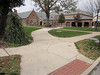
one endAnd lo, the people saw that the faculty parking lot along the south side of the high school gave onto a sidewalk with no curb.

the other endAnd my friends said, behold, the other end of this sidewalk ends with a curb cut on the Avenue of Schantz, near the playing fields. Let us rejoice in this attractive nuisance, and drive your vehicle from the parking lot directly into the Avenue of Schantz, without impediment.

And so it was done, and we drove the America down the sidewalk (think of Jason Bourne being chased through the streets of Paris in his Mini Cooper, but at vastly reduced speeds), and it was good.

That is, until some obstacle loomed on the passenger’s side and put a big crimp in the door. (Was it that big red oak that you can see in the first image? I seem to remember some sort of stanchion.) I achieved a new level of creative prevarication when I explained to my mother that the damage wasn’t my fault. (It was only last year, when she was zonked on hospital sedatives, that I came clean to my mother. But I think she’d figured it out a long time ago.)

Mom drove the America for another year or so, into my first year of college at least, until the hydrolastic suspension leaked and the car developed a severe list.

In any event, the sidewalk connection and the curb cut are still there, almost 40 years later. The ADA-compliant bumpy bits are the only change.