 It’s the off season for ducks in nest boxes at Huntley Meadows Park: a good time to write a little about the boxes themselves.

 As P. and K. are demonstrating here, a typical box for us is made of nominal one-inch wood panels, about the height but not the width of a dorm refrigerator, with a slightly sloping roof, and entrance/exit hole, and a door on the side. Each box has a painted number: the numbering system is there is no system. Sometimes a box is numbered (randomly) by the carpenter who made it, sometimes a box retains its number when it’s moved to a completely different place in the park.
 A box is mounted on a metal pole, usually in some depth of water. And usually we sheathe the pole in a PVC sleeve, as a predator deterrent. As a second deterrent, we’ve attached a metal cone to the PVC sleeve. As you can see from the detailed photo, there’s still a bit of a gap between the apex of the cone and the sleeve: I conjecture that black ratsnakes can slip through the gap, so we’ve recently filled in with foam crack filler.
If you’re mounting boxes on square wooden posts, you wouldn’t have this gaposis problem.

 The box is attached to the pole in a couple of different ways. Typically, we drill two pairs of holes in the back of the box and pass through a pair of U-bolts, securing them with nuts on the inside. There’s not quite enough friction to hold the box in place, so it rests on the top of the PVC sleeve.
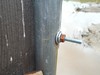
 I’ve also recorded at least one box that uses carriage bolts that thread through the box and the pole.
 And a box with metal straps.
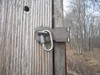
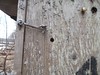 The door must also be secured against predation. Whereas ratsnakes like to come in through the entrance hole, raccoons prefer finding a way to open the door. So we often close the door with a hasp and quick link, or with a hook and eye on a spring.
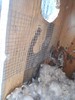 The inside of the box is fitted with a section of hardware cloth (wire mesh), which gives the ducklings more of a purchase when they’re ready to scramble out of the box. This element tends to be a point of failure as the box is used, so we might have to staple the mesh back in place.

 A typical box lasts about five to seven years in the field before it falls apart. If a box develops a knot hole that pops open, we can keep the box going for another season or two with a bit of plywood and some (clumsy) nailing.