DIY Science

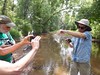
I participated in the inaugural DIY Science day at the Clifton Institute, led by co-Director Eleanor Harris. It’s an adult-tailored version of the Institute’s Young Naturalists program. Not too many rules: explore the field station, formulate a research question, do some science, and present your results. The vibe is a little like the Serendipity Days practice when I was with NPR’s Digital Media.

As I wasn’t sure how the day would play out, I planned a research question ahead of time: roughly, can we measure any differences between two species of oak (White Oak, Quercus alba, and Northern Red Oak, Q. rubra), as sampled as dead leaves from my home and the Institute? The red oaks are well-known for showing more tannins than the white oaks. Is there a way to measure that difference?

So I brought some leaves picked from my backyard, and then at the field station collected some more in the woods. First complication: I was hoping to also analyze another species from the red oaks, Q. falcata, only to find that there are no records of Southern Red Oak at Clifton.

Second complication: methods and materials for measuring tannins were a bit beyond the capabilities of the research station, or so I surmised. However, some follow-up searching suggests some simpler, alternative methods.

specimenAs a result, staffer Bridget Bradshaw suggested some other tests that might yield some interesting results. She also brilliantly suggested a simple way to make equal measured samples from my dead leaves: 10 punches with a paper hole punch from each leaf. No mussing about with weighing something in the sub-gram range. Samples went into small lidded yogurt jars (apparently well-stocked at the research station, and easy handled by the kiddos).

  • Simple chromatography with a bit of acetone and (coffee) filter paper.
  • Measuring acidity of samples steeped in water and set in the sun for 30 minutes.

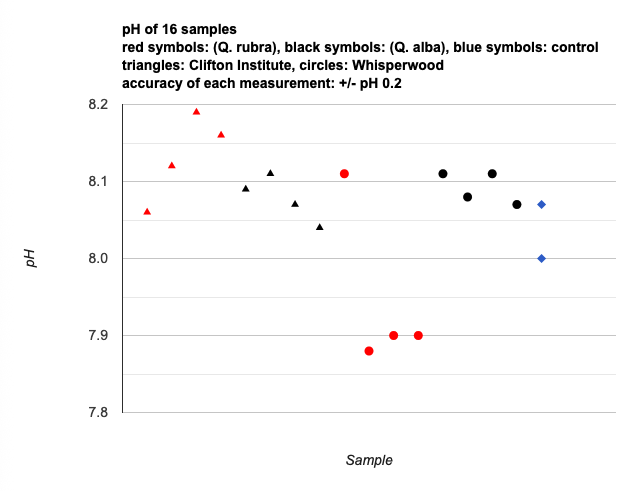
pH samplesThe chromatography didn’t show any results after the hour or so that we had available. But the pH measurement did return some results, on the face of them counter-intuitive. Here’s our 16 pH specimens, sunning on the Clifton Institute porch.

All the White Oaks sampled, as well at the Red Oaks at Clifton, measured more basic than the control (the plain spring water that was used to steep the samples). A possible explanation: fresh oak leaves will measure on the acid end of the scale, but after some decomposition as dead leaves, the acidic compounds leach away preferentially, leaving more basic dead leaf material.

Third complication: the pH meter that we used took several minutes to produce a reading, and readings shifted about as we took our measurements.

For “final presentation” to the group, I drew a quick, crude graph with a Sharpie. I’d like to polish it a bit for presentation here. Update: After some scuffling with the Google Charts API, I managed to produce the following graphic. (It’s a screenshot, not live; the API and vanilla WordPress don’t play well together.)

More research needed: I’d like to try this experiment on some fresh leaves and with a more reliable pH meter.
Clifton Institute NABA Butterfly Count 2025

I returned for the second year to the Wildcat Mountain property as co-sector leader. (Hmm, I see that I didn’t post any trip report for the 2024 count.) We all survived the heat and humidity: MK and Lili had the smart idea to stage a vehicle at the bottom of the hill so that we didn’t have to trudge back up the slope.

Nothing too exciting. Scads of Eastern Tiger Swallowtail (Papilio glaucus); I got a look at but no photo of Red-banded Hairstreak (Calycopis cecrops); I got identifiable photos of Pipevine Swallowtail (Battus philenor).

Clifton Institute bioblitz July 2025

On a punishingly hot and muggy July day, we returned to a property that we had biolblitzed last summer. I was able to last about 90 minutes out in the gardens and meadow, and about an hour down where the Rush River joins the Thornton, but then I had to crash on our hosts’ porch. I was sucking wind just climbing a small rise.

In the garden, I documented my first Snowberry Clearwing (Hemaris diffinis). I tried to expand my horizons by looking for leaf miners.

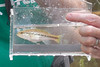
At the rivers, iNaturalist honcho Carrie Seltzer and I found several species of myxomycetes, including the critter that acts like a puffball mushroom, Wolf’s Milk (Lycogala epidendrum). I got a look at a Rappahannock Darter (Etheostoma vexillare) (a Rapp endemic of cool, clean waters) before the rest of the team charged upstream—I just don’t have the footing to follow.

After dinner, activity at the lighted sheets was great. Our big charismatic beetle, Broad-necked Root Borer (Prionus laticollis), settled in at Jeff and Izabella’s setup and stayed all evening. The Scarlet-winged Lichen Moth (Hypoprepia miniata) was shockingly beautiful.

This is National Moth Week. I’m cogitating on getting my own setup for my cubby-hole of a back yard.

Clifton Institute dragonfly/damselfly count 2025

Sunday, more of the same heat. We managed about 3-1/2 hours at Leopold’s Preserve before packing it in. Team leader A.J. did find a few Bar-winged Skimmers (Libellula axilena) for us. We also turned up some puzzling spreadwings; here’s a Lestes in need of a species ID. I still struggle with distinguishing Calico and Halloween Pennants.

I decided to forgo my high boots in the interest of keeping cool, and I brought a couple of American Dog Ticks (Dermacentor variabilis) home with me as a result.

Clifton Institute bioblitz May 2025

I participated in another bioblitz organized by the Clifton Institute, this time at Sunnyside Farm & Conservancy in Rappahannock County. I visited the farm last year for a dragonfly count for the Institute. With several insect experts in the group, I was able to file 57 observations, including

  • a Giant Bark Aphid (Longistigma caryae) resting on Dr. Hardtacks’ back bumper;
  • a Twice-stabbed Stink Bug (Cosmopepla lintneriana), always a popular common name;
  • a pair of conjoined Azure Bluets (Enallagma aspersum), a new damselfly for me;
  • a passable recording of Prairie Warbler (Setophaga discolor) against the background noise of breezes and naturalist chatter; I used my tablet and the Merlin app, rather than my dedicated audio recorder, trading off a better directional mic for on-the-fly ID suggestions;
  • a non-native cress that I didn’t know, Land Cress (Barbarea verna);
  • a very lucky shot of Common Baskettail (Epitheca cynosura) on the wing.

measuring the tare weightlogging the dataEarly in the afternoon, we took a break from chasing plants to observe technicians working with an American Kestrel (Falco sparverius), one of the study subjects in the Institute’s long-running research project into this species’ ecology on farmland and restored prairie.

Clifton Institute bioblitz June 2024 (Rappahannock bis)

The Clifton Institute held a second June bioblitz on private property in Rappahannock County, this time on a smaller site (about 50 acres). Still, there was a good mix of upland, meadow, and a bit of wetland habitat. And it was hot: by the end of the afternoon, I was knackered and I skipped the after-dark UV lights.

in the meadowHere’s the group starting off in the meadow. This is as tight a clump as we formed all day.

As our homeowner’s site has only been partly managed for natives, and (friendly) neighboring properties perhaps not at all, there were opportunities to meet new non-native invasive plants, like Everlasting Pea (Lathyrus latifolius): dig the superwide wings on the stem. The householder was disappointed when I told her that the Persian Silk Tree (Albizia julibrissin) was one of the less-desirables.

On the native plant side of the ledger, I found a huge (1.5 meters tall) sedge, most likely Carex gynandra or C. crinita, and another monster, Soft Bulrush (also a sedge, but with a soft round culm) (Schoenoplectus tabernaemontani).

Organizer Bert Harris went fishing in Beaverdam Creek (tributary of the Thornton River) and netted a Mountain Redbelly Dace (Chrosomus oreas), not showing off a red tummy, alas.

New crawlies for me! A Cherry Dagger caterpillar (Acronicta hasta); a sharpshooter (Graphocephala sp.); a False Milkweed Bug (Lygaeus turcicus) [I’ve been focusing on the red-and-black species this summer]; and the gloriously named Twice-stabbed Stink Bug (Cosmopepla lintneriana).

And—after three seasons of chasing after Larry Meade and Bert, who are always spotting Prince Baskettails (Epitheca princeps) patrolling a pond, I finally found one for myself. Dusk was approaching and I was ready to go home, but I took a little walk down to the swimming pond on my way to the car. I found my guy doing what he should be doing, and with five minutes’ patience I squeezed off a few smudgy photos, sufficient for one of iNat’s experts to confirm the ID.

Clifton Institute dragonfly/damselfly count 2024

Quite hot and muggy.

We started early and only surveyed for about 4 hours, skipping Silver Lake this time. Much of the Pickerelweed at our “secret” pond at the Farm Brewery had been cut back, so the damsels just weren’t there. Our newbies got good looks at some of the common species, so that’s a win. I recorded observations of Calico Pennant (Celithemis elisa) and Banded Pennant (C. fasicata), as well as a couple of butterflies and plants. I’m gradually, unintentionally, building up an interesting plant list for Leopold’s Preserve. Maybe I should be more intentional about that.

Clifton Institute bioblitz June 2024 (Rappahannock)

And one more trip report and I’m caught up until the weekend.

Clifton Institute is holding two bioblitzes on sponsor properties this summer. For the site visit on 15 June, we’re building on an established iNaturalist project. I was briefly on the leaderboard.

In the meadow leading up to the house, I found a Coral Hairstreak (Satyrium titus). Tiniest critter spotted turned out to be a White-margined Burrower Bug (Sehirus cinctus). On an adjoining property (friendly neighbors), a gneiss outcrop hosts a dryland specialty, Round-leaved Fameflower (Phemeranthus teretifolius), very cool.

After dark at the lights we had several species of sphinx moth. I am still getting the hang of photographing under the UV conditions, but I did snap a pic of a handsome Virginia Creeper Sphinx (Darapsa myron). And the iNat community taught me that a Large Maple Spanworm Moth (Prochoerodes lineola) is not the same as a Juniper Geometer Moth (Patalene olyzonaria), seen on last year’s bioblitz.

Most of the birds remained out of sight, but I got some reasonable audio recordings.

The Borrowers were following me around in the field on this trip. The wrist strap on my point-and-shoot came undone and disappeared, and the glass element worked itself out of my loupe for the last time and dropped to the forest floor. I think I even heard it drop and I looked back, but clear glass is kinda invisible.

Rappahannock County dragonfly/damselfly count 2024

So many field trips, such a backlog of trip reports I have! I’ll start with the first annual Rappahannock County dragonfly/damselfly count on 8 June, organized by Bert Harris and the Clifton Institute. Big thanks to Nik and the team at The Farm at Sunnyside for hosting one of our stops. My best photo is a Unicorn Clubtail (Arigomphus villosipes) obelisking.

This was also the trip in which I learned that wading streams with lots of small boulders covered in algae is not my forte. I took a tumble into the Rush River and gave a spiffy new camera a slight dunking. I let it dry, and here’s hoping that it will bounce back.

Clifton Institute bioblitz August 2023

looking more or less northAlmost perfect weather yesterday for traipsing and documenting. We surveyed a farm up on the Piedmont of western Fauquier County that is being converted from cattle pasture to a more native plant-based flora.

low flowgetting the shotquarryThe farm backs on to an upper reach of the Rappahannock River, this summer not running with much water due to our moderate drought. But Bert Harris and helpers managed to net a Largemouth Bass (Micropterus salmoides) for observation and release.

After I chased an Eastern Wood-Pewee (Contopus virens) for half an hour, it settled down to sally from a perch, giving me some excellent, well-lighted looks. I’m not fond of Box Elder (Acer negundo) as a rule, but some of the trees in the river bottom are delightfully gnarly and chonky.

It’s a bioblitz, so everything counts, including Pokeweed (Phytolacca americana) and Bottlebrush Grass (Elymus hystrix) and Eastern Gray Squirrel (Sciurus carolinensis). This one caught our attention because it was loudly gnawing on a bone.

After sifting out the out-of-focus shots and doing my best to color-correct the greenish cast given off by the mercury vapor lamp, I was able to contribute 49 observations to the project.

At the end of the day, as we started to drift back towards the cars, someone gave up a shout, because a female Eastern Hercules Beetle (Dynastes tityus) had come to the light.

Clifton Institute NABA Butterfly Count 2023

I stepped into the role of sector co-leader for this year’s Clifton count. I did some scouting on Thursday, if anything to start to make sense of the maze of mown paths in the Woodcock tract and elsewhere.

lunchtimeVery pleasant weather on Saturday. Not outstanding numbers, but everybody had fun. Our less experienced team members found all the good stuff: Question Mark (Polygonia interrogationis), Dun Skipper (Euphyes vestris), Least Skipper (Ancyloxypha numitor).

Clifton Institute dragonfly/damselfly count 2023

A couple highlights (and a lowlight) from Sunday’s count.

At Silver Lake Regional Park, a new damsel for me, Blue-ringed Dancer (Argia sedula). At Leopold’s Preserve, nice images of Calico Pennants (Celithemis elisa), both male and female.

We got good looks (no pix) of a Comet Darner zipping across one of the ponds at Leopold’s.

And along Broad Run behind the houses adjacent to Leopold’s, my first encounter with Spotted Lanternfly (Lycorma delicatula) in life.

Since I knew the track at Silver Lake, I changed to my more comfortable shoes so that I could keep up with Larry until nearly 16:00.

BANO banding at Clifton Institute

out of the boxin the handClifton Institute technician Caylen Wolfer has her banding kit out again, this time for Barn Owl (Tyto alba) nestlings, just about ready to fledge. A few of us got to ride along.

There are five nestlings (a/k/a fluffballs) in this nest box, which replaced (as far as the owls were concerned) a barn that was pulled down in order to make room for a greenhouse.

Baicich and Harrison write that the owlets are flying after about 60 days in the nest.

I could spot one bird in the box before Caylen got her mitts on it, so this sighting is ABA countable. Yay!