Comma chameleon

We’re doing our first complete run of the show off book this evening. Ordinarily, eleven days before opening, the books would be long gone, but there are a lot of words in this show, and despite early cuts (disposing of the expository bits between Kent and the Gentleman that I call the “Previously on Hill Street Blues…” scenes) we’re still making small trims in an effort to keep the running time under three hours.

I have a nice little scene nearly at the top of the show, where France is betrothed to Cordelia because Burgundy won’t have her now that Lear has disinherited her. And then I get to hang out and finish reading the last two Lemony Snickets until well into the second half, where I am responsible for carrying off maimed or dead bodies and bringing in bad news (the British armies are moving against France, Goneril has poisoned her sister and then stabbed herself—did I need to preface this with a spoiler alert?)

This is my first work with Cedar Lane Stage, which rehearses and performs at Cedar Lane Unitarian Universalist Church in Chevy Chase, Md. The CLUUC campus is a lovely, leafy collection of buildings on a hillside sloping down to Rock Creek, with the Beltway just beyond. As with most church buildings, there are a number of other groups using the space at the same time—a woodwind choir rehearsal, an AA meeting. All last week it was a little tricky to stay focused because someone was rehearsing selections from Carmina Burana. Lear is howling at the thunderstorm while the organ upstairs is blasting out the reprise of “O Fortuna.” It kinda fits.

(Actually, King Lear‘s familiarity makes for lots of mashups. There is a short story by James Thurber that I will have to track down that puts together a radio evangelist with one of Edgar’s “mad Tom” scenes, and the killing of Oswald swirls into the mix at the end of the Beatles’ “I Am the Walrus.”)

We perform in the church auditorium. There is a set of steps leading up to a shallow stage, but in this production, as in most CLS shows, most of the action is on the floor of the auditorium, with audience seating on three sides. By far the most distinctive feature of the space are the floor-to-ceiling windows on two walls. Nice views of the surrounding woods, but it means that any lighting effects are completely lost on matinee performances, and we’re doing two of them.

I’m working again with Tom (Gloucester) and Dan (Kent). I’ve seen good work in the past from David (Fool) and Kelli (Regan), and I’m seeing more of it here. Everyone else is new to me, including our Lou (Lear). This is my first time working with director Ed. Ed is a stickler for punctuation (and what Shakespearean isn’t?), hence his nickname and the title of this post, thanks to Brett (Albany).

Tap

Tap is an otherwise ordinary dance movie from the late 1980s, with just enough plot and characterization to string together the dance numbers. But there’s a gesture about 13 minutes in that’s worth the rental; it tells us a lot about our protagonist Max (Geoffrey Hines), and about what it is to do creative work.

Max is just getting back on his feet; he’s just out of prison. He walks into a tap dance studio, it’s a little grungy, but he knows his way around. He walks three flights up to a private studio. He’s got his shoes in a brown paper bag. He dumps the shoes out of the bag onto the floor, slips off his jacket, strokes the wood of the floor briefly, and then he begins to practice.

It’s not about the best equipment, it’s not about the bright lights, it may not even be about having heat in the building: it’s about the work.

Yay, us! 2

Last spring’s production of Never the Sinner, directed by Michael Kharfen, received three awards for outstanding achievement at yesterday evening’s WATCH awards, including Outstanding Play. The candidate pool was 79 productions by 29 member companies, so, yeah, this is kind of a big deal.

Ordinarily, I don’t get worked up about things like this, but as Ted says, awards programs are bunk until you win one. I was definitely tingly when I came over to congratulate Michael and the rest of the team. I am honored to have been a part of this fine show.

Good on ya: 3

Three of my projects from last year have been honored with nominations for outstanding achievement from WATCH: Seussical, Never the Sinner, and Guys and Dolls. I was especially pleased to see the directing and technical work on Sinner receive its due recognition.

And Leta has the wow moment: she picked up a nomination for her work as Alma in Taking Leave for Vienna Theatre Company. I am very proud of her.

A clean, well-lighted place

beforeafterCheck out the spiffy new tile and furniture (at right) in the main men’s room at Silver Spring Stage. Renovations were completed to the men’s and ladies’ rooms just in time for the opening of Seascape. The best thing about the rehab is that the classic-era tulip-shaped urinal (see the “before” picture, at left) was retained. Second-best thing is that there is once again light in the stalls. Your contribution dollars at work! Thank you!

Rogers Peet

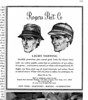
Rogers Peet Co.I was rereading J.D. Salinger’s “Hapworth 16, 1924,” which Sally had graciously printed from her copy of the New Yorker archives (19 June 1965), and there on page 111 was further evidence of Sarah and Adelaide’s favorite haberdasher. Jeez Louise, if their idea of fashion on the mid-1960s was the “Eton-style cap of Arnel triacetate and cotton blend in Oxford weave” (the ugly helmet on the right), they deserved to go out of business.

Squeezing the melons

Adelaide and Sarah summon the names of a few defunct retailers in “Marry the Man Today.” Adelaide’s intro begins:

At Wanamaker’s and Saks and Klein’s,
A lesson I’ve been taught:
You can’t get alterations
On a dress you haven’t bought.

Saks Fifth Avenue (founded by Andrew Saks, and hence no apostrophe) is still with us, after the usual bewildering chain of ownership exchanges. I didn’t know that Saks had merged with Gimbel’s by 1923, but maintaining its distinct branding. Middlebrow Gimbel’s, of course, has passed on. When I was in graduate school, I bought a great sweater from the downtown Philadelphia store.

The Philadelphia institution founded by John Wanamaker, now merged into Hecht’s and then Macy’s, once had a million-square-foot flagship store in New York at 770 Broadway. Klein’s would be S. Klein, On the Square, also long gone from Union Square.

But the real poser comes in the first bridge:

ADELAIDE: Slowly introduce him to the better things, respectable, conservative, and clean.
SARAH: Reader’s Digest!
ADELAIDE: Guy Lombardo!
SARAH: Rogers Peet!
ADELAIDE: Golf!
SARAH: Galoshes!
ADELAIDE: Ovaltine!

As punctuated in the libretto, Rogers Peet sounds like the name of a self-help guru from the first half of the century, someone like Norman Vincent Peale, Émile Coué, or Dale Carnegie. But it turns out to designate the merger of the businesses of men’s clothiers Marvin N. Rogers and Charles Bostwick Peet. Rogers, Peet & Co. was a nineteenth-century retailing innovator, introducing tags that identified fabric content and price (no haggling!) and a money-back guarantee. The final Rogers, Peet store closed in the mid-1980s.

Program inserts

We were called for a pickup rehearsal yesterday evening in preparation for this weekend’s run. It was a refreshingly productive hour. We reviewed only choreography, so we didn’t waste time clowning through the dialog (alas, a practice all too common in the amateur ranks). Really the point of the evening was to work Ivan into the show, as he is substituting for both Billy and Zach these next three performances. It’s not uncommon to see substitutes in the chorus/ensemble. Indeed, Kelly went on for Christy our opening weekend. A lot of the community theaters around here run four weekends for a musical, and it’s hard to keep a group of eight or twelve decent singer-dancers together for that long. It is certainly the case that the orchestra roster will vary weekend to weekend and night to night. A solo line that you’re used to hearing from a violin or trumpet one evening will come from the keyboard. There are directors who make a signature of this. RCP’s production of Barnum is storied for its who’s-on-tonight cast.

I’ve also seen substitutes in speaking roles, and in straight plays as opposed to musicals. It’s an interesting challenge to work with the different energy that you get from an actor that you’re less accustomed to.

I played Dr. Pinch in a production of The Comedy of Errors about ten years ago. The design concept for the show was sort of a comic-book post-modern Anything Can Happen Day. The multi-colored set incorporated a kid’s slide. In the world of this show, anachronism was a good thing. And there was a chorus of about eight without speaking parts; they were there to give some depth to the picture, and to participate in sight gags like a twelve-man double-take. So naturally the markeup of the chorus was fluid.

Dr. Pinch’s big scene is with Antipholus of Ephesus, whom he thinks is mad. Pinch tries to drive out the evil spirits:

I charge thee, Satan, housed within this man,
To yield possession to my holy prayers
And to thy state of darkness hie thee straight:
I conjure thee by all the saints in heaven!

Now David, my director, sometime during rehearsals gave me a battery-operated fan and said, “Use this for the exorcism, if you like, or find something else goofy.” And this eventually turned into “what is Gorsline going to pull out of his kit bag tonight?” I made an agreement with Angus (playing Antipholus) that he would see everything at least once during tech week, but once we were up, I would pull things out more or less at random. I had a rain stick, and a soap bubble pipe, and a couple of other things along with the mini-fan.

(This was not unlike the arrangement that Terry has with our director of The Foreigner that his Charlie would find a different “translation” of Froggy’s “Gomo rim jambo” every night.)

So, it must have been second weekend, and a young lady from England—Nikki I think her name was, first nanny that I met who wore Doc Marten’s—joined the chorus for her first performance. She told me afterwards that it was all she could do to keep her composure when I pulled out a hand-cranked egg beater and waved it over Antipholus like a security screener’s baton.

The cows and chickens are goin’ to the dickens

We’re two weeks into the run now. Audiences have been packed and enthusiastic. Some of the messages that Sue has sent our way from happy watchers have been gushing.

Lots of fun technical elements in this show. Bea and Jerry have dressed the newsstand with a panoply of old cheesy pulp magazines salvaged from eBay—racing and turf news, turbo-charged action stories, comic books, pinups and confessionals (“Why I Am a Prostitute” is one cover story). The only bad thing, for us, is that the mags are stapled closed onto the set piece. I’ll never get to read that interview with Ava Gardner.

I have a great costume of olive greens and golds, incorporating a hat that I bought for myself about 15 years ago, a bad-plaid sports jacket that somebody’s ex-husband once wore, a 40s-era psychedelic necktie with still more greens and golds, and pants (built by Anita and Maggie) with a waist that sits under my rib cage.

The orchestra sounds great. Brian has found five woodwinds (including bari sax!), five brass, acoustic bass, drums, and is filling in the rest with keyboards. I particularly like the bit in the overture where the “A Bushel and a Peck” theme is introduced with piccolo and bass clarinet.

I’m liking my fight choreography in the “Havana” sequence: Dana clocks me with a serving tray, twice, and I finish with a back fall (make your legs into a figure 4, land on your well-padded tushie, and roll the rest of the way down). The only hard part, oddly, is getting up again. Sometime during tech week I pulled a muscle in my chest trying to bounce up too quickly in the following blackout. In fact, I’m nursing a couple more dings and scrapes from this show (one of them definitely my fault) and the rest of the cast and crew seem mildly cursed as well.

I love the grammar lesson that Sarah gives to Adelaide at the end of the intro to “Marry the Man Today:”

ADELAIDE: Now doesn’t that kind of apply
To you and I?

SARAH: You and me.

I think the best thing about doing an ensemble role like this is that I’m so focused on doing my own work well (cleaning up fuzzy bits of choreography; trying to make the inner harmony I have in “Oldest Established” audible) that I’m not wasting energy worrying about what everyone else is doing. Well, that’s mostly true.

Sometimes, just before curtain, I will get all New Age and lay my hand on the floor to pick up some positivity. I think about the many times I have performed in this theater, all the way back to The Foreigner in 1989 when each night I would step blind into a trap door, with Mary Jane’s hand guiding my foot down. So last Saturday night, I placed my palm on the wooden stage deck (instead of the concrete around the edge, like I usually do) and I could the vibrations in the boards as the rest of the cast was moving into place. I felt bubbles of anticipatory energy, just the way Leta describes it.

I’m having a good time.

Summer Garden

Naturally, Miss Dawn Astra reciprocates Ambrose Hammer’s love, because all the time she is Julius Smung’s sweet pea, the best she ever gets is a free taxi ride now and then, and Julius seldom speaks of her as an artist. To tell the truth, Julius is always beefing about her playing the part of a strip dancer, as he claims it takes her too long to get her clothes back on when he is waiting outside the Summer Garden for her, and the chances are Ambrose Hammer is a pleasant change to Miss Dawn Astra as Ambrose does not care if she never gets her clothes on.

—Damon Runyon, “So You Won’t Talk!”

The various venues known as the Winter Garden are well-known in New York, but I had never heard of the Summer Garden. So far, all I’ve been able to turn up is a 19th-century theater also known as Wallack’s Theatre. Not much on dates of operation, but by 1937 the repertory at Wallack’s seems to have moved downscale.

Guys and Dolls update

It’s been a busy, busy couple of weeks, but we are comfortably moved into the theater and we’re on a glide path to opening on Friday. Crew are working out the logistics of scene shifting. Here’s hoping all works out with the operational fountain that is planned for the “If I Were a Bell” scene, which is my surprise favorite, due to the tipsy abandon that Molly brings to the song.

I’m really enjoying working with Brian as a music director. A lot of the things he does (like actually conducting warm-ups, so that we will focus on following him; and his harmony exercises) I’m sure are standard practice, but they’re new to me. He has a dead-calm demeanor, which can make him hard to read sometimes, but placidity during tech week is a valuable commodity. Along with my keyboard and iPod, a really helpful tool has been MTI’s RehearScore, a MIDI-based rehearsal pianist who never gets tired. I’ve been looking forward to music rehearsals, because the music for my four songs (“Luck Be a Lady,” “The Oldest Established…,” “Sit Down You’re Rockin’ the Boat,” and the reprise of “Guys and Dolls”), for the most part, has been easier to learn than the choreography that goes with it.

It’s no surprise that I am one of the slower learners at choreography. Choreographer Ivan and assistant Katherine have been generous and flexible as they take a bunch of middle-aged white guys and make them look like spicy salsa dancers and jitterbugs. Building a dance, in my sparse experience, is more like fashion than anything else: it’s about trying things, piling on things, and then editing them down. From the outside, it looks like the choreographer is “making it up as he goes along.” All this can be unnerving to us short-bus dancers in the back row. When you’re struggling to execute something, it’s hard to hear, “okay, that isn’t working, let’s try this” or “there’s a little dead spot here, so we need to add something…” Now in a scene, if a director were to say, “it’s not reading, try it sarcastic… now try it tragic,” I would think nothing of it. That’s the work. But remembering which way Ivan’s “Happy Arms” move goes, and expressing something with my face at the same time, is another thing. Section leaders Chris and Mark have also been very helpful in getting us through the dances.

Most days at the rehearsal hall, my practice clothes have been a fedora, t-shirt, hiking shorts, and shiny black FBI-shoes oxfords. I look like a hapless tourist. But I am long past caring about that.

To from whence it came

Sources are ambiguous about the precise meaning of Hollanderize in Adelaide’s line from “Take Back Your Mink”:

So take back your mink
To from whence it came
And tell them to Hollanderize it
For some other dame.

While most indicate that it is simple cleaning and reconditioning, Seymour Kass, in a 1992 letter to the New York Times and speaking from a position of authority, points to a subtler connotation:

The common meaning of Hollanderize, when I worked as a furrier for my father (“King of the Muskrats”) in the 1940’s and 50’s, was to dye the cheaper, plebeian, widely worn muskrat coats to give them the look of mink.

It’s all the more confusing, because when the verses are repeated in the fast, dance section of the song, the Girls sing instead “and go shorten the sleeves/For somebody else.”