
Like Leta said when she tipped me to the post, we received a short and sweet review of Significant Others in the Silver Spring Penguin.
Category: Backstage
Some rules
- Learn from everyone.
- Follow no one.
- Watch for patterns.
- Work like hell.
—Scott McCloud, Making Comics, p. 255
Significant Others wrapup
We struck Significant Others this afternoon, insofar as packing up some props and moving a few pieces of furniture back to storage can be called a strike. Leta and I got two solid performances in, after some technically shifty work on our part on Thursday and Friday. The flavors continued to develop over the weekend, and at least some of the fishy bits on my part got clearer. Now I regret not having a few more rehearsals to continue to sharpen things up.
It was fun to get to do a part with so much light banter: think of the fiery relationship between Walter and Hildy in His Girl Friday. And to get most of the laughs, even though I still don’t understand why “It wasn’t my fault. She was your sister.” was so successful.
Director Sharon also dressed the set as one of the outdoor lounges at an expensive wedding reception, and it looked great. We reused the table and chairs that we used for The Gold Lunch last year (which turn out to belong to Andrea, and they’re going back to her house, which is too bad, ’cause it’s nearly the only nice furniture the Stage had).
Update: In an earlier draft I neglected to mention the fabulous tuxedo that Sharon rented for me from a local shop in exchange for a program ad. It’s the first time I’ve worn clothes with bar codes on them. Leta also bargained a sparkly lavender formal (flashy, but not to outshine the bride) for herself.
I took a suggestion from Evan and learned my pages back to front, which worked well for me. I think he says something like, “as the play progresses, you’re heading for your happy place, where you are most familiar with the script.” And Husband has his longer passages toward the end of the play. Early on, the dialogue that Steve has written is a lot of short phrases and sentences, and easy to learn. But it’s full of transitions that sort of skip from to another like following stones in a stream crossing (and it was these transitions that gave me memory trouble), as Husband is trying to ask a question that he’s not sure he wants to hear the answer to. In fact, Husband never does ask in so many words, and Wife calls him on it.
HUSBAND: What did I say?
WIFE: Nothing. But I know what you were thinking.
HUSBAND: I wasn’t thinking anything.
WIFE: You were.
HUSBAND: I was. And the answer is no?
The pleasant surprise was that the rush-hour commute to Maryland was much easier to take than it was in July. Friday, I barely slowed at the big curves on the Beltway near the Mormon Temple, and otherwise had a straight drive in, so I was way too early arriving for my call. I guess everyone really did go to the shore this month.
Over the years, I’ve developed a number of tactical responses to the inevitable traffic jams in eastern Fairfax and lower Montgomery Counties. At bottom, you have to cross the triple barriers of the Potomac River, the CSX railroad corridor, and Rock Creek and its greenbelt, and you have a limited number of ways to do it. I’ve assembled routes involving Chain Bridge, Western Avenue, and East-West Highway; or University Boulevard through Kensington if I bail out of the Beltway once I get across the river; or my new tricky favorite:
- cross the Potomac on the Beltway at Cabin John, and immediately slide off onto the Barton Parkway;
- at the first exit, jog over to MacArthur Boulevard;
- cross over on the stone arch bridge, restricted for many years to one lane of traffic in alternating directions;
- climb out of the valley on Wilson Lane (can be a bad left turn here);
- traversing a lot of expensive real estate, tack left and right on Rayburn Road, Bradley Boulevard, Huntington Parkway, Old Georgetown Road, and then on to Cedar Lane;
- cross under the Beltway and turn into Beach Drive to follow Rock Creek east and downstream;
- left on Stoneybrook Drive, past the Temple campus and over the railroad, around an incredibly blind curve to the intersection with Capitol View Avenue;
- wind through more historic neighborhoods, turn left on Forest Glen Avenue at the old stone post office;
- cross Georgia Avenue and Sligo Creek;
- freestyle from here: Sligo Creek Parkway or Brunett Avenue or any of the neighborhood streets to University Boulevard;
- and you’re in Four Corners!
What gets in your way?
Jane Beard, professional actor and networker on the local scene for many years, is developing a book “to help performers break through some of the most common beliefs and fears which get in their way.” To that end, she is conducting an online survey (using one of Vovici’s competitors’ services, but no matter) to get input from performers about the barriers that they think are there. Most of the questions are checkoffs about the tapes we play in our heads while we’re trying to get work and then do work, like “the director is an idiot/inscrutable/unprepared,” or “there’s an insider list and I’m not on it,” or (one of my Top 40 hits) “what happens when everyone sees that I’m a fraud?” Jane’s intended audience is mainly performers working for pay, but the energy barriers that we put up know no professional/amateur division. If you perform for a live audience, help her out and take the survey by September 30.
Another Sinner update
 The playing space at Silver Spring Stage is much more intimate than the CenterStage, where RCP performs. The first row of seats is only a few feet away, at eye level, and is usually well-lit by the spill from the stage lights. So we usually get a good look at all the humanity who come to see the show, and we’ve seen a number of specimens at Never the Sinner. There was the homeless guy who wandered in after the box office manager had closed up for the night. We wouldn’t have minded him at all, except that he started sorting through his shopping bags of bottles to be recycled, rattling the plastic bags and dropping the bottles on the floor. There was the community theater denizen who always rocks back and forth in his seat through the complete proceedings. The woman who brought her service dog with her wasn’t a problem, but the pooch got a little upset in scene 4 when Ryan and Sam start waltzing with each other, and started to bark. Everyone’s a dance critic. She got the dog calmed down for the rest of the show, but the curtain call—60 people banging their hands together—was too much, and the dog howled through it. There was the woman who seemed to be following along with a script. Maybe a WATCH judge who knocks off points for textual inaccuracies? Oh, and lest we forget, the helpful fellow at our preview performance who announced, as the lights and video projector finally went down after the announcement of the verdict, “That’s the end.”
For all the stem-winding bluster of the second act—the dueling counselors monologues—this is a show about sharp, tiny effects. Sam (Loeb) opens up his heart just a crack with a mournful, “I miss my mom,” and then he slams it shut again with, “Not that she deserves it, the stupid old cow.” Kevin, the sound designer, has built a sound plot that underscores nearly the entire play, but he drops it out to highlight Ryan’s (Leopold’s) killer speech, “to me he is like a hard, perfect gem.” Craig’s (Darrow’s) best moment is just one bitten-off word, and it comes in a passage where he tells us how horrible it will be to hang the killers: “I can see them falling through space and stopped by the rope around their necks.” Maybe the best thing about the role I’m portraying is the fabulous double-breasted suit that Eric found for me through his Washington Opera connections. Or perhaps the eye-roll and cheek-puff that I do when Robin (Germaine) goes off message for the third time during her testimony. But seriously, I think I’m doing a good job technically and using my instrument well, especially when I remember to breathe.
Do not wait
Via Nobody Knows Anything, advice for doing anything creative:
Do not wait till you are sure that you know what you are doing.
The attribution is to Ben Cameron, formerly with Theatre Communications Group, quoted in a comment thread.
Some ink
Our ever-tidy director Michael has linked, scanned, and otherwise organized all the press coverage for Never the Sinner into one handy page.
Sinner update
 We move rehearsals on to the stage later this week, out of the newly tiled and cleaned-up karate studio, and I am really looking forward to seeing the set that Bruce has designed and John built—the renderings look fabulous.
John Logan, the playwright, has selected lots of repetitions from the source material (court transcripts, newspaper and radio accounts) of this play. For instance, his Robert Crowe says, in his five-minute closing summation, “…there is but one penalty that is proportional to the turpitude of this crime, only one penalty that applies to a crime of this sort, and that is death.” Director Michael has been relentless in making me emphasize, depend on, trust in those repetitions. Though this play depicts a bloody crime, it’s ultimately a very talky courtroom drama, and Michael’s vision, as I understand it, is to throw key ideas into precise, high relief: judgment by a jury of peers, mercy, justice, the rule of law. Logan also retains the declamatory conventions of the pre-television age: alliteration, direct quotations from the Pentateuch.
Michael asked me to do something else that no director has ever needed to ask me before: to stop gesturing. In scene 18, Crowe and Clarence Darrow have their one duet scene, a meeting just outside the courtroom. The normally intellectual Crowe, who begins by saying, “I really don’t have to justify anything to you,” in fact spends most of the scene trying to do just that to Darrow, explaining his hardball tactics in pursuit of the death sentence. In the midst of a flailing emotional outburst, Crowe takes the personal tack with Darrow:
You know what’s happening in Chicago. You know about the gangs and corruption. It’s just creeping in. Everywhere. All because the laws are not being enforced! You like that? I want my children to grow up in a city where they can depend on the law to protect them.
And it is Michael’s wisdom to direct me to keep this passage intimate, personal, not stagey. Early on, he walked over to me during a rehearsal of this bit and took my hands in his and placed them at my sides. So I’m forced to use my eyes, my face, my voice to convince Darrow that I’m right.
Claire, who is responsible for hair, took the clippers to us last week. Most of the younger cast members are growing theirs out. I, on the other hand, am still stuck in the 1970s when it comes to the back of my head, so Claire had lots of hair to hack off back there. Crowe had a lush head of hair on his crown, however, and we’re looking for ways to train my baby-fine locks into a bushy fighting Irish do.
Sam and Ryan, playing the teenaged killers Dick Loeb and Nathan “Babe” Leopold, are scary-creepy good at what they do.
Friday night fun
—Number 5, please.
—My name is David Gorsline, and this is from State Fair.
After years of protesting, “I don’t do musicals, if you heard me sing, you would understand,” I walked into RCP’s auditons for Guys and Dolls armed with nothing but my water bottle and the sheet music for “Isn’t It Kinda Fun.” It’s an uptempo showtune, which is what was called for in the casting announcement, and the music is by Richard Rodgers, who makes everyone sound good (this on my authority for all things musical, Leta).
At least Sue, the director, looked pleased to see me, as we have worked on one or two straight-play projects before. And Brian, the music director, had accompanied us for Seussical rehearsals, so he knew what he was getting. Elisa, one of RCP’s sweethearts, was at the piano.
This was a typical evening of wham-bam screening: with 40-plus actors to see, there’s only time to sing your song, crash through the dance combination, and be released. I made sure that I was there early (something I do anyway), so I was in the first group of twelve to sing and dance, and I was back in the car by 8.
I’m not really sure how the song went, but I got a clue from the more experienced singers on the bench next to me. One said, sympathetically, “It’s hard to go first.” This was the first time that I’ve sung this song with piano accompaniment EVER, so I’m not sure that I started on the C that I intended, but rather I may have wandered down to the G, which is the root of the chords in the intro. I got the ship righted in the second 8 bars, and Sue was bopping along with me, but Brian mercifully cut me off after the bridge.
Not everyone followed Sue’s request for “upbeat.” In my group of twelve, I heard some nice Lerner and Loewe, a couple of showcase pieces for good soprano voices, a G&S patter song, and (THANK GOD) since this was a show for adults, only one version of “Popular.” Mike (Horton from Seussical) was in the house, but not in my group, which is too bad, ’cause I wanted to hear him sing.
Choreographer Ivan then ran us through the dance combination, sort of a mashup of the steps he planned to use in the show from various songs. I unabashedly smudged my way through the bourrée that Ivan gave us, but he said he was looking for manly attitude, and I tried to focus on that.
All in all, no one fell down, no one threw up, so I’m calling it a win. Callbacks and casting decisions are this weekend. I’m only trying to get into the chorus, and maybe to do one of the character bits. This is all about pushing against the envelope.
Dirty jobs
Possibly the only job worse than being personal assistant to a certain local sports team heiress (so my sources tell me): scribble, scribble, scribble quotes from Charles C. Mann’s 1491: New Revelations of the Americas Before Columbus:
Minions collected and stored every object [Thupa Inka, an Inca chief] touched, food waste included, to ensure that no lesser persons could profane these objects with their touch. The ground was too dirty to receive the Inka’s saliva so he always spat into the hand of a courtier. The courier wiped the spittle with a special cloth and stored it for safekeeping.
Much worse than the time I ASM’d Forum and a cast member gave me her half-consumed cough drop to hold before she went onstage.
Maybe the walls next?
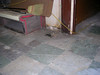 Silver Spring Stage is getting a badly-needed makeover of the flooring and ceilings of its backstage areas, and some of the shabbier partitions are coming down, too. Decades of hard use have reduced the tile to a crumble, as you can see. I’ve been helping out shifting the movables from one place to another as the workmen move through. The new tile flooring is functional if bland, but it looks so much better than what it replaced—I promise to post an “after” picture soon.
Lessons learned
- A headset does not fit over a cheap hairnet without shredding it.
- Performing a relaxation exercise (yoga Corpse pose) on the deck—while sound is running through its cues (thunder, fire exits announcement, a eggshell crack for the elephant bird that sounds like a chainsaw) and while lights has one of the electric pipes pulled in to change an instrument—requires great concentration.
- When you’re looking for the high note, close your eyes, relax (!), and just let go.
- And most of all,
When you’re jouncing along
On a road full of ruts,
Getting jeered by a throng
And performing for nuts,
Tell yourself how lucky you are!
Hazards
The special hazard on this show is confetti. In the Act 1 sequence where Horton sits on the egg through storm and changing seasons, the Cat pelts him with water from a super soaker, a bucket of autumn leaves, and a big batch of confetti. Half of the crew’s intermission cleanup consists of sweeping up little white dots of paper—from the deck, from the steps of the tree unit that Horton is perched on—and still the confetti goes everywhere. It may be worse than glitter. We find bits backstage in the green room, we find chips of it in the auditiorium, I find it in my slippers. There is show confetti in my back bedroom at home where I’m typing this.
This past Sunday was the day for more than one little thing to go wrong. In the Act 1 finale, Gertrude’s lengthy tail, made of feather boas glued end to end, parted in two. Suddenly Alexa found herself tugging against no resistance (from offstage, I’m usually holding the other end while Gertrude struggles in vain to get airborne). Alexa’s a trouper, she covered, and she yanked with all her might against nothing.
Then, late in the second Act, the Bird Girl who usually has the Who-bearing clover so that she can hand it off to Gertrude to restore it to Horton, didn’t have it. As they came offstage, there was a lot of muttering, “I forgot the clover!” and Kevin (the Cat) scampered back to find a substitute. He slipped to Horton during the next scene, and I wonder how many people noticed.
Probably the WATCH judges did. If something goes wrong in a matinee performance, 95% of the (traditionally less sophisticated) audience won’t spot it, but matinees are also peppered with adjudicators. They’re there on Sunday because they often have their own evening performances to deal with.
Sunday was also designated as an autographs in the lobby day. Don’t ask me why, but I just loathe autographs in the lobby in costume. So I got to show my “I’m crew” card, and I cleaned myself up while the rest of the cast Met Their Public. Which meant that I had to do some crew work. Now I don’t mind wet-mopping the deck, and with all that confetti (vide supra), mopping is always in order, and in fact I can Tom Sawyer myself into enjoying it a little bit. Water + swab, swab = things are cleaner.
I’m working on building up that same “hooah” attitude towards the orchestra pit cover. At CenterStage, there are two sections of the deck that you remove to make an opening for the orchestra pit. (This opening is only so that the conductor can be seen by the cast.) The first section is composed of several layers of hardwood, altogether making a slab 20 inches by 70 inches by 5 1/2 inches thick, and the other section (which forms the lip of the stage) is somewhat smaller.
To open the pit, what you do is this: walk downstairs with a buddy into the pit area; unbolt the first section from the girders that hold everything in place; on a count of three, with your buddy, push the section straight up until it clears, then slide it back (upstage) (it has casters to make this part a little easier, and usually there is crew above to help with this step); get a stance on the top of the railing that forms the conductor’s platform and push the smaller section up and out; climb out of the pit; lay the small section on top of the first section and roll them out of the way far upstage.
I don’t have a lot of upper-body strength, so I’m not one of those people that you look to first for jobs that require doing something on three. Usually Chris, Rick and Steve take this detail.
Okay, now that I’ve popped the pit cover a couple of times I can figure out how much it weighs. Figure generously on a specific gravity of 0.6 for the composition of the cover. Eurgh: 170 pounds.
Yay, us!
Another very complimentary review of the show: this one is from Michael Toscano.
June [Schreiner] is a seventh-grader at Reston’s Langston Hughes Middle School, but she seems to be one of those kids with outsize talent who eventually could end up on Broadway. With a crystal-clear voice and lungs of steel, she radiates charisma that reaches to the back of the good-sized theater.
Short bits of string: 5

Three things that I learned recently:
- Cardboard file boxes (“banker’s boxes”) work very well for costume storage, especially if you have a lot of small pieces that don’t easily hang and that you don’t want to get crushed. We’re storing costumes for 26 cast members in a 3′ x 6′ footprint.
- You can drag and drop tabs in an Excel workbook to reorder your worksheets. I’ve been using the right-click context menu to do that for years. I wonder how many clicks and scrolls I’ve wasted.
- A good articulation warmup is to play Tongue Jeopardy: Sing the “Jeopardy!” theme song, but with your tongue sticking out. On each successive syllable, point your tongue up, left, down, and right. (So you’re actually singing “Anh-anh-anh-anh-anh-anh-annnh…”) It gets really tricky when you get to the eighth notes.