Last holiday weekend of the summer and it’s time for the mountains! For yesterday’s hike I picked something that required a bit of a push: the Little Devils Stairs loop hike (PATC Circuit Hikes in Shenandoah National Park 15/e #4), measured at 7.5 miles and 1800 feet of elevation change. Reckoning by my notes, the only other time I’ve climbed Little Devils Stairs was in 1992, that time starting the loop from the parking lot at the end of Virginia SR 614.
 This time I started from Skyline Drive, descending along the Keyser Run Fire Road. I’ve explored territory nearby recently when I did the Sugarloaf Trail. The fire road descent is fairly predictable as far as the footing goes. The surprise of this stretch was the unexpected abundance of butterflies—nothing too unusual, Cabbage Whites, swallowtails, Pearl Crescents (in the photo), Silver-spotted Skippers, glimpses of anglewings, perhaps a fritillary—attracted, perhaps, by the moisture seeps from the rainfall two days ago. Midafternoon late-summer birdlife was expectedly slow: some ravens crawking, woodpeckers, flycatchers, a couple of chickadee-based mixed flocks. I heard no vireos.
 Down the mountain, near where the fire road turns at its junction with the Hull School Trail is the Bolen family cemetery. The charismatic large vertebrate of the trip was a Black Bear cub who ambled across the trail just inside the park boundary at the gate that ends SR 614. It didn’t stick around for a photo, and I explained to it in a fairly loud voice that I had no intention of getting between it and its mother. I paused to let that sink in before continuing down the trail. I think that’s the first bear I’ve seen in the park.
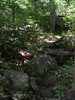
 I made a food stop at a little tributary of Keyser Run before taking on the climb. About 900 feet of the 1650-foot (by my altimeter) climb back to Skyline Drive is up the canyon of Keyser Run, and in the canyon the footing is rock, rock, rocks crossing the run. Generally manageable, nicely shaded from the sun, but there is one shallow chimney that requires a bit of a puff. And at a couple of points the cliffs are exposed on one side or the other, which is good for a whiff of claustrophobia. I paused to take a couple of murky snaps of some Appalachian Browns (Satyrodes appalachia).
3:50 for the circuit. Not bad.
 I warmed up with a quick look in my back yard. Under the cinder block that holds the back gate closed (long-deferred project) I found an earthworm (order Haplotaxida) and what I take to be a ground cricket (order Orthoptera). I didn’t even see the cricket until I downloaded the photo: I was watching something smaller in the field that doesn’t come out in the image.
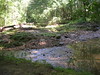 I then moved down to the patch where I usually census for the Great Backyard Bird Count, a stretch of The Glade upstream from Twin Branches Road. The vegetation along the stream bank was still flattened by the runoff from storm Hanna, which passed through yesterday.
 I found fewer flippable rocks in this area than I expected, so I fudged a little and looked under some logs as well. Hence this nice example of a slug. Land slugs that breathe air get their own order, Pulmonata.
 On the way back to the car, my last flip turned up some tiny pale worker termites, order Isoptera. If we count the pillbugs that I didn’t photograph, then my tally for the day is five orders.