When you’re shopping for an assisted living facility for yourself, check the fine print in the house rules and regulations to make sure that you can have a glass of wine in your own dang room.
Takeaways: 1
When you’re cleaning out the apartment of someone who can’t do it for herself, and you’re standing in the trash bags aisle of Longs Drugs on a Sunday evening, spend the extra coin and get the ones with a drawstring top.
Thanks a lot, Jessa
Via Bookslut: Yet one more reason that I should have learned to touch type in high school. Scrabble meets Tetris.
Silver Line progress report: 6
 Construction has begun all along the Phase I corridor of Metro’s Silver Line. I paused to take a snap of the early activity at the site of the Wiehle Avenue station (and terminus, pending completion of Phase II). This is the view looking west, with the Reston Parkway interchange visible in the distance.

 And then, at the foot of the overpass, I came across a bizarre flowering vine that I’d noticed once before in similar disturbed, suburban habitat. My Niering and Olmstead field guide IDs this as Passionflower (Passiflora sp.), with its ten tepals and five stamens. The bumblebees seem to like it.
Upcoming: 16
Reston Community Players and the Reston Community Center will participate in the mass premiere of The Laramie Project—10 Years Later on October 12. Plans are still being put together (as well as the script!), but the goal is for 100 regional, university, and community theaters to present the piece as a cross-country reading on the eleventh anniversary of Matthew Shepard’s death.
Contemporary American Theater Festival 2009
Michael Weller’s Fifty Words heads up the list of five plays (featuring two pianos!) presented at another fine festival in Shepherdstown. A smartly-written, 90-minute two-hander for Anthony Crane (playing the affable “goof-bag” husband Adam) and Joey Parsons (as Jan, his wound-too-tight wife), this sweet-bitter drama plays out in the course of one evening and night in their professionally-polished Brooklyn kitchen. A secret is revealed, and in the ensuing violence and passions, the tidy ménage becomes disheveled, serving as a metaphor for the state of their relationship. The play explores the contradictions in the things we want out of a marriage. A hat tip to Robert Klingelhoefer’s set design and dressing: we hope those rice bowls are on the table at CATF’s next yard sale.
Joey Parsons’ other part in the festival is in the one-woman Dear Sara Jane, by Victor Lodato, a fantasia on our culture’s way of violence and the dissociation of personality—with musical interludes. A Sara Jane, a fragile neurotic bride of a soldier fighting overseas, Parsons offers an intriguing master gesture: she pumps both fists up, ear-level, in what her character must imagine is a cheerleading kind of gesture, but it looks to us that she is warding off a blow. Sight lines in the Center for Contemporary Art and Theater, which the festival has used for its confessional, direct-address monologues like this one, are sometimes an issue.
Meanwhile, Anthony Crane takes on the role of Paul Zara in Beau Willimon’s Farragut North, a internet-age drama of hardball politics at the time of the Iowa caucuses. The show follows Stephen Bellamy (played by Eric Sheffer Stevens), young and idealistic press secretary to one of the candidates. Stevens, striding determinedly through the snow in a camel-hair overcoat, bears more than a passing resemblance to Michael Murphy in Robert Altman’s Tanner ’88. Stevens’ Bellamy is pinched between expediency and loyalty, in a milieu of double-dealing where “You can trust me” can be a laugh line. The production is propelled by David Remedios’ pulsing soundscapes that cover scene changes. asupporting work by Anderson Matthews as a genial dirty trickster of a campaign manager, and John Lescault in a cleverly-rendered cameo.
The History of Light, by Eisa Davis, follows two unhappy stories of mixed-race love, from the 1960s and the 1990s, while also tracking a young woman’s (Amelia Workman as Soph) rebonding with her estranged father (returning favorite David Emerson Toney). Perhaps there’s too much story going on here. Time periods and recollections intersect with dreamlike haze. The most effective scene comes when Workman appears as Vietnam-era shock comedian Dick Gregory, who reverse-heckles a black-white couple in his audience.
The festival is rounded out by Steven Dietz’s riff on conspiracy theorists and the women who love them, Yankee Tavern.
- Contemporary American Theater Festival at Shepherd University, Shepherdstown, W.Va.
- Yankee Tavern, by Steven Dietz, directed by Liesl Tommy
- Fifty Words, by Michael Weller, directed by Ed Herendeen
- Farragut North, by Beau Willimon, directed by Ed Herendeen
- Dear Sara Jane, by Victor Lodato, directed by Ed Herendeen (world premiere)
- The History of Light, by Eisa Davis, directed by Liesl Tommy (world premiere)
Dressed for success
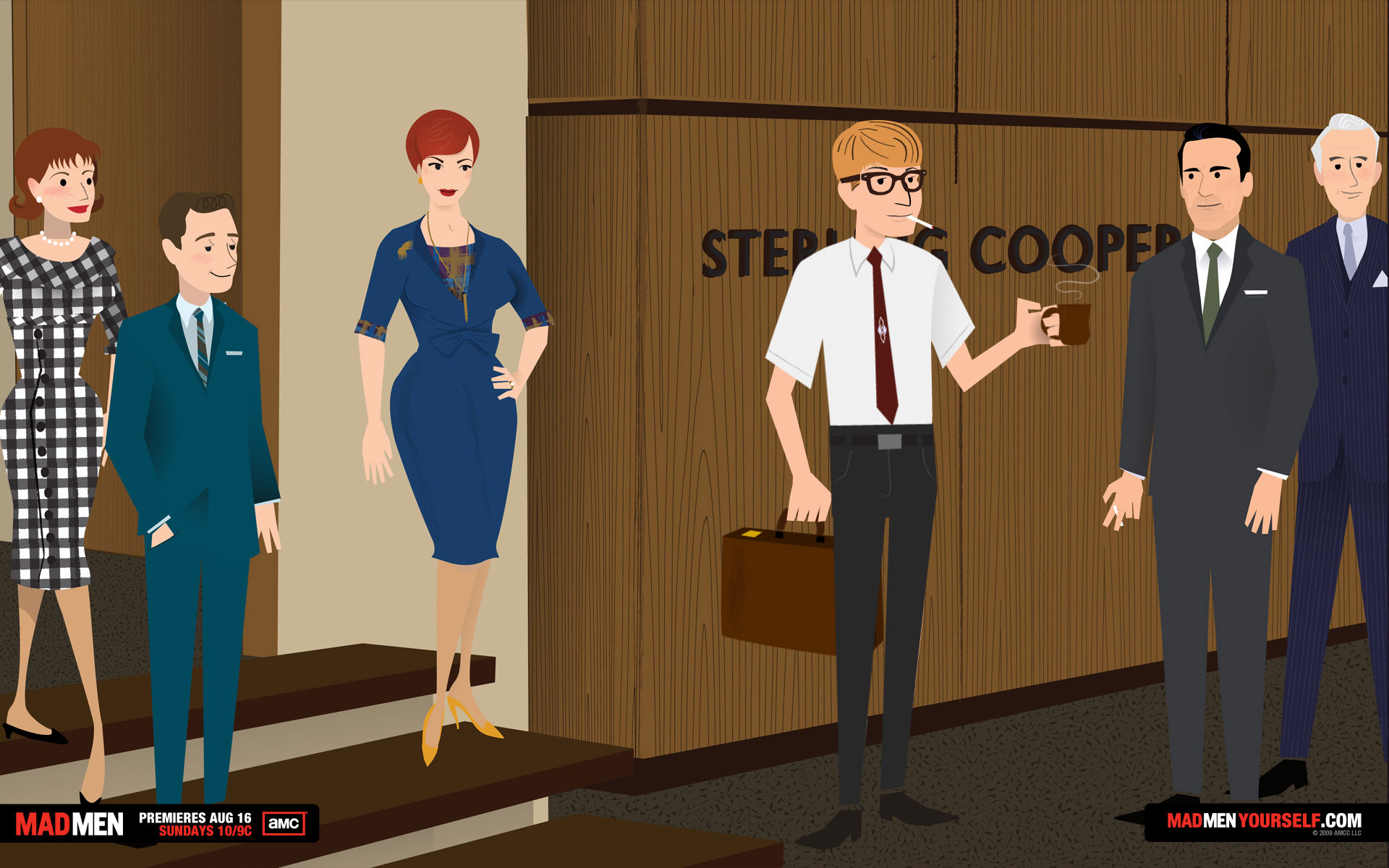
Via Leta: my internship in New York came a little late (1978), but here I am at Sterling Cooper (standing in for W.R. Grace & Co.), ready to set the world on fire. (Actually, John Molloy would have been appalled by the short-sleeved shirt.)
Iconic
Here comes the sad but inevitable news that Merce Cunningham has died at the age of 90.
A turn of phrase
A name from the past: C. Northcote Parkinson has a page at Economist.com, excerpted from Tim Hindle’s guide to management gurus. Looking back, it’s not clear to me that Parkinson was ever serious in his assertion that “work expands to fill the time available for its completion”—the sequels that he generated suggest that he had found a moneyspinning idea that he could not drop—but back in high school in the 1970s, at least some of us took him seriously. John Lund was on my debate team, a year or two ahead of me, and John’s politics were substantially righty. He made a specialty of arguing either side of whatever resolution we were working that year—funding secondary education, judicial reform—from the standpoint of Parkinson. Assigned the affirmative position that the federal government should clean up the air and water, John could argue (not necessarily persuasively) that the most effective way to stop pollution is to do nothing about it. As was often the case with counterplan and other gimmick tactics, they often succeeded because the other side had no specific preparation against John and his partner’s preposterous lines of reasoning.
Accelerando
…under the pressure of endless human tinkering, cultivated plant varieties evolved too quickly for agricultural writers and lumbering printing presses to keep up…. See growing things as the earth’s software for which manuals can never quite keep pace. Rapid botanical change has been a constant feaure of the cultivated plant world since the beginnings of domestication.
—Stanley Crawford, “A Farmer’s Bookshelf [1993],” in The River in Winter, pp. 157-158
Classic
 On my last trip to California, I was dealing with family business, so I didn’t in get much sightseeing or birding—none, really. But I did start building my collection of West Coast street name signs with this easy-to-read example from Arden Arcade, an unincorporated suburban area of Sacramento County. The arrows (which don’t appear consistently) indicate the direction in which street numbers increase.
Who killed Sean Regan?
A host of others, smiling killers and gruesome butlers, stalk through the dark,rainy landscape of the film like wraiths. The Big Sleep [1946] is something other than a detective story, with the drive toward rationality that designation is supposed to represent. It is a carnival of criminality, its underworld supernumeraries crowing the film not so much as picturesque character bits, but as tiny, finely-drawn portrayals of deceit and self-interest in a tapestry of meanness.
—Kevin Hagopian, Film Noir Reader 4, p. 42
Roger, Twan
Via kottke.org, awesome annotated transcript of the last half hour of audio communications between Houston and the Eagle LM during its descent and landing on the Moon. I didn’t realize that an important part of the astronauts’ navigation was watching how fast objects moved past scribed marks on the craft’s window, as means of computing velocity. Sort of like watching tell-tales.
I remember staying up to watch the first walk, my Instamatic in hand to take a snapshot off the TV screen.
A couple of years later, when Apollo 15 landed at Hadley Rille, I thought it would be a fine idea for the city of Oakwood to rename its Hadley Avenue for the lunar feature.
Voice
Good piece by Jeff Lunden on playwright Theresa Rebeck, on the art vs. commerce dance and writing for TV series.
“In television, what you are doing is trying to fit your voice into a particular mold,” Rebeck says. “When I was a staff writer on NYPD Blue, it was truly my job to hear David Milch’s voice for that show and to deliver episodes that embodied that voice.”
All My Sons: an award
Hooray for us: it has come to my attention that Providence Players of Fairfax’s production of All My Sons has been honored with the 2009 Ruby Griffith Award for All Round Production Excellence.