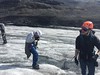
 For the first time, a making-of shot. Fellow tour member Bao snapped a pic of me with her phone while I was documenting my footgear. Our leader “S,” unconcerned, is scanning the scene.
Tag: photo
Across the Mid-Atlantic Ridge: 7
Plants Report
I hadn’t planned on spending any time botanizing… and yet, these interesting plants kept appearing and reappearing. Our guide Elis had a folding brochure with some of the very most common and conspicuous plants of Iceland, but midway through the trip I felt the need to pick up Hörður Kristinsson’s Flowering Plants and Ferns of Iceland (2017, 3/e), with entries for 465 species (including 17 for genus Saxifraga—go figure). With the brochure, I quickly learned to recognize Yarrow (Achillea millefolium) (Vallhumall), the non-native invasive Nootka Lupin (Lupinus nootkatensis) (Lúpína), and Garden Angelica (Angelica archangelica) (Ætihvönn), a truly preposterous-looking plant.
But, provisioned with Hörður, I went looking for more. Some of the following IDs are rather provisional.
This bushy prostrate plant, with flowers gone by, was very common, and the first to catch my eye: possibly Alpine Lady’s-mantle (Alchemilla alpina).
The next day, on the grounds of our hotel in Hövn, Lady’s Bedstraw (Galium verum), a mystery plant with purple tepals, Mother of Thyme (Thymus praecox), and unmistakeable Harebells (Campanula rotundifolia) (Bláklukka).
Equipped with a search image from Elis’s brochure, I spotted something interesting and hopped off the bus in Djúpivogur to get a quick snap of the lovely daisy-like Sea Mayweed (Tripleurospermum maritimum).
So, Heather (Calluna vulgraris) is actually a thing.
In the north, at the Ásbyrgi nature reserve, peely-barked Downy Birch (Betula pubescens).
 Let us not overlook the pioneers of the barrens and lava fields. There are indeed places in the highlands where nothing is growing.
 Nevertheless, there are lava fields that are in the very slow process of being overrun by lichens, mosses, grasses, creeping flowers, and taller things. I took a morning walk around our hotel at Mývatn. All sorts of green things happening. Shrubs sheltering in the potholes.
 But watch your step!
Across the Mid-Atlantic Ridge: 6
Other Reports
Pro tip: As you are preparing your luggage for a flight to Keflavík (KEF), do not pack your windbreaker in your checked baggage. You’re going to need it for the short scrambles to and from the shuttle bus that will take you to the terminal. Sited on a peninsula jutting out into the North Atlantic, the air field is well positioned for the defense of sea lanes (as it so served in WW II). But the nasty cross winds make it an adventure to traverse on foot, at any time of the day.
 This is the quite pleasant view from my shared balcony at the elegant Hotel Holt. Several of my guides emphasized that Iceland is somewhat allergic to city planning—hence the lack of other commercial amenities around this hotel. (On the other hand, my second hotel, the Hotel Reykjavík Centrum, was surrounded by eateries and night life.) The University of Iceland campus is visible in the distance.
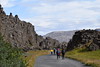 Þingvellir National Park is one of the places where the rift between the North Atlantic and Eurasian Plates is visible on land. I’m standing in the rift, with the North American Plate looming above and on the left. Þingvellir was the meeting place of Iceland’s first parliament, which first met there in 930. As dramatic as the scenery might be, this place was more or less centrally located for the delegates traveling to it across the country, and the rift valley afforded relatively flat terrain.
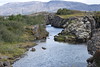 Rifts and cracks mean interesting water features.
 The atmosphere of the Njámafjall hot springs area in the highlands of the north is sulphurous. Stay on the boardwalk, and make sure you’re standing upwind!
 In the East Fjords, this “golly” prospect is on highway #1 between Höfn and Djúpivogur. At left, looking north, and at right, looking south. We didn’t stop for the lighthouse at Hvalnes. Iceland needs to up its lighthouse game.
 It’s a long drive to get anywhere in the East Fjords. Sometimes you just have find opportunities to stop, no matter how silly—like the chair nowhere.
Dark Hollow Falls loop
 It’s Labor Day, so it’s time for a walk in the park. I shared Dark Hollow Falls with many weekenders; the horse trail back from Fisher’s Gap was much quieter. I made the acquaintance of White Snakeroot (Ageratina altissima), which popped up all over the place. Why have I not noticed this flower before? I also found a little patch of Northern Maidenhair Fern (Adiantum pedatum). Both IDs resisted efforts to key them out; thanks, iNaturalist! About 4 miles in the loop, 215 meters of elevation change, a leisurely 3:10 for the circuit.
Across the Mid-Atlantic Ridge: 5
Waterfalls Report
Iceland has a few waterfalls.
And we stopped for many more gorgeous cascades than I could photograph. I was chasing cliff-nesting seabirds at Seljalandsfoss, for instance. But I did get my camera out for a few of them.
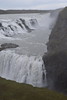
 Gullfoss (the gull means “golden,” like the local beer, but I never got an explanation of why the name applies to these falls) is the mystery waterfall, as the water appears to disappear into a crack in the earth. Once you look back, you can see where it’s gone to.
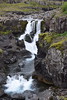 Fossá (“waterfall-river”) in the East Fjords region might be my favorite. It’s small, not spectacular, but it does what a waterfall needs to do. According to an interpretive sign at the site, the average flow is 8 m3/sec, but in spate the flow can exceed 150 m3/sec, and a peak in 1980 was measured at 395 m3/sec. A 30 kW power plant takes off some of the river’s energy.
 Dettifoss, in the north, is nicknamed “the beast.” This one feels as powerful as Niagara.
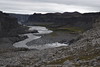 At right is Jökulsá á Fjöllum, the outflow from Dettifoss. The river continuum model of stream ecology doesn’t really fit Icelandic rivers. There is very little vegetation along the banks to fall into the water, and thereby to feed shredders and other organisms. These cold-clean-rocky, often braided, streams are strange and quite beautiful.
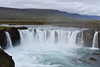 “The beauty” to Dettifoss’s beast, so they say, is Goðafoss. I’ll buy that.
Mammals Report
 On our first day of the bus tour, we stopped at Sólhestur farm for a short ride on the local breed of Icelandic horse. My ride, whose name I didn’t quite catch, patiently endured my clumsy mount and dismount. (I haven’t been on any kind of horse since summer camp as a kid, and I am sure that all equines compare notes on what I klutz I am in the saddle.) Only 3 of our busload of 14 opted for the ride, while almost all of us did the glacier. Hunh.

 The farm is in the shadow of Ingólfsfjall. At left, you can see the no-barn solution to storing fodder for livestock: great bales of hay wrapped in plastic sheeting. At right, more horsey friends.

 At the end of our three-quarter loop around the island country, we boarded the Hólmasól in Akureyri, to see some cetaceans. And perhaps some more glaciers, while we were at it.
 Our guide turned up a small handful of Megaptera novaeangliae (Humpback Whale) in the fjord. It turns out that humpbacks can be individually identified by patterns on their backs and flukes. So, for instance, this whale has the nickname “speckled” (maybe “deckled”? audio quality on the boat was sub-optimal).
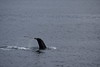 While this fellow, a particular favorite of our guide, can be distinguished by the hook in the dorsal fin.
Across the Mid-Atlantic Ridge: 4
Glacier Report
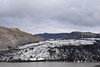 Sólheimajökull is a rather grungy glacier, as it scrapes off bits of the surrounding mountains on its way to the sea. Our guides impressed upon us how much this outlet glacier of Mýrdalsjökull had receded in the past century, in the past decade, in the past year, as a result of global heating. That thought followed us up and down the glacier, as the sounds of rushing meltwater on this sunny summer day were all around us.
Equipped with crampons and ice picks, we set off to climb a bit of it.
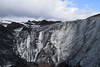 About halfway up our ascent of 200 meters, far in the distance we espied one of the other guides on his way down.
 At the top of our climb, some of us did a “Viking push-up” to get a drink from a meltwater pool.

 At left, looking farther up the glacier. At right, looking back down the valley. Time was, the ridge in the left part of the photo was an island in glacial ice, with another tongue of the glacier flowing around behind it. No more.
Gravelly snow and disappearing ice aside, this hike was the high point of my trip!
 Later in the day, our bus stopped for a photo op with some more picturesque ice draped over Hvannadalshnúkur.
Birds Report: A Correction
A sharp-eyed iNaturalist community member correctly identified the birds on the wing in my photos as Northern Fulmar (Fulmarus glacialis). A closer reading of Sibley’s guide tells me that fulmars occur in light and dark forms, which accounts for the rather dark birds I saw at Reynisfjara. I’m still fairly certain that I also saw kittiwakes on this trip, but I don’t have the photos to go with.
Across the Mid-Atlantic Ridge: 3
Technology Report
 Our first night on the road out from Reykjavík, I encountered this perplexing soap/shampoo dispenser with no visible affordances. Nothing to click or push.
 I figured out that the one latchy thing on the bottom released it from its holder.
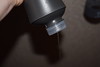 It still took a couple of minutes for it to dawn on me that you’re supposed to squeeze the entire container to get the gel to come out.

 I saw shoe polishers in a couple of places, but nothing so vintage as this example in the Hotel Holt.

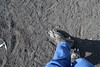 Crampons let you climb the the glacier. They strap on to your hiking boots with this intricate five-step process that our guide “S” explained.
 And they work! Here we are after a climb of 200m up Sólheimajökull.
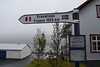 Signs in Reyðarfjörður honor French fisherfolk who once worked these waters.

 Back in Reykjavík, I found a couple of old-school building-mounted street name signs.
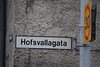 But what I mostly saw were these no-nonsense, very legible signs. Out in the country, signs at crossroads (no pic) are rather low-slung. They wouldn’t look out of place next to an airport runway.
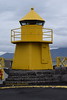 Lighthouses in Reykjavík are rather pedestrian, alas.
Across the Mid-Atlantic Ridge: 1
I’m back from a week traveling in Iceland, most of my time spent on a 19-seater minibus making a three-quarter turn around the island from Reykjavík to Akureyri.
Birds Report
I’m pleased with the results from my birding, considering that our guide Elis made only a couple brief stops specifically to look at birds. Fourteen lifers and 28 species altogether. Just a few photographic records: Greylag Goose (Anser anser) and Whooper Swan (Cygnus cygnus) in Tjörnin hard by Reykjavík’s city hall, and Black-legged Kittiwake Northern Fulmar (Fulmarus glacialus), photographed at Skogafoss.
 The photo opportunities for the kittiwakes were better later in the day at Reynisfjara, but I was looking at other things at the time, like my first Northern Fulmars (Fulmarus glacialis) nesting on the cliffs.

 As we were hotelling nearby, I had the chance to bird the other side of the mountain the next morning. In glorious solitude. The sea stacks, Reynisdrangar, are rather birdy albeit distant.
 Not a new bird for me, but I got excellent up close looks at Arctic Terns (Sterna paradisaea) perched up on the bergy bits in Jökulsárlón.
White Wagtails (Motacilla alba) seemed to be ubiquitous; I heard them in some quite inhospitable places.
Easiest life bird was a Common Blackbird (Turdus merula) outside my hotel room window in downtown Reykjavík. I worked hardest keying out Purple Sandpiper (Calidris maritimus) on the beach along Eiðsgrandi.
Mason and Bailey: 1
 Scouting Rachel Carson Conservation Park for a nature walk. I think we’ll spend a good amount of time in the meadow, so long as something is still happening in September (persimmons ripening, maybe?). And then maybe a quick jaunt through the woods to Hawlings River.
I spent too much time trying to figure out and photographing the Red-spotted Purple (Limenitis arthemis ssp. astynanax) that I submitted to iNaturalist. At the pond, most of the Green Frogs (Lithobates clamitans) hopped in the water but one guy seemed to think he was invisible.
Framed
 I took some photos of the WNF&GA pavilion in the conifer garden at the National Arboretum for Wikimedia Commons. This one is just for me.
Butterflies at Little Bennett Regional Park
 Tom Stock led a walk to several meadow-y and glade-y spots in Little Bennett Regional Park, most of them along Clarksburg Road. Sunny day, not beastly hot, a breeze from time to time.
I got some good looks at butterflies that I have seen before (some of them only once or twice), like Horace’s Duskywing (Erynnis horatius) and Variegated Fritillary (Euptoieta claudia) and Spicebush Swallowtail (Papilio troilus). No pics for the three lifers that I saw on the trip: Northern Broken-Dash (Wallengrenia egeremet), Dun Skipper (Euphyes vestris), and American Snout (Libytheana carinenta).
Rock Creek project: 2
Today’s walk went off pretty darn well. Pulling into the parking lot, I feared that there would not be sufficient spaces for my guests, but the second lot at the Nature Center was quite open.
As people were arriving, I was watching a House Finch in a treetop when Tracie called out, “hey, isn’t that a turkey?” Later, I happened to mention our Wild Turkey (Meleagris gallopavo) sighting to the interpreter in the Nature Center, and she was impressed. She said that she hadn’t seen one in the park in her 2+ years there.
Several of the wildflowers that I had scouted along the stream bank had gone by. We had one little remnant patch of Solomon’s Plume (Maianthemum racemosum). But on the whole, a success. I got to introduce the group to a couple of my favorites, and the Bearcorn (Conopholis americana) patch along Ross Drive was well received (it was vigorously flowering two weeks ago).
My time management was good; we got around in 2:00. We were paced by Cosmo the dog. Alas, I did miss the turnout for Fort De Russy on the way back.
 Near the Fort De Russy site is a patch of what I’m pretty sure is Umbrella Magnolia (Magnolia tripetala). (Both it and M. macrophylla are on the park’s species checklist.)
Rock Creek project: 1
 Scouting a field trip for later in the spring, exploring bits of Rock Creek Park that I don’t know. This is the view upstream from Rapids Bridge.
New York getaway 2019
Snaps from a long weekend in New York.
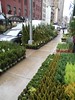 It turns out that my hotel is in the flower district of Chelsea. A nicer streetscape look, when compared to most of the residential streets, which were covered in dead Christmas trees.
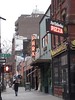 Hopes dashed! The Park is only a restaurant.
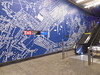 This Second Avenue subway is apparently really a thing now.
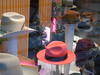 The reflections from the shop window and the strange color cast—I claim artistic license. Who knew that Stetson makes a red hat?
 Sometimes all you need is to hang out your shingle.
Chapman State Park
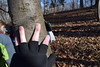
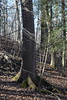 I joined the group making a solstice celebration walk at Maryland’s Chapman State Park—more of a bushwhack, truth be told, with Rod Simmons at the head of the line. Although I can’t recommend him as a trip leader based on this experience, he did point out some huge individuals of familiar tree species in this old-growth woods. For instance, Pawpaw (Asimina triloba) at left, with a trunk as wide as my hand, and an oak-sized Sweetgum (Liquidambar styraciflua) at right.
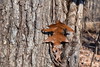 Cherrybark Oak (Quercus pagoda) was a target species, and Rod delivered.