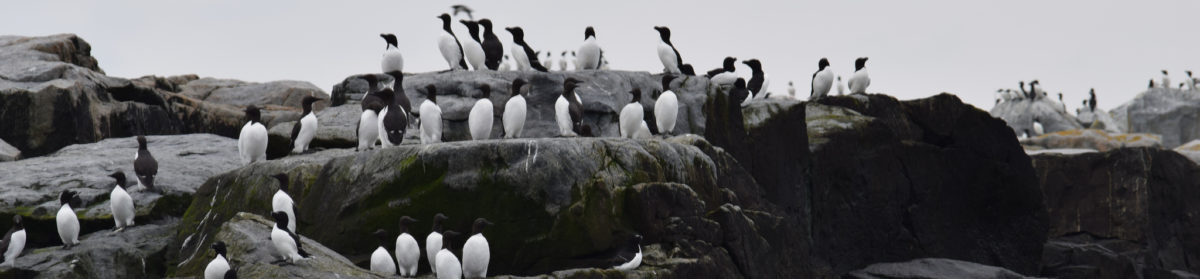
Cleaning out the e-mail folders and bookmarks: here’s a list of notable graduates and attendees of Northwestern University. That’s all.
Author: David Gorsline
At the park: 58
Excerpts from my report for 5 May, last Sunday:
We have hatching activity to report in 9 of the boxes, plus (unfortunately) one nest that completely failed. We have produced 82 ducklings so far, even though box #2 only hatched 5 of its 11 eggs. Box #1 is also a puzzle: I saw evidence of eggs hatched, but 11 unhatched and warmish eggs. We will have to check that box again in June.
We also have 3 nests newly started or still going: boxes #61, #13, and #77 (this is the one that Dave relocated to near the boardwalk).
So, of the 16 boxes we monitored this year, we have had nests in 13 of them. The beavers aren’t the only ones who’ve been busy….
Water gauge: 0.05 (how low can you go?)
Heard or seen: King Rail, Blue-gray Gnatcatcher, Common Yellowthroat, Red-eyed Vireo, Wood Duck hen with ducklings…
Most common question from Wetlands Awareness Day: who dammed up all that water?
Enroute: 4
 On my way to visit one of my clients last week, I stopped to snap a pic of the entrance plaza for their new building on North Capitol Street. Spiffy!
Other Desert Cities
Seeking drama and humor in the living rooms of the privileged class, Jon Robin Baitz introduces us to Lyman and Polly Wyeth, retirees from 1960s-era Hollywood and old guard conservatives. Unfortunately, the drama (a tell-all memoir by their daughter Brooke) is not compelling, and the humor lodges in tired one liners. Helen Carey, as Polly, does give us a flinty Nancy Reagan; Larry Bryggman’s tentativeness as Lyman is puzzling.
The narrative’s chronology is forced and confusing: most of the play takes place shortly after the invasion of Iraq, yet the still-young Brooke is called upon to remember events from the Vietnam War, a minimum of three decades prior.
- Other Desert Cities, by Jon Robin Baitz, directed by Kyle Donnelly, Arena Stage Fichandler Theatre, Washington
DC-7: The Roberto Clemente Story
This biography of Pittsburgh Pirates right fielder Roberto Clemente (the mimetic Modesto Lacén) comes alive in the songs and the dancing. The book scenes convey the story of Clemente’s childhood in Puerto Rico, his 3,000-hit baseball career, and its tragic, abrupt end by a plane crash in 1972. They tend to be choppy and episodic, despite the efforts of Ricardo Puente as the flashy Ramiro, who serves as narrator for much of the play.
The first act ends with a scene in which the dark-skinned Clemente is beaten by two racist policemen—an especially odd choice since we’ve just heard a rousing love song to Roberto from his to-be wife Vera (Keren Lugo).
The ensemble of five is anchored by the versatile Alexandra Linn, equally effective as character actor and musical performer.
- DC-7: The Roberto Clemente Story, book and lyrics by Luis Caballero, music by Luis Caballero and Harold Gutiérrez, directed by Luis Caballero, GALA Hispanic Theatre, Washington
Scrub burrowing wolf spider
Stephanie Mason did some digging, as it were, and turned up this identification for the mystery animal that made the burrows armored with pine needles and beech scales: one of the wolf spiders. Participant Sheryl has posted an image of one of the hidey-holes. Stephanie writes:
After some investigating, I believe the amazing burrows we admired and photographed were constructed by scrub burrowing wolf spiders (Geolycosa sp.). There are 18 species found in the US, with the greatest diversity in the scrub areas of Florida. I don’t know what species is/are found in the mid-Atlantic, but here’s an excerpt from an article on these neat arachnids.
The six species of scrub burrowing wolf spider that occur in scrub habitat are never found all together on a single ridge…. Instead, each of the several high ridge systems in Florida is home to only two species. And although both species of scrub burrowing wolf spiders live in scrub, they occupy different microhabitats. One of the species lives in open, bare patches of sand with no overhanging shrubs, while the other species lives in areas covered with leaf litter, closer to shrubs and trees. You rarely find bare-sand-loving burrowing wolf spiders and leaf-litter-loving burrowing wolf spiders in the same place! Both species are extremely sensitive to an obvious difference in microhabitat: the presence or absence of leaf litter on the sand.
The well-camouflaged, bare-sand-loving burrowing wolf spider mixes sand with silk to reinforce its burrow entrance. If conditions have been windy, the silk and sand will sometimes form a slight raised edge, giving the burrow an ant hill appearance. Bare-sand-loving burrowing wolf spiders are picky about their space! If leaf litter suddenly covers an area where a bare-sand-loving spider lives, the spider will abandon its burrow!
The leaf-litter-loving burrowing wolf spider, which tends to be darker in color than the bare-sand-loving burrowing wolf spider, uses its silk to weave a turret (raised collar) of leaves and pine needles around the mouth of its burrow. The turret helps camouflage the burrow entrance and also helps to reinforce it. Leaf-litter-loving burrowing wolf spiders can be found in open lawns as well as in scrub.
Burrows of both scrub burrowing wolf spiders are usually found near their own kind in an aggregation, or cluster. The bare-sand-loving wolf spiders are very particular and have a tough time finding suitable sites. So when a site is good, lots of spiders will live there. Also, breeding is easier for both species if they don’t have to travel far to find a mate!
Robbe-Grillet decoded
Five words and phrases from Robbe-Grillet’s La Jalousie that I know I never learned in high school:
- le margouillat
- any of various species of lizard; on the narrator’s banana plantation, probably the gecko Hemidactylus frenatus
- l’igname (f.)
- yam, of genus Dioscorea
- la crémone
- window-latch, perhaps named for the city of the same name
- zone blanche
- “blank area”, in Richard Howard’s translation; blanc having the senses of “unwritten”, “innocent”
A… n’est plus à la fenêtre. Ni celle-ci ni aucune des deux autres ne révèle sa présence dans la pièce. Et il n’y a plus de raison pour la supposer dans l’une quelconque des trois zones blanches, plutôt que dans une autre.
A… is no longer at the window. Neither this window nor either of the two others reveals her presence in the room. And there is no longer any reason to suppose her in any one of the three blank areas rather than in any other.
- dans le sens inverse des aiguilles d’une montre
- counterclockwise
Fraser Preserve
I broke from my usual Saturday gig to take a walk through the Fraser Preserve in the northern tip of the county, bordering on the river. Fraser is jointly managed by the Nature Conservancy and Calvary Baptist Church; one of its missions is making nature study available to inner city children. The walk was led by Conservancy volunteers, and a couple of staff were also on hand.
The plant life here is rather similar to what I’ve been shown on other class trips along the Potomac, at Carderock and Turkey Run, for instance.
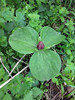 Birds were mostly heard but not seen, as the canopy begins to leaf in. Some of the showiest spring bloomers are gone or nearly so (like Mertensia virginica), but we did find some Golden Ragwort (Packera aurea) coming in. We had stopped to look at a patch of bluebells and I found this single Toadshade (Trillium sessile) just opening up.
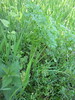
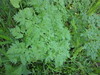 I looked at this lushly growing carrotty thing, not yet in flower, and I had read the flyer for the walk that highlighted some of the property’s specialties. So I asked Ed Clark, who was co-leading, “Is this what I think it is?” and he confirmed that it was Poison Hemlock (Conium maculatum). This non-native is highly toxic if ingested; it has noxious weed status in eight states. The purple spots on the stems that give it its specific epithet don’t read well in my images.
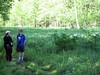 But you see that it can grow to head-height.
Making permanent
The nut of Jeremy Denk’s “Every Good Boy Does Fine,” a recollection of his training and teachers, in the 8 April 2013 issue of The New Yorker:
The aim of that first lesson, I later realized, was to ennoble the art of practicing. You were not practicing “phrasing”; you were drawing like Michaelangelo, or seducing like Don Juan. [György] Sebők said many times that you don’t teach piano playing at lessons; you teach how to practice—the daily rite of discovery that is how learning really happens.
Spring butterflies of southern Maryland
Unseasonably cool, breezy weather greeted us on Sunday for a foray to southern Maryland looking for spring butterflies. Stephanie Mason and Dick Smith took us to two sites on the Coastal Plain. The weather checked the activity of the butterflies, but we found lots of other things to look at.
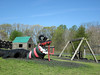 Our first stop was at Calvert Cliffs State Park. The playground near the parking lot is guarded by a fierce dragon made of recycled tires.
We found a spread-wing skipper, most likely Juvenal’s Duskywing (Erynnis juvenalis), according to Dick, given the time of the year; a hairstreak, a battered Henry’s Elfin (Callophrys henrici); and an azure (Celastrina sp.).
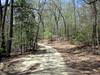 The oaks in this sandy, acid-soil habitat are tricky to ID this time of year. Working from bark, leaves, and acorn cups, we found evidence of Chestnut Oak (Quercus prinus) as well as Swamp Chestnut Oak (Q. michauxii). The understory is well-populated with American Holly (Ilex opaca) and Mountain Laurel (Kalmia latifolia).
We watched three 4-inch-long, yellow-brown elvers (Anguilla sp.) wriggling in the current of a small, shallow brook.
There is a spring hunting season for Wild Turkey (Meleagris gallopavo) in parts of the park (which might explain why we didn’t see any). Back at the parking lot for lunch, a good half dozen of us spent 10 minutes looking for a steadily-singing Pine Warbler (Dendroica pinus) that would not budge from its concealment near the top of a pine. This has not been the first time I’ve chased a bird like this: I’m inclined to consider lack of visibility a field mark for Pine Warbler.
We moved on to the Glendening Nature Reserve of Jug Bay Wetland Sanctuary, and the butterfly action picked up a bit. Several Eastern Tailed-Blues (Everes comyntas) and American Coppers (Lycaena phlaeas) were found. And flitting about its host Juniperus virginiana, Juniper Hairstreaks (Callophrys gryneus). Whereas the elfin basks with its wings held perpendicular to the ground and the duskywings spread their wings parallel, the Juniper basks in a tree “rolled over” with both wings folded together, nearly parallel to the ground and angled to face the sun.
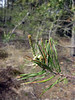 It’s only the new growth of a Virginia Pine (Pinus virginiana), but it’s the only close-focus image that I succeeded at for the trip.
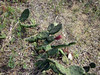 This little patch of prickly pear (Opuntia sp.) was a bit of a surprise.
The big mystery for this stop was a series of burrows, ranging from 1 to 2 cm in diameter, some of them ringed with a little wall of twigs and beech scales. Ben measured one of the burrows to be 10 inches deep. The consensus is that the perfectly round holes were made by one or more species of solitary bee or wasp, but we couldn’t get more specific than that.
Update: Stephanie has suggested one of the scrub burrowing wolf spiders (Geolycosa sp.) as the maker of the holes.
Upcoming: 33
Glenstone, a private art museum in Potomac, Md., looks forward to a $125 million expansion. Come 2016, a new series of exhibition spaces will be open five days a week, albeit by reservation only. Important works by mid-century moderns (Serra, Pollack, Johns, de Kooning) and contemporary artists are part of the collection of Mitchell and Emily Rales. Carol Vogel has the full story.
At the park: 57
Now is the time when my trip reports begin to lag behind the actual field work. My report from 7 April:
A quick look into a half dozen boxes. Whereas #62, which started inauspiciously, now has an incubating Wood Duck, we’re not as optimistic about #13, as the 8 eggs there are not yet being incubated. We expect to report lots of hatching activity from our May trip, which we have scheduled for the first Sunday, 5 May.
All three of our common swallow species have arrived. Some Blue-winged Teal are lingering.
Water gauge: 0.42
The hidden virtues of stones and herbs
Dedicated to everyone who has ever had to swim the sea of script submissions to a theater festival, taken from the hypereducated Puritan snarkmeister John Milton:
…I shall briefly prove in my little half hour that the mind is neither entertained nor educated by these studies, nor any good done by them for society. And at the outset, O Collegians, I put it to you (if I can guess your feelings by my own), and I ask what possible pleasure can lurk in these gamesome quarrels of gloomy oldsters. If they were not born in the cave of Trophonius, their stench betrays their birth in the caves of the monks, they reek with the grim harshness of their authors and are as wrinkled as their fathers. Their style is terse but in spite of it they are so prolix that they bore us and nauseate us. When they are read at any length, they generate an almost instinctive aversion and an even stronger natural hatred in their readers. Too often, my hearers, when it has been my bad luck to be saddled with assignments of research in their contemptible sophistries, when both my eyes and my mind were dull with long reading—too often, I say, I have stopped for breath, and sought some miserable relief in measuring the task before me. But when—as always—I found more ahead of me than I had yet got through, how often have I wished that I had been set to shovel out the Augean ox-stalls rather than struggle with such absurd assignments. And I have called Hercules happy because Juno was so easy-going as never to give him a job like mine to struggle through.
—Prolusion III, “Against Scholastic Philosophy”
This translation from the Latin of one of Milton’s exercises from his time at Christ’s College, Cambridge is taken from Merritt Y. Hughes’s 1957 collection of the complete poems and major prose.
How to Write a New Book for the Bible
Bill Cain’s brazenly autobiographical play takes a wry but clear-eyed view of what the modern clergy can and cannot accomplish. Cain says, through his protagonist also named Bill (the genial, bemused Ray Ficca), that a holy person proceeds mainly by calling attention to details. In this way, by being an indicator (as many depictions of Mary, the Mother of Jesus, show her), he resembles the modern playwright (and Cain is both playwright and Jesuit priest).
The details to which Cain points are simple but strong: the decline and death of his own mother Mary (the flexible Marybeth Wise), the life in flashbacks of his late father Pete (Mitchell Hébert, always a pleasure to watch), and the life journey of his brother Paul (Danny Gavigan). With many short scenes (some no more than a line or two long) and much direct address to the audience, the play clicks along. Hébert and Gavigan fill in minor characters of friends, neighbors, and health care professionals, and Gavigan is at his most watchable as a comically callow physician.
Nevertheless, the side trip to explore Paul’s military career in Vietnam, cut short by a crisis of faith in the rightness of our conduct there, serves to diffuse the focus of the play. Cain deals more effectively with the U.S.’s misadventures in Southeast Asia in his 9 Circles, recently produced by a Round House partner theater.
- How to Write a New Book for the Bible, by Bill Cain, directed by Ryan Rilette, Round House Theatre, Bethesda, Md.
This is the first Round House show directed by new Producing Artistic Director Ryan Rilette, who brings new life to the company’s repertory after its ill-advised overemphasis on dramatized novels. Next year’s season includes works by Martin McDonagh, August Wilson, and area premieres of plays by Theresa Rebeck, Melissa James Gibson, and Nicky Silver.
Next steps
An intriguing piece from a few weeks back by Nicole LaPorte on Kenneth Lander’s THRIVE Farmers Coffee. THRIVE seeks to move beyond the fair trade co-op model, to capture more of the value added by the coffee supply chain (roasters, distributors) for the farmer who got the beans out of the ground in the first place. THRIVE farmers follow organic methods, although not all go through the process of USDA certification.
It’s a small operation now; it will be interesting to see whether it can scale up from its current annual volume, somewhat more than 300,000 pounds of coffee.