Hooray for us: it has come to my attention that Providence Players of Fairfax’s production of All My Sons has been honored with the 2009 Ruby Griffith Award for All Round Production Excellence.
Author: David Gorsline
Untamable
The image from Henry Darger used in the cover design of the NYRB’s reissue of a novel from 1929 by Richard Hughes, is apparently all too appropriate, if we trust reviewer Andrew Sean Greer.
To say A High Wind in Jamaica is a novel about children who are abducted by pirates is to make it seem like a children’s book. But that’s completely wrong; its theme is actually how heartless children are.
* * *
…the children have such a deformed sense of right and wrong that it’s soon the pirates who are frightened of them.
The Vogons among us
Geoffrey K. Pullum reproduces a turd of plagiarized septic verse.
Shakespeare’s R&J
1st Stage presents another successful showcase for its developing young talent in Joe Calarco’s Shakespeare’s R&J, another script that calls for flexible ensemble performers. Four boys in a Catholic prep school take a break one evening from “amo-amas-amat” and antediluvian sex education textbooks and start horsing around with the Shakespeare text they’ve been set. They begin with an overly broad riff on one of the street scenes from Romeo and Juliet, and before they know what’s hit them, they’re realizing a complete performance of they play, picking up male and female roles on the fly as called for. Somewhat like Moby Dick Rehearsed, it’s a script that distills the essence of its source material through the alembic of caricature and improvisation.
Alex Mandell, as “Student One,” brings a fine athleticism to his Romeo, while Aeneas Hemphill (“Student Four”) revels in his comic turn as the Nurse. “Student Three” has the greatest challenge, in that he must cover the widest range of characters, from a ditsy Lady Capulet to a brawling Mercutio, and Jonathan Elliott generally meets it. His is certainly the most vigorous Friar Lawrence you’re likely ever to see. Finally, “Student Four” finds himself pressed into the role of Juliet: this role has the greatest arc, moving from “who me?” diffidence through to full-blooded, warm love. Jacob Yeh does a lovely job with it, especially the moment when his character realizes that it’s time to cowboy up and play the role that’s been assigned him. (Disclosure: I’ve worked with Jacob on projects in the past.)
The set, designed by Mark Krikstan, is a marvel: a thicket of bamboo (harvested by cast and crew from a farm in Calvert County) lashed together by a team of Eagle Scouts into two walls that look like piles of pick-up sticks or a pair of tank traps. It provides multiple playing levels and an endless supply of staffs for the good-looking stage fights, choreographed by Paul Gallagher.
- Shakespeare’s R&J, adapted by Joe Calarco, directed by Mark Krikstan, 1st Stage, Tysons Corner, Virginia
A whole day of Tumbls
Lots of little tasks accomplished today; the sad thing is, none of them are actually written down on a to-do list. This is just dealing with little piles of stuff all over the house.
- Polished two pairs of shoes. Realized that I should treat the Florsheim oxfords that I keep in the overflow storage downstairs with a little more respect, since I seem to wear them in every show I’m in.
- Cleaned my hip waders.
- Cleaned out my makeup kit.
- Found a rain jacket that I thought I’d given away.
- Got together some glass jars for upcoming entomology field trips with Don Messersmith.
- Updated my Goodreads shelves. The [author: ] tag is broken.
- Ran vinegar water through the coffeemaker.
- Tested the batteries stored in the shoebox.
- Reviewed the recent schedule changes for the 505 and 551/553/557 buses.
- Listened to a half-month of Songs of the Day and nearly caught up with reading other blogroll backlogs.
- Got my Day-Timer pages for the year (starts in October) sorted and ready to go.
John and Robert are somewhere smiling
Alex Ross falls under the spell of the Make Music festival in New York:
It was in the spirit of the day to be charmed rather than annoyed by the accidental music of the city: the beeping of a bus’s wheelchair lift during [Terry Riley’s] In C; the syncopated barking of a dog energized by the drumming of Loop 2.4.3.
A milestone: 3
Oy: 767 posts and three years of this stuff.
Radio Golf
The last play in August Wilson’s cycle of Pittsburgh plays, Radio Golf, is set in 1997, at a time when the city’s black upper-middle class is enjoying both economic good fortune and the prospect of genuine political power. The parallels between protagonist Harmond Wilks—African-American real estate developer and aspiring mayoral candidate—and the Current Occupant are emphasized in this production, right down to a Shepard Fairey-inspired campaign poster. Yet , inasmuch as Wilks’s fortunes rise and fall on the basis of some illicit real property transactions, he more closely resembles the more self-destructive President from his own decade.
Walter Coppage’s Wilks, empowered to the point of smugness, as well as the rest of the cast, seem pinned down by the staging in this production: there’s too much of a feel of “this is where I stand for my monologue.” Some transitions are forced: characters change the topic of conversation for apparently no reason. At least that’s the case until the electrifying closing scene when all of Wilks’s deals fall apart and Coppage gets to cut loose.
Easily stealing the show is Frederick Strother in the chewy comic role of “Elder” Joseph Barlow, a shuffling street person who resists Wilks and partner’s attempts to gentrify his Hill District neighborhood.
- Radio Golf, by August Wilson, directed by Ron Himes, The Studio Theatre, Washington
Cultural touchstones I have never seen
And probably never will:
- E.T.: The Extra-Terrestrial (1982)
- Forrest Gump (1994)
- Alien (1979)
- Titanic (1997)
- When Harry Met Sally… (1989)
Seneca Creek Greenway Trail, northern section
 Today’s hike was a leisurely 8 miles (though we had expected 6) up the Seneca Creek Greenway Trail, organized by ANS and led by Bob Pickett. We began where Seneca Creek crosses Brink Road and worked our way upstream, then climbed out of that watershed to follow the Magruder Branch up to its crossing of Valley Park Drive, just south of Damascus in upper Montgomery County, Maryland.
 The hiking is easy, with just a little elevation change. There is one slippery crossing of Magruder Branch which we all managed to varying degrees of dryness. The upper reaches of the trail we followed, above Log House Road, lie within Damascus Recreational Park, and consist of accessible asphalt and boardwalk.
 Bob’s strength is the green stuff, so we botanized great and small, including this huge White Oak (Quercus alba). We found some individuals of another as-yet-unidentified oak species, something resembling Shingle Oak (Q. imbricaria); one of its saplings is visible in the image, between Bob and the big tree. Among the wildflowers blooming in late June, Bob pointed out a yarrow, Water Hemlock, Fringed Loosestrife, Deptford Pink (I gotta learn how to do macro with my point and shoot). The wet bottomlands yield half a dozen species of ferns. I learned that the green case of an immature Mockernut Hickory (Carya tomentosa), when scratched, smells wonderful.
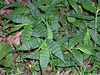 Our destination species, if you will , was found in several patches north of Log House Road. Wavyleaf Basketgrass (Oplismenus hirtellus ssp. undulatifolius) is a new invasive of particular concern in Maryland. Perennial, shade indifferent, and propagated by seeds that can attach themselves to passing mammals, the plant has a lot of weapons at its disposal. The patch in this image was recently treated with a herbicide, but we found another untreated patch nearby.
A colloquy of nuthatches met to discuss our lunch break. Acadian Flycatchers and Wood Thrushes were numerous, if not easy to spot.
On the Green Line
Artomatic 2009 once again takes place in an unbuilt-out office building, this time a new structure atop the enlarged Navy Yard Metro station. There’s a certain regularity to the eight-floor exhibition space, and we miss the rough-and-tumble of some of the funkier spaces in years gone by.
But the art keeps getting better, year over year. Representation by artists outside the immediate metro area continues to grow, especially artists from Sunderland in the U.K. There are many good photographers working with D.C. as their subject, coming from just as many perspectives. A standout is Angela Kleis, who showed “…There’s been a terrible accident,” high-angle images of a dead body lying artfully posed in the setting of various local landmarks.
Yes, there are a number of immature pieces in the show, some of them rather naively priced. But then there is a set of three accomplished abstractions on canvas by Jacqui Crocetta; or consider the lightly textured sculptures of heads by Anthony J. Ouellette. I generally don’t pause for video work, but Tracey Salaway’s “Seed Heads” caught me up short. It’s a long tracking shot through a patch of weeds, a beetle’s-eye-view of a dandelion in which its globe of seeds fills the screen.
No mistake
Forty years after an attention-grabbing fire, Christopher Maag gives a progress report on the cleanup of the Cuyahoga River. We’re getting there, after $3.5 billion spent to reduce pollution, $5 billion on upgrades to the wastewater system, along with dam removals and other restoration projects.
“This didn’t happen because a bunch of wild-haired hippies protested down the street,” [John] Perrecone [manager for Great Lakes programs at the Environmental Protection Agency] said. “This happened because a lot of citizens up and down the watershed worked hard for 40 years to improve the river.”
The recorders
HAMLET. Why, look you now, how unworthy a thing you make of me! You would play upon me, you would seem to know my stops, you would pluck out the heart of my mystery, you would sound me from my lowest note to the top of my compass; and there is much music, excellent voice, in this little organ, yet cannot you make it speak. ‘Sblood, do you think I am easier to be play’d on than a pipe? Call me what instrument you will, though you fret me, yet you cannot play upon me.
Act III, sc. ii
At the park: 31
 Last weekend, I did a spot check of the last two nest boxes, and was gratified that both were successful. Box #2 (at left) hatched out eight Hooded Merganser eggs, and box #68 (at right) hatched eight Wood Duck eggs, with one unhatched. For the season, our totals are down a little bit from last year, which had seen a big spike in Wood Duck activity. In 2009, we had four Hooded Merganser nests, three of which hatched out: 39 eggs laid, 29 hatched. We had five Wood Duck nests, all of which hatched out: 61 eggs laid, 59 hatched. Park staffer Dave Lawlor reports one successful nest in the boxes he is monitoring, with nine baby mergs.

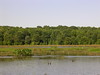 The park is a green blast of primary production. Bird activity is subsiding, with only one lazy egret to accent the landscape. I saw a family of Mallards; a Red-shouldered Hawk was screaming an important message to someone. Chris IDs the large-leaved plants in the right image as Spatterdock (Nuphar lutea).
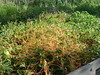 Set off by the green is the bright orange of a drift of Dodder (Cuscuta spp.), a parasitic vine that I find absolutely fascinating.
Some links: 38
Siteworx is co-sponsoring one of the D.C. events in support of the U.N. children’s health initiative against malaria, Nothing But Nets.