Donations

Applying market-oriented techniques to allocate resources where there is no market: how can we get food bank donations to the charities that need them most? Sendhil Mullainathan summarizes a points-based approach.

Markets report such dispersed information in the form of prices. Feeding America, for example, was surprised to see pasta at one point trading for 116 times the price of fresh vegetables. That was revealing data. In hindsight, it made sense: Vegetables spoil rapidly, which is why food companies donated them freely; pasta, with its longer shelf life, was a rarer commodity, as far as donations go.

Angels in America

A short post to call out just a couple of the exceptionally strong elements of the Round House/Olney Theatre Center joint production:

Jon Hudson Odom is delightful as Belize; Dawn Ursula’s keening as the Angel is other-worldly. The production relies much on fun projections by Clint Allen and lights by York Kennedy: the arrival of the Angel, the alien streetscape of San Francisco, the talking dummies at the Mormon visitor center.

  • Angels in America: Millennium Approaches and Perestroika, by Tony Kushner, directed by Jason Loewith and Ryan Rilette, Round House Theatre and Olney Theatre Center, Bethesda, Maryland

Re-quotable

Quoted in this blog several years ago, even more apposite now:

ROY COHN. So send me my pills, with a get-well bouquet, PRONTO, or I’ll ring up CBS and sing Mike Wallace a song: (Sotto voce, with relish) the ballad of adorable Ollie North and his secret contra slush fund. (He holds the phone away from his ear; Martin is excited.) Oh you only think you know all I know. I don’t even know what all I know. Half the time I just make it up, and it still turns out to be true!

—Tony Kushner, Angels in America: Perestroika, Act 1 (“Spooj”) sc. 5

In transit

Joe Palca takes a ride on the personal rapid transit system on the University of West Virginia campus at Morgantown. The system was built in the 1960s-70s.

The concept feels strangely familiar. Somewhere in my boxes of files from B school I may have some lecture notes from Russell Ackoff. I seem to recollect that he had done some consulting on the psychology of transit riders that led him to promote the idea of small transit pods. In his view, what transit riders valued more than speed, or reliability, or short headways, was the ability to control who they shared a vehicle with. Hence, big city busses, not so popular; private automobiles, very desirable.

ADHD

“Why Some Wars Get More Attention Than Others,” by Amanda Taub.

Conflicts gain sustained American attention only when they provide a compelling story line that appeals to both the public and political actors, and for reasons beyond the human toll. That often requires some combination of immediate relevance to American interests, resonance with American political debates or cultural issues, and, perhaps most of all, an emotionally engaging frame of clearly identifiable good guys and bad guys.

Most wars — including those in South Sudan, Sri Lanka and, yes, Yemen — do not, and so go ignored.

VNPS 2016: Wildwood Park

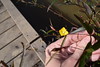
very wet meadowsharpRyley Harris led last Sunday’s walk through Wildwood Park in the City of Radford. The park lies on both sides of Connelly’s Run, as it flows roughly north to the New River; the stream lies at the bottom of an abrupt gorge that once separated the two halves of the city. Seeps and other flows provide wet meadow conditions along the hike-bike trail. At left you can see Impatiens capensis (I. pallida is also found here), a Solidago, an ironweed (Vernonia), Queen-Anne’s Lace (Daucus carota), and Cowbane (Oxypolis rigidior) (and in closeup). Also along this path were the remnants of the preposterously-leaved, square-stemmed Cup Plant(Silphium perfoliatum).

lushlush, tooOn the far slope of the gorge, it was another day for looking at lush, leafy green ground cover: Wild Ginger (Asarum canadense) (left) and Sharp-lobed Hepatica (Hepatica acutiloba) (right).

mystery lepThis mystery caterpillar (maybe an Banded Sphinx Moth (Eumorpha fasciatus): the book says that they show a lot of color variation as they prepare to pupate) also made an appearance.

On the boards

A very nice piece by April Peavey about the electro-mechanical flip-flapping annunciator boards that have all but disappeared from American train stations. I now know that they can be called Solari boards, after the Italian manufacturer that first introduced them in 1956. Maybe I realized, but have forgotten, that the letters and numbers flap in only one direction, so that the transition from an E to an H, for instance, takes much less time than for an S to an A—and hence the new destination or train name is displayed one letter at a time, as the individual units cycle around. It’s that gradual reveal that I remember, like watching a photograph develop, or like playing the word puzzle from Wheel of Fortune in real time.

Alas, the news peg for this story is that Amtrak is replacing the Solari board in Philadelphia’s 30th Street Station, where many years ago I would wait for the regional train to New York to take me back to my internship.

VNPS 2016: Mountain Lake

A busy-busy week (build manager at work, video production class in the evening), so I am just now writing up two successful field trips that were part of Virginia Native Plant Society’s annual get-together. Home base was Blacksburg, and this year’s meeting was hosted by the New River Chapter.

My first surprise, once I arrived and took a look at the geophysical and hydrology maps, is that this part of Virginia, such a long schlep down I-81, is not part of the system that drains to the Atlantic Ocean. Rather, the New River drains north and west to the Ohio, and thence to the Gulf of Mexico. However, it is part of the same Ridge and Valley Province (do you say Valley and Ridge?) as the more nearby Massanutten Mountain and Sideling Hill.

shrubbyOn Saturday, Dave Darnell led a walk on the War Spur Trail in the vicinity of Mountain Lake in Giles County. Much of the lands here are part of the George Washington and Jefferson National Forests. Mountain Lake is one of only two natural lakes in the commonwealth; unfortunately, drainage conditions lately have left it rather dry. The trailhead was at about 3700 feet. On the mountain, immature sprouts of American Chestnuts (Castanea dentata) are easy to find, their reproductive fates unfortunately sealed by the pathogen Cryphonectria parasitica. This is an acidic, rocky soil; the plant community is probably best described as High-elevation Red Oak Forest in Timothy Spira’s system.

somewhat shinyOn the ground, the evergreen leaves of Galax urceolata are easy to spot. Also abundant were the non-photosynthesizing plants with a complicated lifestyle: Bear Corn (Conopholis americana), Pinesap (Monotropa hypopithys), and Indian Pipe (M. uniflora). In the darker patches, individuals of Eastern Hemlock (Tsuga canadensis) are undaunted.

thanks for the drinkDave pointed out a bit of Lung Lichen (Lobaria pulmonaria); the photo shows the lichen after it was doused with my water bottle and sprang from shriveled, dusty brown to fresh green. Lung lichen is does not tolerate air pollution well, so this is a good species to see.

boggy landscapeIn the afternoon, Dave took us back down the road to the University of Virginia’s Mountain Lake Biological Station, a residential research and teaching space for undergrads and graduates. At the edge of this property is a rather extensive spahgnum/spruce bog, where some really big Red Spruce (Picea rubens) can be found, along with thickets of Rhododendron maximum the size of a house.