Yosemite National Park and Mono Basin: 4

Sunday was intended for driving and birding, but I did as much botanizing as I did birding, and that without a local field guide. I drove east over the mountains along the road to Tioga Pass, which was not cleared of snow and opened to traffic until June 18 this year. I used LoLo and Jim Westrich’s Birder’s Guide to Northern California and Jean Richmond’s Birding Northern California as guides.

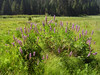
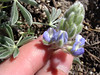
lots of itflower and fruitAt Hodgdon Meadow (4,900 feet), I heard a few difficult flycatchers but saw few birds. At the campground, smoke was still evident in the air from a managed burn a couple weeks previous. I saw a lot of this lupine, perhaps Lupinus grayi.
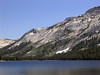
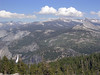
yes, that's snowAt Olmstead Point, I couldn’t even scare up a Clark’s Nutcracker. Tenaya Lake is beautiful, but wasn’t birdy when I visited mid-day.

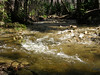
ahhAt Tuolumne Meadows, the bird that surprised me was Spotted Sandpiper (Actitis macularia), working the banks of the river.

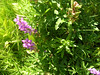
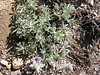
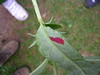
colonizer: 1colonizer: 2On a side trail from the meadow, I found this fuzzy congener of the lupine I saw at lower elevations. I believe this to be Lupinus breweri. It was doing a scrappy job of colonizing otherwise bare soil; pines were the only other veg in evidence.

A final stop at Dana Meadows (about 9,700 feet) yielded a distant look at a Cassin’s Finch (Carpodacus cassinii). I got a good look at the strong red crown contrasting with the rest of the head feathers.

I left the park at Tioga Pass, just shy of 10,000 feet, and dropped down into the Mono Basin via Lee Vining Canyon.

Yosemite National Park and Mono Basin: 3

One of the best ways to get around Yosemite National Park, I quickly figured out, is to hop one of the shuttle buses that work the valley. Shuttle to your trailhead, walk a circuit or a straight line, and get back to your car at the central parking area on another shuttle. This plan is not without pitfalls, however, as I learned.

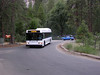
Saturday afternoon, after climbing to Columbia Rock in the morning, my plan was to use the El Capitan shuttle to its stop at the bridge over the Merced, hike the western loop of the Valley Floor Trail, then catch the El Cap shuttle at the picnic area and return to my rental vehicle. Now the Valley shuttle (the green route) runs into the evening, serving the campgrounds, the lodge, and suchlike; but the El Cap shuttle (the burgundy route) only runs until 18:00. No problem, I was on the trail by 14:45, the loop was about 6 miles on mostly level ground (rated moderate by Ranger Mates only for its length), I should be back to catch the last shuttle easily.

As soon as I left the shuttle stop, I discovered a hard truth about hiking in the park: the park doesn’t believe in trail blazes, and it’s not too keen on lots of wayfinding signs. I missed the trail I wanted to follow and was immediately backtracking along the road. (I’d like to turn the PATC loose in this park.)

Confidential to the man of the couple who asked me for directions to Half Dome on this same road: in casual conversation with a stranger, to make a point about gender roles, it’s best to avoid references to the Jaycee Dugard abduction case.

I found the trail I was looking for and started moving. It turns out that the Valley Floor Trail is not a good choice for a sunny July afternoon. It touches the very busy roads at too many points, and is generally too full of people. What is nice about the trail is that it’s nearly flat and smooth—the trail is worn-out pavement in a few places.

I was still making good time, looking to make the turn at the Pohono Bridge at sometime after 4. In the section leading to the bridge, the trail crosses the southside road, fords some braided streams, then skims along the Merced. I crossed the road and promptly found myself off trail; maybe I was disconcerted by the huge idling bus I had to walk around at the road crossing. But since I could keep the river on my right and the road on my left, I figured a little bushwhacking wouldn’t kill me.

a ford too farIt was then that I came to the ford. Lots of late snowmelt means good waterfall action into July, and it also means that the ford was two to three feet of fast-moving water. At first, I wasn’t sure where I was; it took a consult with my compass and several looks at the map to realize that the teensy blue line on the map was this dangerous-looking pour of water.

One of my survival skills is having a reasonable assessment of what I can do. I was just not ready to make this crossing, not by myself (where were the crowds now?), so I started backtracking. With the bushwhacking and the pondering, I had lost a lot of time, and I didn’t see a way to continue the loop. I would have to return the way I came, along some well-traveled trail.

My other survival skill is stubbornness. I got back to the southside road, and realized that I could still make the loop and the 18:00 shuttle if I beat feet along the road to the Pohono Bridge.

I made the turn at the bridge and started the return along the north side of the valley. Have I mentioned how profligate the scenery is around here? There you are, walking along, then there’s a break in the canopy and WHOMMP! there’s El Capitan looking at you.

I got to the northside road… and no picnic area. So I crossed the road and continued east. Lovely meadows, but no picnic area. Well, the last mile is always the longest, right? Somewhere just shy of 18:00 I realized that I had misread trail and map again, and that I had overshot the picnic area. I calculated that I could turn around and make a westward dash for the picnic area and the last El Cap shuttle, or I could continue east to Camp 4 where I could catch a Valley shuttle at the westernmost point of its route. After hiking 6 miles (and a climb in the morning), I wasn’t ready to outrun a bus. So I headed for Camp 4, adding another 2 miles or so to the walk. Total time for the open-jaw walk: approx. 3:30.

saved!A busman’s holiday: waiting for the bus to arrive.

I did pause long enough to look at what I keyed out as a female Black-headed Grosbeak (Pheuticus melanocephalus).

Back in Mariposa in the evening, many of the eateries roll the sidewalks up by 21:00, but I had a fine dinner at The Butterfly Cafe. This place can even make a house salad interesting.

Yosemite National Park and Mono Basin: 2

Saturday was the day set aside for some serious walking and climbing, and I made good on that plan. I followed, after a fashion, two moderate hikes scouted by Ranger Vickie Mates.

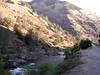
two roads divergedBut first I made the drive up Merced Canyon from Mariposa to the park entrance, following CA 140 along the south side of the canyon. The sight of the abandoned bed of a one-lane road running along the north side of the canyon is somewhat disconcerting. Sections of the old road are crumbling and overgrown after perhaps a mere half-century’s disuse.

However, not completely disused: the road jumps to the north side of the canyon (via a pair of temporary truss bridges) to get around a quite impressive rock slide. Between the signalized waits to traverse this section of the canyon and Monday’s trip up and down CA 270, I realized that driving through a damaged canyon is California’s answer to the Outer Banks’ wait for the impromptu ferry boat that crosses a new hurricane-opened inlet.

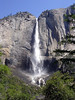
worth the walkBut back to the hiking. From the main parking area south of the visitor center, I took the “El Cap” shuttle bus to Camp 4 and the head of the trail that climbs to Upper Yosemite Falls. Following Ranger Mates’ advice, I climbed 1000 feet to some very nice vistas of the falls at Columbia Rock, then pushed on to one more look about a hundred feet higher. But I knew I would not have the juice to make it to the top. Lots of company on this trail: I heard a lot of German spoken. On the return descent, the slippery sand worn from the granite steps made me glad I’d brought my stick. I spotted a few White-Throated Swifts (Aeronautes saxatalis) in the valley. 3:30 up and down.

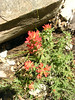
parasiteAlong this trail and elsewhere I found examples of paintbrush (Castilleja sp.), a hemiparasite of plant roots now placed in the broomrape family. The green leaves shading to red at the distal end should have been a clue that I was not dealing with a conventional wildflower.

gray squirrel 1gray squirrel 2These rather tame squirrels in the park are an unexpected ID mystery. The pale “shrug” and non-bushy tail don’t match any of the candidate species I see in the field guides, but I suspect I’m dealing with nothing more exotic than a Western Gray Squirrel (Sciurus griseus).

Yosemite National Park and Mono Basin: 1

on the way upAfter a midday drive from Sacramento, I put in a 2-hour round trip climb to Sentinel Dome summit, using scouting reports like this one from Jason and Katie Loomis. I had originally planned the complete loop around the dome, with the side trip to Taft Point, but I got started later than I planned and I didn’t want to force myself in unfamiliar country at elevation. From the parking area on Glacier Point Road, it’s but a 400 foot ascent.

scoping the areaThe nearly bare summit (8122 feet [2476 m]) nevertheless supports quite a bit of life — several wildflowers, including Mountain Pride (Penstemon newberryi); a succulent shrub that provides cover for the rather tame ground squirrels; an unidentified butterfly having a bask; and a couple of Common Ravens (Corvus corax).

nice viewA handful of people on the trail and at the top, like me, enjoying the extravagant views.

Frederick City Watershed

Our wrapup field trip took us to the Frederick City Watershed Cooperative WMA (part of the municipal forest property), on Catoctin Mountain between the national park and Gambrill State Park. We were cleared for netting in this area, and fortunately it’s not deer season, so we got good up-close looks at three skippers, Little Glassywing (Pompeius verna), Northern Cloudywing (Thorybes pylades), and Tawny-edged Skipper (Polites themistocles), as well as a Summer Azure (Celastrina ladon neglecta). I am still struggling with IDs of Papilio swallowtails, but Pat called Spicebush and Pipevine for the butterflies we brought in.

The destination butterfly for this area, however, is Edwards’ Hairstreak (Lycaena phlaeas), which is dependent on scrub oak and barrens habitat. Starting from a parking area on Gambrill Park Road north of Five Forks, Pat led us to a heathy patch (Vaccinium in fruit) known to be a hotspot. We were extremely fortunate to find several individuals, many of them ventrally basking on the oak foliage (Quercus ilicifolia). My field trip organization skills let me down however, so I was without means for good photographic documentation. The butterflies didn’t seem to mind.

Montgomery County butterflies

for next yearOur first stop on today’s field trip, part of Pat Durkin’s class on butterflies and their conservation, was to Black Hill Regional Park and a captive breeding facility for Baltimore Checkerspot (Euphydryas phaeton). This relative of the Pearl Crescent is dependent on wet conditions and its host plant of Turtlehead (Chelone glabra); in Maryland, it’s in decline but has earned special attention because its black and gold colors recall Lord Baltimore’s livery. It overwinters as larvae, wrapped in a self-spun web of silk. Adults from the first breeding season in this modest facility (a pair of mesh-walled pup tents) have already flown, but they have left a promising egg mass on this Turtlehead leaf.

starting pointWe then moved on to the Native Grassland Conservancy property, 23 acres leased from Seneca Creek State Park. Randy Pheobus showed us the work that the conservancy is doing, attempting to reclaim this old field, overrun with some nasty invasives like Johnsongrass and Canada Thistle. Randy is passionate and very persuasive about the need to protect grassland and meadow habitat in the mid-Atlantic. While forests and wetlands warrant legal protections and mitigation, grasslands are in a “blindspot” and get short shrift, according to Randy.

the first patchAfter three years of work, he and other volunteers have established four tiny beachheads of native grassland plants, including the one you see here. Randy’s team has transplanted Little Bluestem (Schizachyrium scoparium), a grass, and Viola sagittata, a heliophilic violet. Not everything you see in the plot is native, but there are about 50 native species represented. As Randy might say, you have to pick your battles. The plastic pot holds rotting Star of Bethlehem, which apparently deters the deer population. Elsewhere on the property, a native thistle, Cirsium discolor, is gaining ground. Randy describes thistles as the keystone of any project managed for pollinators.

As interesting as the botany was, we were there to look at butterflies. The class found an even dozen species at this stop, including a fine Variegated Fritillary (Euptoieta claudia) and a couple of skippers that I hadn’t met, and I added several names to my extremely short twitcher’s list. We agreed that netting a butterfly and transferring it to an observation jar is trickier than it looks.

good spottingOn the way back to the cars we left at the park, we made a quick stop at a garden planted for Monarchs; most of the planting has gone to Dogbane (Apocynum sp.) and were rewarded with great looks at a Banded Hairstreak (Satyrium calanus).

At the park: 44

We did our last full check of all the nest boxes on Sunday. Three more boxes hatched out; one box with only two eggs was apparently predated. We have two boxes with eggs remaining that M.K. will check as she is checking warbler boxes.

Val Kitchens and others have reported sightings of Common Moorhen (Gallinula chloropus) in the park, but we were not so fortunate to spot the bird. As a hemi-marsh breeder, it’s a bird of special interest to park management.

M.K. showed us photos of the two snakehead fish that Dave Lawlor and staff took from the waters around box #13.

spot the damselUp at the north end of the wetland, where we find all the trash that washes down from the subdivisions, the Lizard’s Tail (Saururus cernuus) was waist-high, making trash-picking a non-project. Would that the damselfly in this image had busied itself with the mosquitoes that were chomping on me.

wetAt this same (very wet) location, I snapped a couple images of this purple-pink blooming milkweed, which I had identified previously as Swamp Milkweed (Asclepias incarnata). But take a look at the leaves, with the veins forming an almost right angle with the midrib. Newcomb keys this plant out as either Purple Milkweed (A. purpurascens) or Red Milkweed (A. rubra).

dryFurthermore, over by the observation tower, in the drier flat that is managed for meadow, milkweeds were in fuller bloom.

I need to go back and take a closer look at the underside of the leaves and the flowers. Milkweed flowers consists of a corona of five erect “hoods,” with a curved horn jutting from each hood. The size and configuration of hoods and horns is an ID key.

The species checklist prepared by the friends organization says that A. purpurascens is found in the park. Newcomb describes the habitat for A. purpurascens as “dry fields and thickets,” which is a better match for the meadow by the tower. Newcomb locates A. rubra in “wet pinelands and bogs,” which more closely describes the conditions at the north end of the wetland.

Sugarloaf wildflowers

After a misty start, the weather proved especially cooperative for our final field trip for spring wildflower ID. Would that my point and shoot had done the same. I made suitable images neither of a darling yellow flower of the amaryllis or lily families, Yellow Stargrass (Hypoxis hirsuta), nor of the delicate Canada Mayflower (Maianthemum canadense), another lily.

Along Mt. Ephraim Road, where it crosses Bear Branch, to the west of the Sugarloaf Mountain summit, we compared the wiry stem of Indian Cucumber Root (Medeola virginiana) (yet another lily) to the fleshy stem of the pogonias, in this case Large Whorled Pogonia (Isotria verticillata) (an orchis family member). We also found some lingering fruits of Partidgeberry (Mitchella repens) along with this year’s tiny red flower buds in pairs. Coltsfoot (Tussilago farfara), looking like a dandelion as the flower is opening, is easy to distinguish from its fellow Composite when you see the somewhat hoof-shaped leaf.

don't insult itThe bottomland along the stream turned out to be a bonanza for non-spermatophytes, with at least five ferns in evidence. These are early fronds of Sensitive Fern (Onoclea sensibilis), so named because it dies back after the first frost.

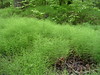
neighAnd as an added bonus, a completely different division of the vascular plants: Equisetophyta, the horsetails. This drift of plants, per one general guide, is Field Horsetail (Equisetum arvense).

We then took a quick drive and climb to the summit, finding hawkweed along the roadside and blueberries as we mounted the stairs. Up top, there are a few tiny patches of Pink Lady’s Slipper (Cypripedium acaule)—I think I prefer Moccasin Flower for its common name. Also some nonreproducing American Chestnut trees (Castanea dentata). We went in search of Checkerberry but only found a group of five-plus Mourning Cloak butterflies (Nymphalis antiopa).

blackjackAlso scratching out a living on the summit, along with the Table Mountain Pine, is the leather-leaved Blackjack Oak (Quercus marilandica).

At the park: 43

new boxesDave and M. K. have installed new nestboxes for Prothonotary Warblers (Protonotoria citrea) in clusters near some of our duck boxes, in some cases sharing the same pole. Today was out first check of boxes in four weeks. Since that time in April, five boxes have hatched out, two boxes have new clutches, and, alas, one nest has failed (in addition to a failed nest that we cleaned out last month).

General bird life was a little quiet, although we did see several Great Egrets (Ardea alba) stalking the shallows, and White-eyed Vireos (Vireo griseus) made themselves heard. In the openish woods by box #13 and the observation tower, I found a couple patches of Quaker Ladies (Houstonia caerulea).

getting friendlyOn the walk back along the boardwalk, Richard ID’d this pair of Northern Water Snakes (Nerodia sipedon sipedon).

Thompson WMA

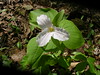
three-waythree of themWe set off down the Trillium Trail on the western edge of the Thompson Wildlife Management Aera, and we indeed did find trilliums. In abundance. Heck, you don’t even need to leave the parking lot, if that’s your thing. The species found here is Trillium grandiflorum, which blooms white and fades to pink and purple as it sets seed. Formerly, a patch of Nodding Trillium (T. cernuum) could be found on the property, but no more, it would seem.

Thompson is on the Blue Ridge, southwest of Sky Meadows SP; farther to the southwest, across Interstate 66 and Manassas Gap, is Shenandoah National Park.

for miladyKaryn showed us the way to two orchids, the Larger Yellow Lady’s Slipper (Cypripedium calceolus var. pubescens), with its penchant for growing at the end of pipestem trails off the fire road, and the Showy Orchis (Orchis spectabilis), which is showy in comparison only to other members of the genus.

I’m beginning to understand the Avenses (Geum sp.), but these members of the Rose family are still perplexing. One clue that seems to work is that the basal leaves are a darker green, almost like wintergreen. We looked at Carrion Flower (Smilax herbacea), the smilax without thorns. Lots of Wild Geranium (Geranium maculatum), a mystery boneset not yet in flower, bellworts, two ragworts, Eupatoriums in past and future fruit. Newcomb says that the leaves of Horse Balm (Collinsonia canadensis) smell of citronella when crushed, but Bella noted the even stronger smell of agaric mushrooms.

I tried to avoid the distractions of warbler song. I heard my first Wood Thrush of the year.

green violetWhen is a violet not violet? When it’s green. And, in fact, the Green Violet (Hybanthum concolor) is not in the same genus with the other violets. Down the fire road where it meets a stream that eventually feeds Goose Creek, we also found Viola trilobata and V. cucullata.

Violette’s Lock

moving fastThe river was running high and fast at Violette’s Lock, so we did most of our botanizing along the tow path. Great Crested Flycatchers (Myiarchus crinitus) breeped their presence.

I captured some out-of-focus images of Field Chickweed (Cerastium arvense) and Corn Salad (Valerianella locusta) (found in the disturbed patch near the parking lot). I’m developing a fondness for the delicate chickweeds. We found Bladdernut (Staphylea trifolia) and Pawpaw (Asimina triloba) trees in flower—these are both species that we studied in winter woody plant ID two winters ago. I made some notes on separating Glechoma from Lamium, but I still need more practice with these common weedy plants. More Field Pansies (Viola bicolor), with their crazy stipules to match the specific epithet of the European species, (V. kitaibeliana).

new favealso found hereI find that I always come back with a new favorite flower. This week it’s Golden Ragwort (Packera aurea). The ragwort (perhaps named for its ragged leaves) is often found with Wild Blue Phlox (Phlox divaricata), a color combination that Karyn dotes on.

Karyn recommends the USDA PLANTS database as the authoritative answer on species synonyms. I am finding quite a few differences between USDA and our field guide, Lawrence Newcomb’s Wildflower Guide. It’s hard to keep track of the nomenclature changes: I am sure that I have made some errors.

Governor Bridge Natural Area

first of the seasonMayapple (Podophyllum peltatum) has begun blooming, or at least it has at Governor Bridge Natural Area in Prince George’s County, south of Bowie. I made the acquaintance of two exquisitely tiny blue flowers, the five-petalled Smaller Forget-Me-Not (Myosotis laxa) and the four-petalled Bluets (Houstonia caerulea), also known as Quaker Ladies.

side by sideDown along the river trail, we had side-by-side looks at Solomon’s Seal (left) and Solomon’s Plume (right). Solomon’s Seal (Polygonatum sp.) has a gently arching stem, smoothly curved, while the stem of Solomon’s Plume (Maianthemum racemosum) shows sort of a zigzag effect.

A bedraggled Common Fleabane (Erigeron philadelphicus) and Canada Pussytoes (Antennaria howellii Greene ssp. canadensis) with is bicolored leaves were our introduction to the Aster family.

Bonus birds for the trip: we heard the first Ovenbirds and Common Yellowthroats, and a few of us got brief looks at Louisiana Waterthrush (Seiurus motacilla).

Turkey Run Park

Our first class field trip, led by Karyn Molines, was much more fruitful. We looked at more than twenty species, and keyed out most of them, as lots was in flower.

good for a toothacheAfter a look around the C-1 parking lot, with a warm-up with the inevitable Garlic Mustard, we started down the hill through a patch of Cut-leaved Toothwort (Cardamine concatenata). The Bloodroots were done blooming, but we were able to key a single fallen flower. Both Dicentra species were to be found, large drifts of Dutchman’s Breeches (D. cucullaria) and a little bit of Squirrel Corn (D. canadensis).

welcome springNear the bottom, along the river, most of the abundant Trout Lily (Erythronium americanum) was not yet in flower, but we found a few blooms.

gotta know where to lookThe crowd-pleaser for a walk at this time of the year is the patches of Virginia Bluebells (Mertensia virginica)—curiously, one of the few species with a common name in the plural. We found them in several places along the river trail.

Wildflowers along the Glade

done bloominIt’s been a wet, cold March, so I didn’t find too much in bloom during this afternoon’s walk along the Glade, part of my homework for Karyn Molines’ Spring Flower ID class—a violet, a non-native speedwell, and I made the acquaintance of Cardamine pennsylvanica. But I did find a spot close to home for Skunk Cabbage (Symplocarpus foetida). Maybe next January I can find its flowers.