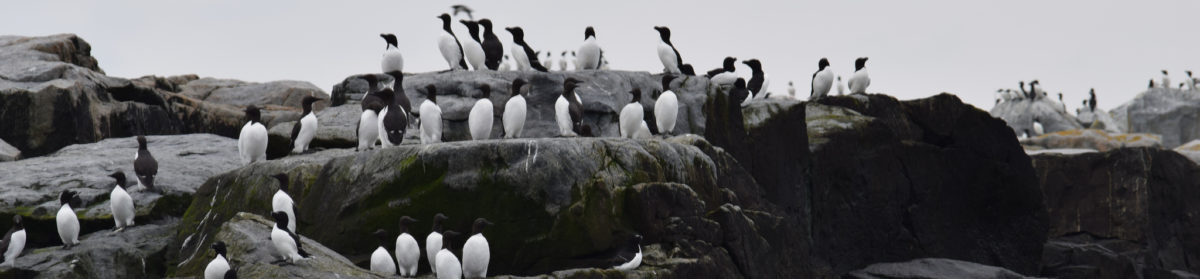
 Fulfilled my modest Chunkster Challenge for the year, so most of the pending titles are more slender. My to-read list includes a couple of borrows from Leta, new titles from my favorite A’s (Ali, Anne, Atkinson), some backlist items from Four Seasons Books in Shepherdstown. Towards the left end of the shelf, some art books to browse through during hockey intermissions.
Category: Like Life
On the radio: 6
Stacey asked me to do a voiceover for the first part of Jason Beaubien’s three-part report on the harrowing journey that Central American migrants make across Mexico, so they can then cross (illegally) into the United States to find family and work. I voiced the worker Hector Valdez, who is remarkably low-key about the prospect of being kidnapped by gangsters; he’s introduced at 2:00. And who’s that we hear near the end of segment? Stacey herself!
The entire series is worth a listen (part two, part three), as well as Beaubien’s reporter’s notebook post:
I’d dozed off on what the local media have dubbed “the Highway of Death.” I jerk awake and immediately feel for my backpack on the floor of the bus. My bag is still there.
The bus has come to a sudden stop and several young men are coming up the front stairs. A few weeks earlier, hijackers, allegedly from the Zetas cartel, had been boarding buses on this road, pulling off migrants, bashing their heads in with blunt instruments and dumping them in mass graves.
The young men are yelling and for a second I’m trying to make out what language it is. This often happens to me when I’m traveling. I wake up on an airplane, I look up from a cup of coffee in a restaurant and I have no idea where I am.
It’s Spanish. They’re speaking Spanish and they’re selling snacks. Everything is OK. I fumble in my pocket for some coins to buy one of the sandwiches wrapped in foil that they promise are very hot and very tasty.
For scale
 So before I whacked this Paulownia tomentosa to the ground I thought I would get some photographic evidence. Leta helped out, but balked at doing a fan dance with the dinner plate-sized leaves. More fool I for not identifying the tree (known as Princess-Tree or Blue Catalpa) last year and letting it overwinter. There are several other weeds along this side of the house that I need to deal with, as I clean up after the overgrown juniper that was damaged by recent winters, but one thing at a time, please. Besides, I rather like Pokeweed.
How did it get here? Well, Sibley describes the fruit as “pods persistent, brownish, splitting open to release hundreds of seeds.”
Thanks, Mr. Schaper
The monthly newspaper of a certain advocacy organization for which I only recently became eligible for membership is generally forgettable (at best), especially when it comes to “Do you remember this?” roundups. But the staff box callouts for a web site feature brought back to mind a game that I’d forgotten that I remembered: Cootie. I had a set when I was a wee one, and the reason that I don’t remember the rules is that they’re so simple they hardly exist: roll a die until you collect all the plastic body parts for your cootie bug. Sort of like playing Hangman with less skill required. I recall putting the critter together, Mr. Potato Head without any possibility of phenotypic variation, but I don’t think my parents or anybody else ever played with me. There were limits, even in 1961, to an adult’s capacity for boredom just to entertain a child.
On deck: 7
 A small armload of books from last week’s Stone Ridge Used Book Sale plumps the shelf. The Dylan Thomas has a title that has long intrigued me, Portrait of the Artist as a Young Dog, and for two beans, how could I say no? TriQuarterly #137 is, alas, the last print volume for this alma mater literary publication. The Rachel Carson is a loaner from Leta, residual from last October’s project.
On the radio: 5
Louisa Lim and me, together at last. I voiced Peking University sociologist Zheng Yefu for Lim’s piece about new sumptuary laws in China restricting language on billboards. 2:50 is the lucky time point again.
On the radio: 4
Stacey used me for another voiceover, this time for restaurateur Hironari Takanobu in a Jim Zarolli piece for ATC. That’s me at about 2:50.
For Lydia Davis
13 June 2002
This evening on the subway I saw a man reading a comb-bound book with a green cover. From the side I could see diagrams, small circles arranged in orderly polygons. I reasoned that I was seeing diagrams of aromatic molecules. Perhaps this man was a medical student on his way to a class at GWU.
The I read the phrases “four couples…,” “partner…,” “in a circle or a square…” The book was a manual of square dance patterns, hundreds of them.
In the man’s hand I could see a walkman and a bandanna, folded, printed with stars and stripes.
On deck: 6
 My read-me shelf is freshly built up with a Christmastime shipment from Amazon.com and a visit to the ARC rack at work. About half of these titles are also queued up in my Goodreads account.
My year in cities, 2010
Not very much travelling this time around. Overnight stays this year:
2009’s list. 2008’s list. 2007’s list. 2006’s list. 2005’s list.
On the radio: 3
I recorded two more translation voiceovers: for another Peter Kenyon story, this one filed from Kurdish Iraq (I come in at about 1:30); and for Ofeibea Quist-Arcton’s report from Ghana (at about 2:40).
Providence side trip report
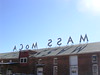 Leaving the Providence metro, I took a long swing west to the Berkshires to visit the Massachusetts Museum of Contemporary Art and its incredible edible installation of Sol LeWitt wall drawings. The painted brick and steel of these former mill buildings is a perfect counterpoint to LeWitt’s hard-edged, sometimes kandy-kolored koncepts.
 A couple of blocks away from the museum, I found another relic fallout shelter sign.
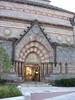 On the way to my motel, I paused for this gaudy building in Pittsfield that’s seen some better days. At one time an athanaeum, it’s now a courthouse building named in honor of James A. Bowes.
On the radio: 2
The ever-awesome Stacey again used me for a voiceover, this time in Peter Kenyon’s Morning Edition piece from today. Filing from Istanbul, Kenyon interviews Ramin Haghjoo, a gay Iranian activist living in exile.
Riding the rails
When I interned in New York back in the late 1970s, my colleague/mentor Glen taught me how to ride the Long Island Rail Road in comfort. The rolling stock was fitted with five seats across, with the center aisle dividing them into a bench of three and a bench of two. Trouble was, there was really only enough room for four to sit easily. So what the two of us did, per Glen’s instructions, was to sit in the three-seat bench “and look big.”
The other thing I remember—dimly—about commuter rail in New York was the bar cars. It turns out that the tradition of alcohol service is still going strong in the New York metro, with the added assist of bar carts on or near the platforms. Michael M. Grynbaum reports on new data released by the MTA about differential tipple preferences between Metro-North and LIRR riders.
Wait for it
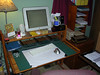 My desktop is never this clear, so why not take a picture to remember it this way? My in basket is sorted; my out baskets are empty; my Thunderbird inbox is empty. To be sure, I do have a lot of little piles in the project boxes.
Be assured, this state of grace won’t last long.