Old Rag

Sometimes it’s good to find out what you really can’t do any more.

The only other time that I’d hiked the Ridge Trail to Old Rag, that craggy outlier of the Blue Ridge in the eastern reaches of Shenandoah National Park, was August, 1992. Back then, the only notation I made in my logbook was my time to complete the 7.1-mile circuit from the upper parking lot: 4-1/2 hours. Now, I remember from that hike that it was a little tricky, and I particularly remember the section where you have to billy goat-hop from one boulder to another. I think it was foggy, and I went on a weekday when there wasn’t much traffic. What I found this past Sunday when I repeated the hike, was a lot harder than I remember. I almost wish that the ranger at the check-in station had told me, “This trail is not for you, out-of-shape middle-aged guy.”
on the way upLet me back up a bit. Old Rag is one of better-known mountains to hike in this part of the country. The north face is a ragged mess of tanker-sized boulders, and the upper reaches of the Ridge Trail are more the idea of a trail than a real trail, at least compared to what we day hikers in the East deal with. Or, as the concrete signpost at the Byrds Nest Shelter says, with unaccustomed albeit understated frankness, “RIDGE TR. IS VERY STEEP AND ROCKY.”

The first half of the climb, about 1000 feet, is not particularly arduous, just a steady climb through the usual Blue Ridge woods, with a smattering of mountain laurel. The biggest hazard you face, at this season, is the steady pelting of falling acorns. After that, things start to get a little crazy. There are three or four narrow, deep cracks that you have to negotiate. Then, at one point, the trail blaze, instead of the usual inch-and-a-half bars of friendly blue paint, is an arrow pointing straight down. I’ve lost a little agility and flexibility in my legs, and I’ve never had any upper-body strength to work with. I’ve made up for it with stronger claustrophobia. As I worked through the first crack, I experienced a twinge of panic, and once I got out of it, I felt the second twinge, when I realized that I could only go up—I was not going back down through that again. Ever.

When I got to the ledge, and couldn’t get over it the first time, I honestly wanted to cry like a little kid, “I cannot do this.” See, there was this ledge, about waist high, that you have to get up onto to continue on the trail. It’s in a crack about four feet wide, and blocked by a pointy stone jutting out about shoulder height. Probably what I did 14 years ago was chimney-walk the wall and jump over, but by this time I was already running at 80% and I didn’t trust my legs. So I pulled myself up on the jutting-out stone and slung myself over. Maybe it was easier the first time with new boots and no mud. Halfway up, I sincerely hoped that I wasn’t going to twist a knee.
under the rockI think I reached the first of the false summits shortly thereafter. After that, I didn’t so much mind the mini-tunnel that makes you drop to your knees, or the nasty joke of a boulder wedged above the trail made of steps cut into the rock. When I got to the boulder-hopping section, I sort of crawled up the boulders on my knees. I just kept working it, maybe three minutes on, three minutes off to get my breathing and anxiety back under control. I stopped for some food, but the lunch I brought, some poor choices, just sucked the moisture out of my mouth.

from the topI did indeed make it to the top of that G.D. mountain, three hours after leaving the parking lot. The views are fine up there, but the thing with me is that I usually enjoy the process, the climbing, more than I enjoy the summit. I took a picture for three guys hiking together, and I surprised myself by joking with them about the swarm of gnats that rests on the uppermost rocks, waiting for a foolish human to climb up.
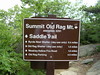
trail junctionGoing back down, the Saddle Trail is a lot easier to take. It would be one of the more severe climbs of the Blue Ridge trails, but it’s still doable. Oddly enough, the Weakley Hollow Fire Road, which connects the Saddle Trail to the parking areas in a long gentle downgrade, is perhaps the smoothest, best-maintained fire roads in the Park that I’ve ever hiked. I had a brief “Big Two-Hearted River” splash in the cold waters of Brokenback Run, a tributary of Hughes RIver.

My time wasn’t too bad: from the lower parking area, which added about 40 minutes to the hike, I made the 9.4-mile loop (2300 feet of elevation change), in 5:40. But I think that’s my last time over the Ridge Trail.
Everybody dance

Ringing mobile phones, simultaneous audio interpretation for slow-on-the-uptake audience members, rackety cleaning equipment upstairs, booming HVAC gear—these are all part of the background rumble of sonic disruptions that have punctuated performances I’ve given or heard. At Woolly Mammoth’s old Church Street venue, the sound of police sirens just outside the door was so common that I’d begun to assume the sound designer had specified them as part of the plot. I’ve had building fire alarms go off twice, once in the middle of my first day room scene in One Flew over the Cuckoo’s Nest. When order was restored about 20 minutes later, our Nurse Ratched (Megan) picked up the scene with a “Now, as I was saying before we were interrupted…” Five minutes of Maura and Ted’s performance of Perfectly Good Airplanes in Geneva earlier this year was played over an insistent, strident alarm, one that was intended to alert every volunteer firefighter in Ontario County. It wouldn’t have been so bad, but the BEEEEP BEEEEP BEEEEP BEEEEP would cut out for half a minute at a time, making us think that the coast was clear and that the Chinese invasion had been called off, before resuming.

The most recent unfortunate sonic event took place Saturday, at a staged reading of several short plays, part of the Kennedy Center’s Page to Stage play development program. The Center packs professional companies into every possible small playing space, who present previews of their upcoming seasons as well as material still in development—sort of a fringe festival with book in hand. Every possible playing space: the two Millennium Stages, the Terrace, even the Theatre Lab gets used as a lab instead of a bordello for the moneyspinner Shear Madness. We were in the South Atrium Foyer (the foyer? I had to check a map to find it), with one set of doors separating us from the lobby of the rooftop restaurant, which had been rented out for a Cambodian wedding. (Are you getting the idea that Labor Day weekend is a slow time at the Center?) When the RATTA TATTA TATTA TATTA of the lion dance began, to celebrate the happy couple (think taiko drums with more attitude), several of us thought that small arms fire was being exchanged.

It Happened in 1956

  • Frederick Reines and Clyde L. Cowan, Jr., of the Los Alamos Scientific Laboratory discover the first evidence of the neutrino in a chamber 12 m under the Savannah River nuclear reactor (called, in the August 1956 Scientific American article that reported the story, an “atomic pile”). The ghostly particle, electrically neutral, was thought at the time of its discovery to have no mass as well, which explained why it hardly interacted with its surroundings and was so difficult to detect. Reines shared the 1995 Nobel Prize in Physics for this work.
  • 11 February: Ed Norton teaches Ralph Kramden how to dance the Hucklebuck in the “Young at Heart” episode of The Honeymooners.
  • 2 August: Albert Woolson, of Companies C&D, 1st Minnesota Heavy Artillery, born 11 February 1847 in Watertown, N.Y. and the last surviving Union veteran of the Civil War, passes away.
  • Chess prodigy Bobby Fischer meets Donald Byrne in the Rosenwald Memorial Tournament in New York. Their game, won by Fischer playing black, is called by many annotators the “Game of the Century.”
  • 19 April: A nuptial mass celebrates the marriage of Grace Kelly to Prince Rainier III. Kelly exchanges her film career for life as Her Serene Highness Princess Grace of Monaco.
  • 15 December: The phrase “Elvis has left the building” is first uttered. Elvis Presley’s hits that year include “Hound Dog,” “Heartbreak Hotel,” “Don’t Be Cruel,” and “Love Me Tender.”
  • IBM Almaden4 September: The IBM RAMAC 305 is introduced, the first commercial computer to use magnetic disk storage, and one of IBM’s last systems to use vacuum tubes. The RAMAC systems (Random Access Method of Accounting and Control) used the IBM 350 disk subsystem, which stored 5 million 7-bit characters on 50 disks 24 inches in diameter and mounted vertically in a refrigerator-sized cabinet. (IBM Almaden, originally uploaded by jurvetson)
  • More passings: crusty journalist and satirist H.L. Mencken; A.A. Milne, author of the Winnie-the-Pooh books; baseball Hall of Famer Cornelius Alexander McGillicuddy (a/k/a Connie Mack); Adolf Hitler’s half-brother Alois; Alben Barkley, vice president for Harry Truman; virtuosic bebop trumpeter Clifford Brown; and, in one deadly week in August, painter Jackson Pollack, actor Bela Lugosi, and playwright Bertolt Brecht.
  • 15 October: the first blasts begin construction of the dam across Glen Canyon on the Colorado River, the controversial Bureau of Reclamation project that ultimately formed Lake Powell.
  • Grace Metalious publishes the potboiler Peyton Place; Allen Ginsberg releases a “Howl.”
  • 23 October: Tens of thousands of people take to the streets in Hungary, seeking an end to Soviet domination. Russian tanks roll into the country in November, crushing the uprising.
  • 30 September: The Dodgers win their last pennant in Brooklyn, one game ahead of the Milwaukee Braves. World Series champions the year before, this year the Dodgers lose to the Yankees (again) and Don Larsen’s perfect game.
  • 2 August: The first construction contracts are let under the new legislation enabling the 42,000-mile interstate highway system. Meanwhile, in Edina, in the suburbs of Minneapolis, Victor Gruen opens Southdale, the archetype of the indoor shopping mall.
  • 13 November: the Supreme Court upholds a ruling declaring segregation on buses unconstitutional, effectively ending the boycott that was begun in Montgomery, Ala. the year before when Rosa Parks refused to give up her seat.
  • 3 January: Alan Schneider directs Bert Lahr and Tom Ewell at the Coconut Grove Playhouse in Florida in the first United States production of Samuel Beckett’s Waiting for Godot.
  • 6 August: Chris Schenkel wraps “Boxing from St. Nicholas Arena,” the last program broadcast on the DuMont Television Network, America’s first fourth TV network. So long, Captain Video.
  • 26 July: After a collision in the fog off Nantucket the previous evening, the ocean liner Andrea Doria slips beneath the waves. Fortunately, improved communications and rapid response avert major loss of life.
  • John Ford releases the noir Western The Searchers, inspiring living room movie theorists for years to come.
  • The first group of “Hiroshima Maidens,” survivors of the 1945 bombing, return to Japan from New York. The Maidens, disfigured with keloid scars from burns sustained in the attack, underwent plastic surgery treatments at Mt. Sinai Hospital. A contemporary CBC broadcast fills in some of the details of the story. In 1999, survivor Miyoko Matsubara reflected on her experiences.
  • 13 August: Doris and Don Gorsline welcome their brand-new son David into the world.

In Martinsburg

Saturday morning I spent drinking coffee and reading a not-great short story anthology by a well-known American novelist, early-career efforts that were solidly mediocre, while I sat on Audrey and Charlie’s deck, listening to their neighbor running a backhoe across the top of the next ridge, scraping the pasture into what will become lawn. Along with the mockingbirds disputing territory and the goldfinches singing just to be singing, I watched a pair of Ruby-Throated Hummingbirds (Archilochus colubris) visit Audrey’s sugar-water feeder. The feeder was close enough that I could hear the buzz of wings as the birds hovered. And I heard something new, as a bird decided to perch up, the better to slurp artificial nectar: small chip notes, like tiny sneakers on a basketball court.

Flattop

As part of a gradual sprucing up, they’ve installed new tables in the Friendship Heights Booeymonger. In place of the funky butcher block tables with irregular tops that suggested organic molecules or a game of Pac-Man, there are tables with faux-stone laminate tops of various colors and textures and sturdy, rolled black edges. The new tables are very, very rectangular—uniform, characterless 4-tops throughout the place.

Four Mile Run Trail

This afternoon I finished my traversal (on foot) of the short but interesting Four Mile Run Trail. The trail is one of two connections for cyclists looking to get from the Mount Vernon Trail along the Potomac to the Washington & Old Dominion Trail to Purcellville.

The path covers widely variable territory along its 7.5-mile length. The trailhead is in the neighborhood of the East Falls Church Metro station. In this stretch of Arlington, the trail serves to connect several county parks: ball fields and back yards. Although it’s very pleasant here, the trail can be hard to follow, because it intertwines with the W&OD as both trails cross and recross Four Mile Run, a rocky stream at this point—and the signage is inconsistent. Distance markers were once set every half mile, but a couple of them are missing. At points the trail is no wider nor any more level than a hiking trail, and this serves to divert bike traffic to the much busier W&OD.

At about mile 5, there is a complicated diversion onto city streets at Shirlington to take you to the overpass that spans an interchange of I-395 (the Shirley Highway), the multilane transitway that connects the heart of the city to all the suburbs to the south. Beyond that, the trail follows streets around the cozy brick community of Parkfairfax in Alexandria.

The last mile and a half of the trail follows the north shore of the channelized Run, which gradually widens out into an impressive floodplain. Before passing under U.S. Route 1 and Metro’s Blue/Yellow Lines and its connection to the Mount Vernon Trail at the airport, the trail passes a Dominion electrical substation and, perhaps most instructively, an Arlington County wastewater treatment plant. (Fortunately, the plant was nearly odorless on this hot summer day.) The Run, perhaps 50 m across now, entices a few shoreline fishermen, as it empties into the tidal Potomac River.

Marlie

We drove out to the Eastern Shore yesterday to say goodbye to Marlie, who died last week in a traffic accident induced by the heavy rains we’ve been experiencing.

“Boisterous” is perhaps the first word that comes to mind when I think of Marlie. She was always having a hell of a good time, and wanted to make sure everyone else was, too. Her idea of a backyard cookout was to arm all the guests with Super Soakers; we would then all take a turn racing around the lot with her Jack Russell Terrier, Indiana. It was her idea to heave a plucked chicken carcass onstage for our production of a prison drama-fantasy called Crocodile.

I can think of only one time that I got the better of her.

Some years back, Marlie and her husband John came to my house for a birthday party for me. She invited herself upstairs to the TV room/bedroom, and started rummaging around in the (closed but not locked) cabinet under the TV. “What’s this?” she said, as she pulled out a copy of Student Sorority Nurses Do Detroit, Part 2, or some such title. “Hunh” was my clever rejoinder. I bustled her downstairs, probably opened the CD changer and slapped on a copy of the classic “go home now” music Carmina Burana. Anyway.

Then some time after that, Leta and I met during a show that John was directing. Now, I can be a little fastidious and anal retentive at times, I own Dawn Upshaw recordings, my decorating senses are not completely stubbed out, and I hadn’t dated anyone for several years, so it was generally suspected among the theater community that I was gay. When Marlie learned that Leta was interested in me, she said, “It’s okay, I checked, all the porn in his house is straight.”

So Leta told me this, probably in a crowd at Barnaby’s. And losing only half a beat, I said, “All of it that she found.”