It looks like every outlet has picked up this story by now, but ICYMI: a small citizen science study suggests that a house cat will sit in a box, even if it’s only lines on the floor, and even if the box is an optical illusion.
Category: Natural Sciences
Germination
A little bit pitch drop experiment, a little bit Michael Apted, a little bit genetic repository: William Beal’s 142-year-old seed viability experiment, reported by Nell Greenfieldboyce.
A microbiologist named Richard Lenski looked on. “The others were digging and trying to figure everything out, and I sort of held the map and held it under my jacket to keep it dry at one point. That was my hard work,” says Lenski. “I was wondering if cops might show up at some point.”
Blewits, not bluets
Hannah Kingsley-Ma goes mushrooming in Green-Wood Cemetery with the New York Mycological Society.
[Potter] Palmer and [Sigrid] Jakob think that one of the reasons for this fungal diversity is that some trees in Green-Wood—of which there are thousands, and hundreds of species—date back to the cemetery’s earliest years. (Green-Wood was founded in 1838.)
Drone
If you live in the mid-Atlantic, you’ve probably heard that Brood X is about to join us after its 17-year nap. Some links to prepare you:
- My field report from 2004.
- Melissa Block points her mic at “a zillion cicadas,” back when ATC could spend 7 minutes on a story like this.
- Pics and recipe pointers from Alonso Abugattas.
- Ditto from Kevin Ambrose of the Capital Weather Gang.
- Views of the instars from John Cooley and Chris Simon.
- Interactives of the various broods by year and geography by Jonathan Corum.
- David Attenborough messes with an amorous male.
Don’t worry
Yes, Asian Giant Hornets are big and scary, but they’re not here in the mid-Atlantic, and present no cause for alarm.
Toni Burnham, the president of the D.C. Bee Keepers Alliance, says that, actually, “everyone should chill the hell out.”
* * *
While the murder hornet concerns may be less irrational than calls over putting toxic chemicals into a human body, Burnham says bee experts and entomologists in Washington are on the case, and that there’s no reason for those in the region to worry.
“Let [Washington state] handle it, and everyone calm down,” Burnham says. “Have a beer.”
Hot metal
A new non-native wasp has been spotted in the Pacific Northwest, Asian giant hornet (Vespa mandarinia). These suckers could devastate native bee populations. Mike Baker reports.
Individuals are two inches long, and are big enough to be RFID-tagged for tracking.
Some ink: 11
Beautiful decapods: I was part of a team that reviewed and edited a white paper on crayfish, published by the commonwealth’s cooperative extension. Most of the work consisted of chasing down dead web links and finding replacements.
Eyes right
I attended a workshop focused on early detection of Spotted Lanternfly (Lycorma delicatula) (SLF) in Fairfax County. Speakers represented the Virginia Cooperative Extension, the Virginia Department of Forestry, and the Fairfax County Urban Forest Management Division.
Spotted Lanternfly is native to China, and has also been found in India, Vietnam, and Japan. Introduced in Korea in 2006, it is considered a pest in that country. The insect was first detected in the US in September 2014, in Berks Country, Pennsylvania, where it was likely imported as egg masses laid on landscaping stone. The first Virginia populations were detected in the Winchester area last year.
A hemipteran, L. delicatula is highly invasive and can expand its range rapidly; it can use at least 70 North American host species, although it has a particular association with Tree of Heaven (Ailanthus altissima). A phloem feeder, the lanternfly sucks sap from its host plant, leading to wilting and reduced photosynthesis. Spotted Lanternfly also exudes honeydew, which promotes the growth of sooty mold, further impairing the health of its host plant.
Because its American hosts include species of grapes, hops, stone fruits, and Malus, the threat of significant economic losses looms.
Egg masses are laid on the roughened, brocaded bark of A. altissima, other tree species, and even weathered stone, concrete, and metal. Spotted Lanternfly undergoes incomplete metamorphosis, the eggs hatching into nymphs that go through several instars before transforming into winged adults. It is conjectured the lanternfly extracts and isolates toxins from its ailanthus host, and hence that the bright red coloration of its later instars and adults constitutes aposematic coloration. The adult, about an inch long, resembles a colorful black-brown-and-red moth.
In Virginia, first instar nymphs for this season were observed on 26 April 2019. If you see an egg mass, nymph, or adult that you suspect to be Spotted Lanternfly, please report it via https://ext.vt.edu/spotted-lanternfly.
But, wait, there’s more! Fairfax County foresters hope to monitor possible sites where SLF might first appear, and that means monitoring populations of A. altissima, itself a non-native invasive species. It turns out that our map of ailanthus patches in the county is incomplete, especially on private property. Therefore, please report any Fairfax County observations of Tree of Heaven (Ailanthus altissima) to the MAEDN (Mid-Atlantic Early Detection Network), either via its mobile app or the web site.
Mimickry
In passing, David George Haskell mentioned the “news teller bee” in The Songs of Trees. Eric R. Eaton has the deets on this syrphid dipteran.
Slice
A beautiful one-frame visualization of the geology of the Mid-Atlantic by Kat Cantner, courtesy of Callan Bentley.
Ellanor C. Lawrence Park botany and ichthyology
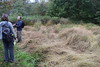 Charles Smith led the botany basics workshop at Ellanor C. Lawrence Park for Fairfax Master Naturalists. (I studied the eastern section of this park for a class in 2014.) We met a lot of old friends from the plant world. Charles pointed out a non-native invasive that I had not seen before, Small Carpetgrass (apt name, that) (Arthraxon hispidus).
In the meadow, Charles pointed out Beaked Panicgrass (Panicum anceps). I need to look at this plant a few more times before I can grok it. A tip for learning sumacs: fruits hang down from Winged Sumac.
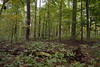 On the west side of Walney Road, we did a very short ascent of the Ridge Trail to a patch of woods that has been left alone by White-tailed Deer. Charles describes this view a “what a good forest looks like.”
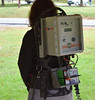 In the afternoon, Chris Ruck and his team electrofished a short reach of Big Rocky Run. Again, this was not a complete, protocol-compliant survey, but rather some cherry-picking so that we could see what species could be found in the stream. Forgive me for geeking out on the equipment, but it’s pretty cool.
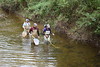
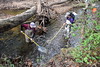 A circuit is established between the anode, the pole in Danielle’s right hand, and the cathode, the cable in her right hand. Fish in the water are stunned, and can be scooped up in a net for study, as Chris is doing in the image at right. Voltage and other electrical characteristics can be adjusted for water conditions. You want rubberized waders for this job; if you’re wearing breathable waders, you will probably feel an unpleasant tingle, or worse.
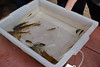 Some of the catch, ready for identification.
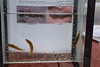
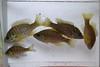 We turned up 13 of a possible 20 species or so, according to Chris’s accounts. We spent a lot of time with the keys and the minnow representatives (family Cyprinidae). A little easier to ID were these Fantail Darters (Etheostoma flabellare) at left, and these four sunfish species (at right).
The scoop
The photograph of the Munsell soil color chart book pulled me up short. As I read Richard Schiffman’s piece, my thoughts bounced around from “wow, this is cool that soil scientists are getting profiled in the Times” to “New York has a soil brokerage clearinghouse so that good fill dirt from a construction site can be used to rebuild a wetland? That’s bananas—no, that’s brilliant!”
While the idea might seem obvious, Dr. [Dan] Walsh maintains that this is the first soil exchange anywhere in the world that is run by a city government. It is currently being watched by officials from New Orleans and Los Angeles as well as municipalities in Germany, China and Australia, which are considering implementing similar programs.
* * *
“We’re essentially matchmakers,” Dr. Walsh said. “We don’t stockpile the soil, so both a donor and a recipient have to be ready at the same time. Our job is to coordinate the transfer.”
The NYC Urban Soils Institute has plans to establish a soil museum in Brooklyn’s Green-Wood Cemetery—something for my to-see list in New York.
Some links: 83
Some links, Wild Card Edition:
- Andrea Appleton’s report: Chris Swan uses vacant lots in Baltimore (there are 14,000 at present) as experimental ecology plots.
- Callan Bentley road tests a tool for teaching his geology students what went on in the mid-Atlantic: a worksheet matrix that brings together the What (e.g. Culpeper Basin), the When (e.g., Taconian orogeny), and the Why (evidence, to be filled in by the student).
- Like Ducks? Thank a Hunter, by Wes Siler.
There are 47 million birdwatchers in the U.S., but only 2.6 million waterfowl hunters. Conservation of wetlands falls disproportionately on the shoulders of hunters. And that’s a problem because hunter participation is decreasing. With fewer hunters, who’s going to pay for wildlife conservation?
Some links: 82
Some links, Creepy Parasite Edition:
- Dodder (Cuscuta sp.), a twining plant parasite, can inject bits of microRNA into its hosts, blocking gene-based plant defense mechanisms. Summary of new research by Saima Shahid et al. at Phys.org.
- We’re understanding more about how the fungus Ophiocordyceps unilateralis takes over the behavior, if not the mind, of its ant hosts, as Ed Yong reports.
Once an infection is underway, he says, the neurons in the ant’s body—the ones that give its brain control over its muscles—start to die. [David] Hughes [at Penn State] suspects that the fungus takes over. It effectively cuts the ant’s limbs off from its brain and inserts itself in place, releasing chemicals that force the muscles there to contract. If this is right, then the ant ends its life as a prisoner in its own body. Its brain is still in the driver’s seat, but the fungus has the wheel.
A mystery: 8: solved
Alonso Abugattas identifies the mystery spiders that I met two autumns ago: Neoscona sp., probably N. crucifera. He explains why they “seem to appear” in fall:
During the earlier part of the year you likely never noticed them. Not only were they much smaller as spiderlings, but they hide during the day. They would tear down and consume their webs every morning, so you often didn’t notice their webs they constructed nightly. They did this to avoid daytime predators such as birds or wasps from finding them. Mud Dauber wasps for example often sting and paralyze many of these when they’re young, stashing them in their mud nests as living paralyzed food for their own babies.
But by Fall, they’re often too big for wasps to eat. Many wasps have also concluded hunting and egg laying by this late in the year. So the spiders sometimes hang out during the day. Many birds also don’t go after them as much, having no babies to feed or they themselves leaving on migration South. Prey also gets scarcer as it gets colder, so leaving the web up during the warmer day increases the chance of a catch. Consequently, Spotted Orbweavers don’t hide as much and also don’t tear down their webs and rebuild them at night as much once autumn arrives.