Happy 80th to 50s mathematician/satirist Tom Lehrer, still with us, if not actively performing. (Link via Scott Rosenberg’s Wordyard.)
Upgrades: 4
And there was great rejoicing in the land: a WordPress upgrade (to 2.5) without changes to the blog template.
High Lonesome
The afternoon’s two pieces from the company repertory, George Balanchine’s The Four Temperaments and Choo-San Goh’s Fives serve as reminders that some rules are to be broken. In Fives, it’s the rule that dancing must be set to music, for some of the most interesting passages come early in the piece when the ten ballerinas have nothing to sync with but themselves and their own breathing. Similarly, Balanchine achieves some stunning effects even when his dancers are motionless, in preparation. Jason Hartley’s dives to the floor in the “Melancholic” variation belie the truism that ballet is about pretending that gravity doesn’t exist, and Jared Nelson gives us a buttery-smooth “Phlegmatic” variation.
Hartley’s floor-tumbling prowess also works well for him in Trey McIntyre’s semi-autobiographical High Lonesome, set to music by Beck, a series of sketches of family dysfunction. Jade Payette, in the kid sister role, catches some serious air.
- High Lonesome, Washington Ballet, Washington
I knew her when
60s spandex stunner Yvonne Craig—Batgirl, alter ego of Barbara Gordon, daughter to Police Commissioner Gordon—played by Neil Hamilton: Craig and Hamilton appeared as father and stepdaughter in a 1958 episode of Perry Mason titled “The Case of the Lazy Lover.” And according to the IMDB, while Hamiliton played seven different roles in Perry Mason eps across eight seasons, Craig played five characters (Linda Sue, Aphrodite, Myrna, Hazel, and Elspeth) in six installments of The Many Loves of Dobie Gillis across four seasons.
Spring green
Good botany links this past couple of weeks.
First, Anne-Marie at Pondering Pikaia explains the difference between two families of succulents in You Can’t Milk a Cactus.
Second, at Botany Photo of the Day, guest bloggers Connor Fitzpatrick, Hannes Dempewolf, and Paul Bordoni promote the Global Facilitation Unit for Underutilized Species with reports on four examples: emmer wheat (Triticum dicoccon), laurel (Laurus nobilis), maya nut (Brosimum alicastrum), and sea buckthorn (Hippophae rhamnoides). The GFU’s mission is to “Promote and facilitate the sustainable deployment of underutilized plant species to increase food security and alleviate poverty among the rural and urban poor.”
Little comfort
LEAR: Thou must be patient; we came crying hither.
Thou know’st, the first time that we smell the air
We wawl and cry….
When we are born, we cry that we are come
To this great stage of fools.—William Shakespeare, The Tragedy of King Lear IV.vi
One incremental change
Bobolinks and other migratory songbirds are getting clobbered by pesticide use outside of the United States, beyond the protections offered (such as they are) by federal regulations, as Bridget Stutchbury notes in an op-ed piece for the Times.
Since the 1980s, pesticide use has increased fivefold in Latin America as countries have expanded their production of nontraditional crops to fuel the demand for fresh produce during winter in North America and Europe. Rice farmers in the region use monocrotophos, methamidophos and carbofuran, all agricultural chemicals that are rated Class I toxins by the World Health Organization, are highly toxic to birds, and are either restricted or banned in the United States.
Stutchbury cites research by Rosalind Renfrew of the Vermont Center for Ecostudies.
What’s a consumer to do? Look for shade-grown, organic coffee, and organic bananas. Conventionally-grown bananas are typically produced “with one of the highest pesticide levels of any tropical crop.”
I found organic bananas at my local Giant Food next to to the conventionally-cropped fruit, shrouded in plastic bags to discourage price tag switching.
Some links: 25
The third rail of nearly every relationship: what does your loved one read?
“I know there were occasions when I just wrote people off completely because of what they were reading long before it ever got near the point of falling in or out of love: Baudrillard (way too pretentious), John Irving (way too middlebrow), Virginia Woolf (way too Virginia Woolf).” Come to think of it, [novelist James] Collins added, “I do know people who almost broke up” over The Corrections by Jonathan Franzen: “‘Overrated!’ ‘Brilliant!’ ‘Overrated!’ ‘Brilliant!'”
Princeton HQ
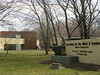 Into the bus and over the Susquehanna and Delaware with a group of volunteers from the Washington Unit to visit the National Headquarters of Recording for the Blind & Dyslexic in Princeton, N.J. The satellite radio in the bus kept kicking out as we passed under bridges (just as well, ’cause the vocal standards station that our driver chose had far too much Sinatra for my taste), and we spent a few minutes driving around an adjacent office park before we found our building, but getting anywhere in the Northeast Corridor in three hours is a blessing. The one-story building is between U.S. 1 (Brunswick Pike) and the main Amtrak line, on the other side of the Pike from the main university campus.
We were greeted by John Kelly, CEO, and Tom Butler Duncan (Thanks, Kathryn!) and then toured the facility, pretty much every place except the payroll department. John noted that vision-impaired borrowers continue to decline in proportionate numbers: 80% of new registrants are learning-disabled (in other words, somewhere along the broad continuum of characteristics known as dyslexia). The organization’s ambitious goal is to reach 1 million of the estimated 2 million Americans who could benefit from audio-assisted learning.
 The textbooks that RFB&D records aren’t retained afterward, so the only books to be found were in this corner of Library Services, the acquisitions department, if you will. White stickers on the spines identify each book by a five-character shelf number. The org acquires two copies of each title, one for the reader and one for the director/quality monitor.
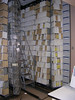
 All new recordings are direct to digital, but there is a sizable collection of legacy analog recordings. This storage room (left) was at one time filled with master tapes, but now it’s being cleared out as the tapes are converted to digital format in this area (right). What used to be a big room with analog tape duplication equipment is now largely empty, being backfilled with desks from staffers who had been located elsewhere. Alas, my snaps of the digital production facilities, including four CD duplication machines, are not release-worthy. The data center is onsite, and surprisingly small. But then again, audio doesn’t eat storage the way video does.
More chat back in the conference room before we hopped on the bus for home. The organization will soon be piloting a program of web-based distribution (to augment the current CD mailings) with the possibility of downloads to MP3 players: borrowers are clamoring for this. Volunteers, in the past only used for production, are now being sought for outreach as well. Teachers are especially wanted to help follow up with members to make sure they’re getting all they can out of the program. And I came away with an idea or two to perhaps follow up on.
Two tickets at will call for Pinth-Garnell, Leonard
Via 11D: Joe Queenan parses awful, or why The Hottie and the Nottie is not in the same class of wretched as Heaven’s Gate.
…that is the reason I became a critic in the first place; criticism seemed to be a way to channel my unwholesome fascination with train wrecks and fires into a socially acceptable framework. The truth is, every time I go to the pictures, I get goose bumps all over, anticipating that this, after all these years, could be the worst movie ever made.
Sadly, it never is.
At the park: 13
There still isn’t very much green in the park, but the birds are getting busy. We have two nests of Hooded Merganser active, and three of Wood Duck. As we were getting our gear ready in the parking lot, a scruffy-looking Red Fox (Vulpes vulpes) scarpered down the blacktop path in the direction of Lockheed Boulevard.
Since the visitors’ center doesn’t open on Sunday mornings until later in the season, we were glad to see the return of the portable outhouse to the grounds.
Spring Beauty (Claytonia virginica) is beginning to scratch its way through the leaf litter. New birds spotted include Eastern Phoebe (Sayornis phoebe), Osprey (Pandion haliaetus), Belted Kingfisher (Ceryle alcyon), and Pied-billed Grebe (Podilymbus podiceps).
Tailspin
Oh, my: in a leader published just prior to the most recent bad news about the Environmental Protecton Agency ignoring good science (splitting the difference on ozone standards), a leader for Nature makes a modest proposal:
In a rational world, [Administator Stephen] Johnson would resign in favour of someone who could at least feign an interest in the environment. Alas, it seems that he will probably stay on until January 2009, refusing waivers, fighting lawsuits and further depressing employees’ morale. In the meantime, we can only offer those employees a fantasy: the White House doesn’t want the agency to do anything, so shut it down until next January. Take some fully paid sabbatical time to relax, and prepare for a return to the old-fashioned protecting of the environment that so many of you joined the agency for.
About nothing but itself
“Color as Field: American Painting, 1950-1975,” organized by the American Federation of Arts, is stopping at the Smithsonian American Art Museum in between visits to Denver and Nashville. It’s a smallish show, with some good large pieces by Jules Olitiski and Helen Frankenthaler that we don’t see enough of here, and some looks forward to minimalism as represented by Frank Stella. Some of our hometown stars like Alma Thomas don’t get much space, but the Smithsonian includes a pair of her works in a connecting hallway.
What astonished me was a painting by Larry Poons from 1963, Han-San Cadence, shown in the room with other successors to the heyday of color field painting, the Louis/Noland “post-painterly abstraction.” On a field of dark mustard yellow canvas (achieved with fabric dye), 30-cm ovals in just two colors, cyan and dark azure, are arranged in an irregular rectilinear pattern. Each oval is oriented on either a 45° or 135° axis. The pattern of dots is almost but not quite symmetrical on both the vertical axis and the southwest-to-northeast diagonal. As our eyes look for patterns in the spots, shifting from one area to another, afterimages of blue on orange dance and shimmer. After spending some time with the piece, we notice that there is a faint grain to the shading of the canvas (perhaps the result of age) suggesting wood, an organic foil to the otherwise mechano-digital ovals that whisper of secret codes and punch cards.
Stunning
David Adjmi’s new play, set in the enclave of Syrian Jews of Brooklyn’s Midwood neighborhood, gives us a look into that prosperous but highly isolated community in which he himself grew up. It opens with a bang-up scene to introduce us to Lily, one of our two protagonists; in rapid-fire comic dialogue of a brevity suggests Beckett or Mamet, the not-quite-seventeen-year-old Lily (the flexible Laura Heisler) recounts her Caribbean honeymoon with Ike, whom she wed by arrangement, to her older sister Shelly and friend Claudine. Flighty Lily, who insists on telling us how mature she is, seems obsessed by her peeling sunburn.
Back in Brooklyn and setting up housekeeping, she hires Blanche as a live-in maid. Even though Blanche is African-American, Lily insists on speaking Spanish to her because she’s always had Puerto Rican servants before. Blanche (the charming Quincy Tyler Bernstine) is apparently down on her luck temporarily but waiting for it to turn with an expected job in academia. Blanche is biding her time, and she can be ingratiating or firm, as need be.
Blanche catalyzes Lily’s attempt to break out of her own ivory tower, the stultifying environment of this hidebound community where she is encouraged to do nothing but go shopping, symbolized by a two-level set by Daniel Conway painted (and repainted in the course of the evening) in nothing but white. Unfortunately, the set (which owes something to Woolly’s recent set for The Clean House) at times is too much a character, with mirrors that offer intended and unintended looks into the house and backstage, and balky sliding panels.
Lily’s community is nevertheless childishly naive at times, as when Shelly uses Pig Latin to tell something to Lily in Blanche’s presence, assuming that she won’t understand.
Alas, neither Lily’s effort to fly free nor Blanche’s attempts to find security (Ike is her brutal Stanley Kowalski antagonist, played as a nasty piece of work by Michael Gabriel Goodfriend) come to a good end, and one that doesn’t feel fully earned. Adjmi shows us that the cruelty of this culture is something it shares with the rest of the world without achieving a universality.
- Stunning, by David Adjmi, directed by Anne Kauffmann, Woolly Mammoth Theatre Company, Washington
A more perfect union
Taking as his text the Preamble to the Constitution, and quoting the Gospels and William Faulkner, Barack Obama delivers a moving, thoughtful, and genuinely inspiring speech on race relations.
Most working- and middle-class white Americans don’t feel that they have been particularly privileged by their race. Their experience is the immigrant experience—as far as they’re concerned, no one’s handed them anything, they’ve built it from scratch. They’ve worked hard all their lives, many times only to see their jobs shipped overseas or their pension dumped after a lifetime of labor. They are anxious about their futures, and feel their dreams slipping away; in an era of stagnant wages and global competition, opportunity comes to be seen as a zero sum game, in which your dreams come at my expense.