Only two—two—cases of guinea worm have been recorded this year. Jason Beaubien has the update, and Robert Siegel checks in with Jimmy Carter re The Carter Center’s efforts to eradicate the disease.
At the park: 87
One more report from the nest box monitoring team for the season:
This year is turning out to be quite successful. Two more Wood Duck boxes have hatched out (box #61 at left), bringing the total to 8 successful WODU nests and 3 HOME nests. This is not counting boxes #1 and #3, which may have been predated, even though a second look turned up some egg membranes. We did see 3 young mergansers in the vicinity of these boxes.
We have at least two boxes still incubating (#6 and #77). #6 will be a second clutch for that box. #68, down at the end in the cattails, has 6 eggs, but it is perhaps a drop nest — we have not been checking it regularly.
We’re done with all-hands work days for the season. Kat and Chris, if you could check #6 and #77 in a couple of weeks, that would be good; I will spot-check #68 probably in two weeks on 19 June, or I will check it a week after that.
Paul, was is Wood Duck eggs that you saw in #68?
A Wild Turkey crossed the entrance drive as I arrived this morning. Paul spotted a Red-headed Woodpecker, down along the reach of Barnyard Run that they are partial to. Many tiny toadlets were crossing the trail as we walked out to the wetland.
Thank you all! I will post a wrap-up message, probably some time in July.
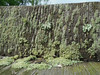 Our boxes support life of all kinds. This the the top of box #67, showing examples of three lichen growth forms: crustose (clinging to the substrate), foliose (peeling up like a leaf), and fruticose (bushy, like Reindeer Lichen).
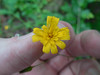
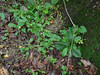 There is a little patch of one of our hawkweeds, Rattlesnake Weed (Hieracium venosum) centered on a tree along the Cedar Trail, right before it divides to make a loop. I’ve keyed this flower out before, but this time around I was able to get some passable images. The purple-veined leaves of the basal rosette are the ID clincher.
Macbeth: a recollection
Reston Community Players is planning a commemorative booklet of reflections and remembrances to celebrate its 50-year mark. I offered the following story, told by many people since the event. This is my version:
I was a supernumerary in our production of Macbeth in the winter 1993 time slot, directed by Jan Belcher. I filled in the background for the battle scenes; I was a servant opening doors and setting tables; I supported the Bloody Captain during his speech; that sort of thing.
Jan was bluntly opposed to the tradition/superstition that the name of the play not be spoken within the confines of a theater, and she broke the taboo loud and clear on load-in day. Perhaps she was justified: the show went on to weather its share of mishaps and technical delays, but no more than usual.
Except for one night.
The first scene with the witches featured a dead body made of styrofoam, hung as on a gibbet. The three weird sisters (Maggie Geuting among them) did a dance around it, and at the end of scene, performed a wash-up move, cueing the flyman to take the corpse out.
But on this night, the corpse missed its spike and sailed all the way up to the top of the flyspace. We heard a loud bang as it crashed into the grid.
OK, nothing to see here; the play continued.
Lady Macbeth (Penny Cupina) came on for the letter scene. Halfway through the scene, one of the plastic corpse’s legs detached and fell to the deck, with a small crash but no ceremony. The stage manager said, “David, there’s a leg on stage. Can you help us out?” “Uh — sure thing.”
I came on to execute my next assigned gate-attendant maneuver, perhaps a little early. I strode over to the chunk of loose set dressing, scooped it up, and tried my best to hold it upstage of my body.
The gates being opened, Macbeth (Tel Monks) and his entourage entered as I skedaddled off stage and disposed of the artificial limb — to everyone’s relief.
IWLA Bethesda-Chevy Chase herps
Our final field trip with Rachel Gauza’s class took us to the Bethesda-Chevy Chase chapter of the Izaak Walton League of America, 600-odd acres near Poolesville and McKee-Beshers WMA. Out host was Larry Anderson. Our targets were snakes, but we didn’t score well with that taxon. However, we found plenty to look at off the West Woods trail. Please don’t mind the nearby gun range.
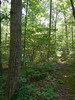 As you might imagine, deer management is an advanced art here, so it’s not uncommon to see nicely developed understory vegetation. Although we did see patches of the usual non-native invasives, we also saw some good natives—lots of Pawpaw (Asmina triloba), some Smilacina, a chance encounter with a bellwort, not yet in flower, Chestnut Oak (Quercus montana) on the ridgetops; Cathy spotted Wild Ginger (Asarum canadense).

 I tried to puzzle out some ferns, unsuccessfully. This possible myxomycete also caught my attention.
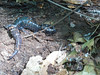 And we did see some herps! Pickerel Frog (Lithobates palustris), too hoppy for my camera, and multiple Marbled Salamanders (Ambystoma opacum). Rachel says that this is the first time that she’s seen Marbleds on the property.
Trash = props
Eight set designers and dressers tackle the problem of designing for The Flick, by Annie Baker. Electromagnets in blackout—brilliant!
At the park: 86
The latest from our nest box monitoring:
A quiet, drizzly Sunday morning, but a sufficiency of activity to report. Upstream, Kat and Chris report hatches in boxes #4 and #7; and at the other end, box #67 hatched as well. We have a second clutch going in box #6, by the big pool, as well as clutches going in boxes #77, #5, and #61. When I opened #61, the Wood Duck flushed and executed a fine broken-wing distraction display.
Of our 16 boxes, we have had nesting activity in 14 of them….
Let’s do this again in two weeks on 5 June and check all boxes, and then one more time on 19 June to spot-check the stragglers.
Just a few days ago, I remarked to my herps instructor that we had never stepped on a Snapping Turtle in the wetland. And then yesterday, I came dang near close to doing just that…

Unplugged
Drain Lake Powell? Abrahm Lustgarten writes that it could happen, and indeed be for the best.
Journey to the West
Mary Zimmerman’s Journey to the West is another of her masterful renderings of ancient texts as modern theater, and it receives an equally masterful staging by Allison Arkell Stockman’s Constellation Theatre Company within the friendly confines of the Source Theatre space. The ensemble cast portrays episodes from the pilgrimage of the monk Tripitaka, drawing on a Ming dynasty novel that in turn adapted mythic materials from 1000 years earlier. The evening is packed with theatrical storytelling.
We watch very entertaining personified animals who accompany Tripitaka on his journey to the wellsprings of Eastern religion—strongest of these is the yogic, gymnastic Dallas Tolentino as the Monkey King. (This is basically a superhero road trip movie, with better karma.) There are trickster’s personality exchanges, a lengthy fight in slow motion, and multiple distinct water effects achieved with banners. The magnificent cornucopia of costumes are by Kendra Rai; composer/musician/sound designer Tom Teasley crowds numerous effects into his small space, including an inventive rendering of a pig at the trough.
- Journey to the West, by Mary Zimmerman, directed by Allison Arkell Stockman, Constellation Theatre Company, Washington
There were several respectful younger audience members at this matinee performance, but with a running time of 2:50, some budding theatergoers may find it a bit long.
Modern agriculture
Emily Helliwell explains her approach to talking with creationists. In short, focus on the concepts that are important to the here and now:
If we want to get back to the dinosaurs, we can say the cumulative effect of billions of years of changing environments have allowed for some pretty amazing creatures to come and go. But, let’s resist the urge to talk about that, and stay focused on the small-scale stuff. Because if there is any concept necessary for our modern, developed society to believe in and understand, it’s microevolution.
Through microevolutionary principles, we would not have developed two of the most important contributions to society, antibiotics and pesticides. Without antibiotics, we would be subject to horrible infections, and without pesticides, we would be subject to devastating crop failures. Many of us would be dead or suffering.
At the park: 85
From our most recent nest box monitoring report, with some photo annotations:
A quite pleasant morning on the wetland.
Win some, lose some: Box #84 is hatched out, and Kat and Chris found WODU ducklings in box #2. It’s possible that a Wood Duck is starting a second clutch in box #6, with 2 eggs laid there recently. So for the season, that’s 13 of the 16 boxes with nests, and 6 nests that have fledged so far.
On the downside, it appears that boxes #1 and #3 were predated by snakes: the boxes are not messy inside, just empty, and there is mud streaking in box #1’s pole that could be snake-caused. These are the 2 new boxes bear the observation tower, the ones that don’t have predator cones.
Let’s meet again on 22 May and check all the boxes. Based on what we find then, we’ll make a plan for at least one day in June, perhaps two.
We got some looks at the Barred Owl adult and owlets; newly-observed birds for the season were Acadian Flycatcher and Northern Rough-winged Swallow; migrant Pectoral Sandpiper and other shorebirds. Chris turned up a wee American Toad near the vistors’ center.

Former Schönberg student makes good
William Schallert has taken his last bow.
In an interview for this obituary in 2009, Mr. Schallert said he had never been particularly selective about the roles he played. “That’s not the best way to build a career,” he admitted, “but I kept on doing it, and eventually it paid off.”
NEW
The Economist‘s recent leader in favor of a revised metric of economic well-being is rather refreshing, surprising. Among the steps that it recommends be taken to improve on the slavish following of GDP, the piece leads with improving the measurement of what is already measured. But then the editorial pushes into measuring quantities that have never been systematically considered before: income inequality, negative externalities (like pollution), depletion of natural capital, and perhaps most importantly, the role of unpaid services like homemaking and caregiving. There are still other aspects of welfare that should be accounted for (e.g, crime rates, time lost to long commutes), but if we were to formulate a new metric along the lines suggested, it would be a big step in the right direction,
At the park: 84
From my most recent report on nesting activity:
12 of 16 boxes with nests, and one more with adults seen in the vicinity! As of 1 May, boxes #10 (Hooded Merganser), #6, #13, and #62 (Wood Duck) have hatched out, more or less in the usual proportions.
Birds noted on 10 April: Glossy Ibis, Eastern Phoebe, Eastern Kingbird. Birds noted on 24 April: Common Yellowthroat, Eastern Towhee, Red-eyed Vireo, Lesser Yellowlegs, Chimney Swift, Barn Swallow, Green Heron. On 24 April, Houstonia sp. was in bloom near the end of the berm. There is a Tree Swallow nest in the broken top of a maple, down along Barnyard Run, near the “helper log” that lies across the channel near box #61.
We’ll meet again this Sunday, 8 May. Let’s skip checking box #7.
Bleached
Oh, dear Fox, yes: Stop Saying ‘I Feel Like.’
This is what is most disturbing about “I feel like”: The phrase cripples our range of expression and flattens the complex role that emotions do play in our reasoning. It turns emotion into a cudgel that smashes the distinction—and even in our relativistic age, there remains a distinction—between evidence out in the world and internal sentiments known only to each of us.
Jug Bay herps
Our first field trip for Rachel Gauza’s herps class took us to Jug Bay Wetlands Sanctuary in Anne Arundel County. Our host guides were Mel Fegler and Mike Quinlan. This is a popular natural place on the Coastal Plain, and rightly so. I heard my first Wood Thrushes of the year in the parking lot.
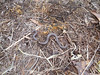 But the focus today is amphibians and reptiles! In the morning, we worked several spots near the McCann Wetlands Center. Mike found an Eastern Wormsnake (Carphopis amoenus) under a coverboard in the meadow adjacent to the center.
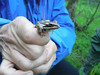
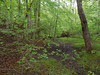 Moving into the deciduous woods along the Middle and Forest Trails, we saw a nice selection of herp diversity: Eastern Box Turtle (Terrapene carolina), Wood Frog (Lithobates sylvaticus), American Toad (Anaxyrus americanus), Fowler’s Toad (A. fowleri), Marbled Salamander (Ambystoma opacum)—and one toad of doubtful status that I want to follow up with Rachel on.
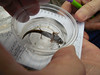
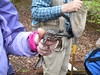 We dropped down from the right of way of the railroad that once ran from Seat Pleasant to Chesapeake Beach into the floodplain of Two Run Branch to visit several seasonal (now dried) and persistent pools. Opportunities to see Marbled Salamander larvae, Eastern Cricket Frog (Acris crepitans), and a choice-sized American Bullfrog (Lithobates catesbeianus). Marbleds breed in the fall and the eggs overwinter, giving them a head start in develop come spring, so (as you can see), they’re already well along the way to becoming adults.
At lunch break, back at the center, I heard a Summer Tanager (Piranga rubra), and I think this is the first time that I’ve heard the call that Dick Walton’s tapes taught me so long ago as “piki-tucki-tuck.”
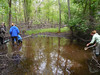
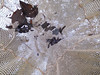 In the afternoon, Mel took us to a seasonal pool on the the Glendening Nature Preserve section of the sanctuary, the pool known locally as Barn Pool. We did some sweep netting through this pool, in a very rough approximation of the sampling protocol that Mel follows when she’s monitoring. The water levels were quite reduced, but there were many Marbled Salamander larvae to be netted.