Box Turtle research at Clifton Institute

Andrew Eberly of the Clifton Institute led a show-and-tell-and-do workshop on the organization’s research into Eastern Box Turtles (Terrapene carolina carolina). The research focuses on what habitats the turtles are using, and what habitats nearby that they give a pass to. Like the kestrel research, one of the goals is to inform landowners about management choices (i.e., when and how to mow). The Institute has numbered more than 100 turtles (there are lots on the 900ac property) with small, harmless notches on the edge of the carapace.

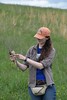
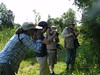
tale of the tapeweigh-inOne aspect of the research is simple mark-recapture, with the collection of various vitals. Andrew is weighing and measuring a turtle that hadn’t been observed on the property before—so it’s a new entry in the database.

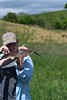
found 'ergot my ears onCertain of the turtles carry radio transmitters (attached with marine glue to the carapace). These turtles are surveyed more regularly. They are relocated with a receiver and antenna (not unlike the gear that I saw in use in North Carolina tracking Piping Plovers). Each turtle is transmitting on a distinct frequency, and the transmitters are good for about 400 days.

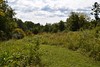
To sample nearby habitat that a turtle isn’t using requires finding a randomly selected point within a 100m radius of where it was found. Bushwhacking required.

Kestrel research at Clifton Institute

Sam, beforeSam, afterYesterday’s trip to Warrenton provided a recap of current research results from studying American Kestrel (Falco sparverius) behavior in the field, a bit of hands-on experience preparing ink traps (to detect the presence of prey items) and walking transects (ditto), and the opportunity to observe (at a safe remove) a female kestrel being fitted with a GPS-based transmitter. At right, the bird (nicknamed Sam [her mate is Frodo]) after getting her backpack.

A few Eastern Forktails (schnura verticalis) (and) and dragonflies were flying at the Institute.

Piedmont geology foray

We visited two Triassic Basin sites in Fauquier County, on a trip led by Clifton Institute staffers Andrew Eberly and Bridget Bradshaw. No pix of living things to post to iNat, so the pix are Flick embeds today!

At the Institute, Andrew gave a quick geology refresher. I have trouble remembering that felsic rocks are low in iron (that “fe” is for feldspar) and it’s the mafic rocks that are high in iron and magnesium.

cropping outFirst road stop was an outcrop of Newark Supergroup siltstone on the shore of Germantown Lake in C. M. Crockett Park. Andrew demonstrated that the dip of the outcrop is about 15°.

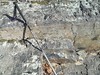
two piecesbreaks easilyThe siltstone fractures easily, but not cleanly.

at the fordWe then moved farther south, to Kelly’s Ford on the Rappahannock River. This site is part of the C. F. Phelps WMA.

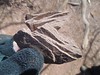
broken into blocks, but how?darkerThe siltstone here has been metamorphosed into something much harder to break, and the stone is much darker.

beddingBedding is clearer in this photo.

We didn’t stop for pix of the blooming Early Saxifrage and Cut-leaf Toothworth, but you are likely to see these in my iNaturalist feed soon.

Clifton Institute bioblitz August 2022

no, over hereboth sides nowI took part in a Clifton Institute bioblitz on the property of an institute sponsor. I didn’t know quite what to expect, or what to focus on, so I walked along with the group, recording observations of what looked interesting to me, some of which I had to key out at home.

The woods have been logged over recently, and show evidence of disturbance: a fair amount of non-native invasives, as well as Indian Tobacco (Lobelia inflata), about which the Flora of Virginia says, “In a wide variety of mesic to dry forests and woodlands, depression wetlands, flood-scoured shores and bars, clearings, fields, roadsides, and other disturbed habitats.”

There seemed to be some disagreement among the group about this Swamp White Oak (Quercus bicolor). I’m not sure why. Seems obvious to me.

Flipping rocks, the group found three Eastern Wormsnakes (Carphophis amoenus amoenus). White and White write, “This snake does not bite when handled but will try to escape by probing its head and tail into the captor’s hand searching for a way out,” which is just what this li’l fellow is doing in Ben’s hand.

At the lights, most of the group focused on moths and caddisflies. I’m just getting started with moths—I’ve never before seen moth eyeshine—so I spent more time getting to know some beetles on the groundcloth, like this handsome darkling beetle, Alobates sp.

Rea was giddy when she found this late-instar Regal Moth (Citheronia regalis). The larvae have the common name Hickory Horned Devil.

I took the opportunity to practice using my audio recorder. Need to work on setting levels and generally using it more before I splurge on field headphones and a shotgun mic.

Observations are still coming in.
NABA Butterfly Count 2022

mitigationBack to the area around the Clifton Institute for my first NABA Butterfly Count. We visited an extensive pollinator garden on private property (thanks to Shane’s Signs), a gravelled patch of Thoroughfare Road adjacent to a wetland mitigation project (photo), and a private horse farm. In the pollinator garden I made my first acquaintance of one of our hummingbird moth species (Hemaris thysbe) who were going gangbusters—not on our checklist, but still. I found the first of a few Sleepy Oranges (Abaeis nicippe) and Juniper Hairstreaks (Callophrys gryneus) that we tallied, and was finally able to twitch Peck’s Skipper (Polites peckius). Stephanie Mason pointed out this critter to me ages ago (“Peck’s have checks”) but that was before I started listing butterflies. But dang, skippers burn me out fast. We saw so many Sachems (Atalopedes campestris) in all their variability that the mental key began, “Is this skipper not a Sachem?”

No lie, it was hot. We started at 08:00 and I began to flag at 11:00. I am finding that a few hours of heat tends to make my feet swell in the waterproof light hikers that I usually wear. I was grateful for the jug of lemonade at the tally rally back at Clifton.

Clifton Institute dragonfly/damselfly count 2022

Dragonfy watchers at Leopold's Preserve by Marie Pinto (White House Farm Foundation)As usual, that’s me in the back, the last one to get on whatever we’re looking at. (Thanks to photographer Marie!) But well equipped.

No luck getting good images of the two common saddlebags species, but I did snap some reasonable images of Twelve-spotted Skimmer (Libellula pulchella) and what turned out to be Citrine Forktail (Ischnura hastata). Dang, those pond damsels are tricky. The best spot in our sector for pond damsels was again the pond behind The Farm Brewery at Broad Run. You know, the place with the axe-throwing barn.

Last Sunday was plenty hot, and we pooped out by 15:00 except for leader Larry. His pro tip for finding Wandering Glider (Pantala flavescens) is to check the parking lot: the critter has a tendency to mistake a car roof for a puddle.

Clifton Institute wildflowers

pond at HQthru the upland meadowA lovely morning walk through the upland meadows of the Clifton Institute for fall wildflowers, led by Bert Harris and staff. I got good photos of Field Thistle (Cirsium discolor) and found Hog Peanut (Amphicarpaea bracteata) in flower. The group met Slender Bush Clover (Lespedeza virginica), Trailing Lespedeza (L. procumbens), and Green Milkweed (Asclepias viridiflora)(called Green Antelopehorns by iNaturalist). Bert explained how to distinguish New York Ironweed from Upland Ironweed—this is the first time I really got it, with an example of the yellowish pappus of Upland in hand.

Clifton Institute dragonfly/damselfly count 2021

I made the acquaintance of several new odonates during Saturday’s inaugural count organized by The Clifton Institute, as well as a warmup walk with executive director Bert Harris a couple of weeks prior.

I walked with Larry Meade, Kurt Gaskill, and others at Leopold’s Preserve (near Thoroughfare Gap) and Silver Lake Park.

Top photo observations include a nice up close Eastern Pondhawk (Erythemis simplicicollis ), an Elegant Spreadwing (Lestes inaequalis) that we mis-ID’d at first, and an Eastern Amberwing (Perithemis tenera) that I got to sit down for me. Slaty Skimmers (Libellula incesta) were common; making an early appearance were a few Autumn Meadowhawks (Sympetrum vicinum). I might have to start keeping a list.