Postcards from Ohio: 4

another oneLeta and I walked around downtown Piqua on a quiet, somewhat chilly Saturday afternoon. We had coffee at a local ice-cream parlor, chatting with the proprietor; he said that much of his business was party catering out of a truck. I found a fallout shelter sign on the wall of the YMCA where I used to play bumper pool.

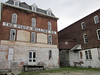
the mill's closedEvidence of the city’s milling and manufacturing past is still quite evident. This building is close to the river, just a few blocks down Main Street from what used to the the movie theater and is now a Hallmark store.

renewed 2renewed 1The centerpiece building of the downtown square, once the Orr-Statler Block and then the Fort Piqua Hotel (where the Greyhound buses would stop), is now the recently-restored Fort Piqua Plaza. The public library is the main tenant; I can’t turn up the story of how and why the library moved out of the Flesch mansion on Greene Street.

Postcards from Ohio: 3

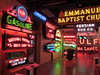
We didn’t have as much time to explore Cincinnati as we had hoped, but we did make it to my first intended destination: the American Sign Museum, located in an industrial district between the Mill Creek expressway and the rail yards.

check the back pocketThe strength of this place is its collection of neon and other lighted signs, but there are some fun non-electrified artifacts as well. This Big Boy adheres closely to the original design: three-dimensional slingshot in the back pocket, striped pants, saddle shoes, and a zaftig physique. You can also find some well-authenticated Burma Shave signs, not the dime-a-dozen reproductions.

street of dreamsdew drop innThe examples of neon on display are just stunning, and many of them in remarkably clean condition, especially considering the proprietor’s disposition against restoration work. Leta was extra fond of this tavern sign, at right.

broadcastThis Crosley sign features a lateral lightning bolt that zings on and off, much too quick for my point and shoot.

rotatorLong before electronic ad rotators and carousels on web pages, before windowshade roller signs at the ballpark, these flip-down rotating ads were in service. No, there’s no such thing as progress.

Just a few blocks back toward the freeway, at Colerain Avenue and Hopple Street, we stopped for cheese coneys and chili at Camp Washington Chili, then back on the road!

Postcards from Ohio: 2

Fortified with gluten-free donuts, we set off south from Columbus to visit three Scioto Valley sites dedicated to preserving earthworks built by pre-European peoples. We talked a lot about the “mound builders” when I was going to school as a boy in Ohio, but I can’t recollect actually visiting any of the sites.

shadowsThe first two were built by what we know as the Hopewell culture, Mound City, north of Chillicothe (first capital of Ohio)…

for scale, again…and the Seip Earthworks, southwest of town. This section of a circular wall has been reconstructed; original or not, it’s impressive.

The orderly groundskeeping by the NPS makes you wonder what the Hopewell did to keep these enclosing ceremonial walls tidy. Certainly they didn’t have access to golf course fescue for planting.

the mound that took a walkWe continued southwest, and after recovering from a wrong turn in the town of Bainbridge and chasing the setting sun, we proceeded to Serpent Mound, near Peebles. Current scholarship now attributes this work to the Fort Ancient people. The two approaches could not be more different. Where the Hopewell sites are geometric and situated on level ground, the Fort Ancient construction is organic, undulating along a ridgetop. It reminds me of Andy Goldsworthy’s wall at Storm King. The one thing the sites have in common is proximity to a watercourse.

No more elephant hunting

last parking spaceLast week I donated Alberta, my venerable Ford Explorer, to one of my local public radio stations. She and I had a good run: we traveled (usually on birding/hiking trips) to Louisiana, Key West, Niagara Falls, the Adirondacks, twice to the beaches of North Carolina’s Outer Banks, Cape May, several trips to Delmarva. She carried set pieces to a theater competition in Geneva, N.Y.; we took Mom birding in southeastern Indiana; during nesting season, my waders were always in the cargo area.

that scrapeThe biggest body damage she sustained was a scrape in the driver’s side rear fender: I ran into a support column in an otherwise empty parking structure in Vienna. Another time, a driver banged into her in Falls Church, but he nosed down and hit her square in the hub cap: you can’t see the damage at all.

208KIt was the multiple trips to the shop that did her in: she was on her third transmission; we repaired the brakes last October only to have them fail again in May. But we still got past 200K miles before Della came on the scene, and we finished up with 208469.4. I will miss her.

Postcards from Ohio: 1

Leta and I took a quick road trip to Ohio last week. First stop was Bexley in the Columbus suburbs to visit friends. On our way out of town we stopped at the Cherbourg Bakery, which makes an excellent line of tasty treats, all of them gluten-free and Leta-friendly.

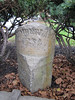
254Next to our parking space on Main Street, we found a mileage marker from the original National Road. We had covered the 254 miles from Cumberland much more quickly than those who traveled before us. Distances from Wheeling, to the east, and nearby Columbus, just 3-1/2 miles to the west, are somewhat legible in this image. (Point and shoots don’t do well with inscribed stone.)

Silver Line progress report: 26

still closedIt’s been a while since I photographed the construction site at the future Wiehle Avenue (temporary) terminal. The building definitely resembles a station at this point. See how nice and clean all that gravel ballast is.

bridge to be madeWork for the pedestrian overpasses is also progressing nicely, and the canopy over the west end of the platform is in place.

Cape May fallout

birding the elmsAlmost ideal weather conditions (Friday’s passing cold front with storms, Saturday’s northwest winds) set up a great weekend birding in Cape May with a group led by Mark Garland. Warbler migrants were numerous (15 species for my count, including my darling Black-throated Blue and Black-throated Green). In the afternoons, we worked the neighborhood streets around Lily Lake. An insect hatch in the elm trees caused them to “turn on,” in Mark’s words. A brilliantly yellow Prairie Warbler; a crazy weekend for Red-breasted Nuthatches (Sitta canadensis).

reached the beachFalcons and accipiters were also plentiful (ID mnemonic: the tail of a Sharp-shinned Hawk is sharply cut off, while a Cooper’s tail is rounded) , and easier to see from the west side of Cape May Point than from the official watch station in Cape May State Park. A trio of Brant in Delaware Bay was a small surprise. Mark called the goldenrod thriving in this windblown habitat Beach Goldenrod (other sources call it Seaside Goldenrod) (Solidago sempervirens).

Sunday morning at Higbee Beach we were seeing half a dozen Northern Flickers at a time. Higbee runs north-south along the bay side of the peninsula. Mark explained an early-morning phenomenon that I didn’t understand the first time I visited Cape May, in 1998. As the sun comes up, a passerine (migrating by night) that finds itself over Delaware Bay takes the strategy “water! go back the way you came!” So at sunrise you will see birds flying back north over Higbee, looking for a dry spot to land.

Monarch butterflies were also in migration, a steady stream all weekend. The flicker of a butterfly was always catching my eye, making me think that I’d spotted a bird. I added Common Buckeye (Junonia coenia) to my very short butterfly list.

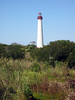
a point of lightEveryone came scrambling to see the Say’s Phoebe (Sayornis saya) in the park east of the lighthouse. I’ve seen this bird in the west, so I got my look and then went elsewhere: there had been reports of Clay-colored Sparrow in the brush along the back of the dunes, and some of our group got a brief look, but I did not succeed.

80 species for the weekend, plus good looks at several Cape May Warblers for a life list twitch.

Mark’s suggestion paid off: Westside Market on Broadway is a good place to get a sandwich and Krimpets for lunch. If you’d like a split of wine to go with dinner (many of the restaurants are BYOB), Collier’s is the place to go.

funky nouveausodas and iceI like the funky nouveau street name signs in Cape May City. And the hand-painted sign at my motel (a mom and pop operation now converted to a chain’s branding) was very cute.

Aisle of View

Sunday we walked the property of VNPS Pocahontas Chapter President Catharine Tucker in Hanover County. Her 70 acres have seen little farming disturbance over the last 150 years, and hence are one of our better representatives of mesic hardwood forest in the upper Coastal Plain. The fall zone runs through Richmond, and this part of Hanover County is northeast of Richmond.

good morningOn the state road leading to her land, Catharine pointed out Red Morning-Glory, or Redstar (Ipomoea coccinea) growing in a hedge managed for butterflies. There seems to be some question as to whether Ipomoea is native to this part of the country.

Catharine effectively used the subsiding road cut to illustrate the soil profile: a sandy horizon lying atop red clays.

big treeThe bulk of the property is a Beech-Tuliptree forest, with some magnificent examples of Fagus grandifolia. Our group measured around one tree, computing a DBH of 110 cm. And with beeches come the parasitic Beechdrops (Epifagus virginiana)—plentiful here, but difficult to photograph with a point-and-shoot.

hiding in plain sightOur destination plant was Shining Clubmoss (Huperzia lucidula), found in one small clump at the base of a tree. This fern ally is kin to the more often-seen Lycopodium ground pines.

Bonus local common name: Catharine calls Mayapple (Podophyllum peltatum) May Pops—although Google thinks that this name goes better with Passiflora incarnata.

VCU Rice Center

building frontFor my first field trip as part of the Virginia Native Plant Society’s annual meeting, we visited the Virginia Commonwealth University Inger and Walter Rice Center for Environmental Life Sciences in Charles City County. The botanizing was what it was, but the education and lab facility was a stunner.

the JamesVCU acquired the property, on a bluff with a majestic view of the James River, via a gift from Walter Rice’s widow, Inger. She then went on to specify (and fund!) a state-of-the-art sustainably-built edifice. Panelled in American White-cedar, the building has achieved LEED platinum certification. Early plans called for solar panels on the roof, but they would have been shadowed by the huge oak that provides the shade in this image. So the panels were relocated to the research pier at the bottom of the bluff.

Vertical geothermal tubes provide some of the heating and cooling. I was surprised to learn that the permeable paving system for the entrance drive and parking area (a plastic grid over layers of sand and gravel) was one of the more expensive elements, blowing out the original $2M budget for the entire package.

the windows openThe south-facing conference hall is naturally lit and ventilated. Knee-height casement windows are supplemented with industrial-strength ceiling fans, keeping temps in the room very comfortable (albeit on a breezy early fall day).

As we talked outside, our presenters were upstaged by a pair of chippering Bald Eagles, their arrival announced by an unhappy Blue Jay.

Along with research into Eastern Box Turtles and Prothonotary Warblers, the Center is in the midst of a wetland restoration project—one that was prompted by Nature herself. Kimages Creek, just to the east of the educattion building, was dammed in the 1920s by a real estate developer who sought to establish a hunting club. Although he busted almost immediately, the dam remained for the time being, impounding a body of water called Charles Lake (it’s still labelled as such on Yahoo!’s maps). The earthen dam, never well-maintained, was eventually breached by storms in the 2000s. Efforts are now underway to re-establish the tidal freshwater creek.

Land use in the area is exceptionally well-documented and mapped, owing to the place’s strategic importance during the American Civil War. Gen. George McClellan’s Army of the Potomac was encamped on the eastern side of Kimages Creek for a short period of time in 1862.

Red roadster

thinker frontthinker backLeta and I spotted this polyethylene-bodied Th!nk City electric vehicle getting a drink of juice in a local parking garage. The manufacturer has gone bankrupt four times in twenty years, but Electric Mobility Solutions AS has plans to restart production soon. Most of the U.S. production was to the state of Indiana for government fleet use. What’s this one doing in Silver Spring?

Rachel Carson Conservation Park

For our second field trip to look at invasive non-native plants of the mid-Atlantic, Carole took us to Rachel Carson Conservation Park, a darling gem of 650 acres in northeastern Montgomery County.
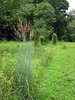
native and plantedMost of what Carole had to show us were success stories about the restoration of this former agricultural land. In the meadow, warm season grasses like Indian Grass (Sorghastrum nutans) have been planted and are thriving. Autumn Olive (Elaeagnus umbellata) is generally under control.
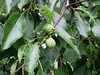
another comebackpucker upNaturally occurring Persimmon (Diospyros virginiana) (ripening fruit at right) is avoided by the deer, for some reason. Goldenrod is also making a comeback.

Unfortunately, at the forest edges, Polygonum perfoliatum is still running wild, just barely checked by the Japanese Beetles that find it as tasty as home cooking (which it is, for them). Carole is less concerned about the non-native Foxtail Grass (Setaria sp.), whose nodding heads you can see in the background above.
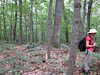
ridgelineIn the woods, we found two of my favorite plants. Spotted Wintergreen (Chimaphila maculata) was showing some fruit. I like this plant a lot, because it’s fairly easy to spot and identify. At a ridgeline, Chestnut Oaks (Quercua prinus) were in control. I like its chunky bark and its disdain for the good soils of the bottomlands.
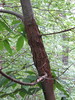
doomedAt the end of the ridge, Carole showed us a mature American Chestnut (Castanea dentata), blighted yet nevertheless putting out flowers and fruit. It is likely to succumb eventually, but it continues to throw out suckerish regrowth.
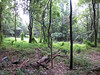
more work to doThere are patches in the woods, however, that are still works in progress. This old farmstead was ablaze with Oriental Bittersweet before Carole’s machete-wielding team attacked. Now the battle is against the sprawling Polygonum.
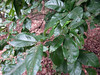
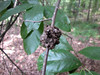
shingles?gallingHeading down into the stream valley, the trails show evidence of scouring. But in a section that has been reclaimed from the big vines, Carole was able to show us Shingle Oak (Quercus imbricaria) along with its characteristic galls, formed by a cynipid wasp.
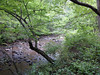
hawling what?The Park’s east-west axis is the Hawlings River, which rises west of the park and flows to the Patuxent. The group spotted several little patches of Cranefly Orchis (Tipularia discolor)—in flower but long before the autumn emergence of its two-toned leaf. We looked at some additional restoration work; Carole likes to use Christmas Fern (Polystichum acrostichoides) (what a jawbreaker of a name!) because it stabilizes the soil and deer don’t like to eat it. Back in the meadow, we smelled two species of mountain mint (Pycnanthemum spp.) and a Monarda.

Bird life in the park sounded good: we heard Wood Thrush, Acadian Flycatcher, Common Yellowthroat. Eastern Bluebirds were hanging around, perhaps influenced by the nest boxes that were mounted in the meadow.
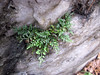
somewhere in MarylandBonus plant for the trip was the tiny Asplenium montanum, a Montgomery County rarity.
Black Hill invasives

mixed blessingSunday brought us back to Black Hill Regional Park, this time with Carole Bergmann in the first of two field trips to look at invasive non-indigenous plant species. We explored an area quite close to the patch where Baltimore Checkerspots are being reared. The newly-paved hard-surface Black Hill Trail, which snakes through the park property, is a mixed blessing. This hike-bike trail, much wider than the footpath it replaced, exposes more forest floor to daylight, allowing opportunists like Japanese Stiltgrass (Microstegium vimineum) to take over.

still tastyAnother common invasive to be found in the park, one that I am less familiar with, is Wineberry (Rubus phoenicolasius), a tasty raspberry cousin with impossibly red drupes. It hopscotches across habitat by sending out hairy red canes that droop over and root when they touch ground.

long pastOne of the bad guys we met in Karen Molines’ spring class, Garlic Mustard (Alliaria petiolata) is all done by this time of year, leaving nothing but dry stalks.

mile a secondBut Mile-a-Minute, a/k/a Asiatic Tearthumb (Polygonum perfoliatum), is just coming into fruit. This annual will continue producing fruit and seeds until frost.

Even though Polygonum and Microstegium can form dense mats that choke out all diversity in the ground cover, Carole (in her capacity as botanist for the county park system) gives less management attention to sprawling and trailing species like these and more to climbing vines and shrubs like Oriental Bittersweet (Celastrus orbiculatus). These are species that can weaken and kill mature oaks and hickories and hence open up yet more gaps in the canopy. While the bittersweet is the bane of upcounty forests, in the south the big problem is Porcelainberry (Ampelopsis brevipedunculata).

Near the boat landing area, Carole showed us a meadow that had been largely restored. Most of the Autumn Olive (Elaeagnus umbellata) has been removed, and Spotted Knapweed (Centaurea stoebe), a thistle lookalike that is usually thought of as a pest of the west, is under control.

lunchBonus invertebrate for the trip was this Wheel Bug (Arilus cristatus) munching on a Japanese Beetle.