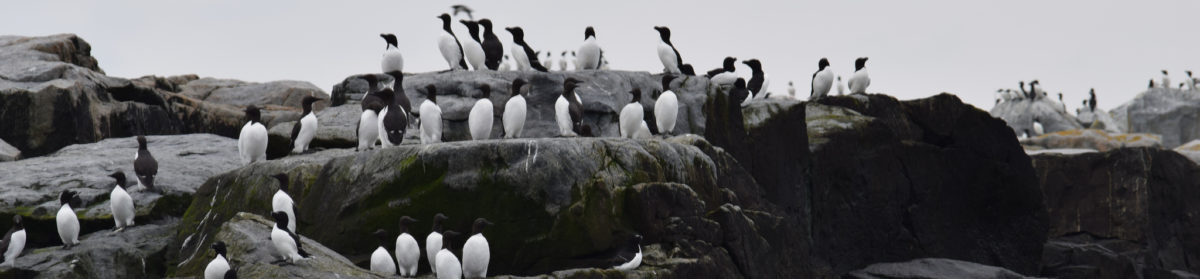
 Our little crew from last Saturday, when the weather was much nicer than this morning.
Tag: photo
At the park: 130
Mixed blessings in this week’s report:
Wood Thrush singing in the parking lot, and was that a Little Blue Heron in the main wetland? Warm weather, some good results and some less so.
Boxes #6 and #67 finally hatched, having been overdue. Box #3 apparently only fledged one duckling. Boxes #1 and #77 have new Wood Duck eggs, having already fledged a clutch. On the not so good side, boxes #2 and #10 were abandoned, and we cleaned out those boxes.
So while we had clutches started in 15 of our 16 boxes, which is higher than usual, 4 were abandoned — also higher than usual. Plus the predation of box #13 by a Black Ratsnake (Pantherophis alleghaniensis). Perhaps it was the same animal that we saw at the box again on Sunday.
I put another patch on the knothole in the roof of box #67.
Down lower Barnyard Run, I found a big patch of Rattlesnakeweed (Hieracium venosum), and about four Fragile Forktails (Ischnura posita), a male and three females.
So we can shift over to spot-checking the remaining boxes with eggs (#77, #84, #1, #5, #61) on our next work day, on 29 May. I am on call for work that day, so I will have my phone charged up.
* * *
Thank you very much!
At the park: 124
A much warmer and more successful morning.
More nests started, and five are incubating! Eight boxes are active. Our first Wood Duck box is #1, in the pool by the tower.
We repaired the hardware cloth on box #68. Access to #84 remains a problem: as mounted, the lid won’t open sufficiently. Next week we plan to repaint the number for box #67 and clean up trash around the tower.
Some splashes of Spring Beauty, with most buds tightly closed in the mid-morning.
Until next week! Arigatoo!
At the park: 123
Small disaster. Last week’s cold snap and snow left the ponds iced over on Sunday. Ordinarily, we can break through the ice with our sticks, but the ice was just thick enough that instead, I tried following C’s footsteps out to box #2, the first box off the boardwalk— walking in an area that I didn’t know very well. Almost immediately, I lost my balance and caught some serious mud from the wetland. As a result, we cut the work day short. We’ll get ’em next week.

 Fortunately, I had my chest waders on. My jacket got the worst of it.
At the park: 122
Another Sunday’s report:
Nests continue to develop. Box #68 added 7 eggs, just as if the hen was reading the calendar. My notes say that we have 4 eggs in #7 and 4 eggs in #77 — I will double check. And the 14 eggs in #6 are now incubating. It’s a little difficult to get a good count for this box.
We screwed together boxes #7 and #77. We also tried to adjust box #84, but in the process, the pole snapped off. It had rusted at the former waterline. So we did what we could, but the box is now low to the ground and a little wobbly.
K and C will leave some hardware cloth in the shed so that we can patch the duckling ladder in box #68.
I was responding to a query from a Friend of Little Hunting Creek: that group is looking to install some nest boxes, and I was sharing some of our experiences. And I realized that I didn’t have a previous blog post to direct them to on the subject of raccoon-resistant box closures. In fact, I couldn’t remember the name of one of the pieces of hardware that we use. So let’s rectify that missing information.
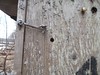 In some cases, a hook-and-eye on a spring has been sufficient.
 For the more tenacious critters, we’ve gone to a hasp closed with a quick link. Links come in various sizes, so make sure you have one to fit the hasp. The link looks something like a carabiner, but it doesn’t squeeze open. Rather, you have to twist the hexagonal part. After a few years in the elements, you will need to give the link a bit of lubricating oil.
Day 111

 Finally, after a dark and cold winter, some color in my Winogradsky column project. The streaks of rusty red are perhaps iron oxidizers, or purple non-sulfur bacteria. And perhaps at the bottom of the column I see some blobs of purple, evidence of sulfate reducing bacteria.
On deck: 22
 The shelf was getting a little unbalanced, with too much fiction, but a tip from NPR’s Books We Love led me to Dreilinger. Of the Thoreau, I’ve got The Maine Woods and Cape Cod to read. The Bellotti is for a book club at work—not my usual cup of tea, but I want to contribute to the discussion. I have promised myself that I will crank through another story in the French parallel text collection; will I ever find time for the Echenoz? Juggling two volumes is too much trouble for the subway.
Suitland Bog
Lynn Rust’s Microbial Ecology class field-tripped to Suitland Bog (a magnolia bog that’s actually a fen). The property was once mined for sand and gravel before M-NCPPC picked up some of the land, while allowing development on another parcel. (In the inexorable logic of new streets being named for what they replaced, Rock Quarry Terrace passes through one of the nearby townhouse subdivisions.)

 In the successional upland accessed by ample parking at the community center, we found the rocky, sandy soil of the Coastal Plain. Virginia Pine (Pinus virginia) is waiting to be overtaken by the beeches and oaks, while Blackjack Oak (Quercus marilandica) hunkers in the understory. Thundering helicopters from nearby Joint Base Andrews are just something you have to deal with.
In the bog itself, we easily found Purple Pitcher Plant (Sarracenia purpurea). According to Lynn and the park ranger, this introduced species is outcompeting the sundews, and is subject to some culls. Yellowing leaves of Sweetbay Magnolia (Magnolia virginiana) were recognizable.
Bisected by a power line cut, the place definitely shows the marks of human influence, and could use some major trash pickup love. I don’t remember, but I reckon that my visit in 2013 was from the other entrance, from the south.
Day 0
 My Winogradsky column project for Microbial Ecology, taught by Lynn Rust. We sampled sediments from the Wheaton Branch stormwater ponds on Dennis Avenue. Hope I added enough egg yolk (S) and not too much newspaper (C)!
We won’t see results for a few weeks.
Mason Neck State Park 2021
 Holiday weekend, and a chance to earn my next badge in the state parks Trail Quest challenge. Somewhat unintentionally, I followed the same trails that I walked last year in late spring. Much quieter this time of year, cloudy-cool and a bit drizzly—glad I brought my hoodie.
 The understory of the woods (holly-oak-beech) is very open; I suspect deer browse pressure. The oaks have dropped an abundance of acorns.
I found a little patch of Strawberry Bush (Euonymus americanus) (a/k/a Hearts-a-burstin’), still in fruit, on a hummock in a very wet spot. And an orbweaver making short work of an unfortunate Eastern Pondhawk.
The thing to remember about the Meadow View Trail, pleasant enough as it is, is that it is a trail to a view of a meadow. You won’t see any meadow along the trail itself.
3:00 for the circuit again, with a lunch break.
Neabsco Boardwalk
Barbara Saffir led a workshop at Neabsco Boardwalk on using iNaturalist and ISO axanthic Green Treefrogs (Hyla cinarea). And we found some!
 The boardwalk trail is rather new—nicely accessible and wide, open to multiple use (jogging, dogs, scooters). While the upland path to the boardwalk could serve for a nonnative invasives workshop, the wetland itself is pretty clean, a major exception being a population of Japanese Knotweed (Reynoutria japonica).
Clifton Institute wildflowers

 A lovely morning walk through the upland meadows of the Clifton Institute for fall wildflowers, led by Bert Harris and staff. I got good photos of Field Thistle (Cirsium discolor) and found Hog Peanut (Amphicarpaea bracteata) in flower. The group met Slender Bush Clover (Lespedeza virginica), Trailing Lespedeza (L. procumbens), and Green Milkweed (Asclepias viridiflora)
(called Green Antelopehorns by iNaturalist). Bert explained how to distinguish New York Ironweed from Upland Ironweed—this is the first time I really got it, with an example of the yellowish pappus of Upland in hand.
Crescent Rock and Limberlost Trails
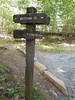 Labor Day means a hike in Shenandoah National Park. I made a keyhole loop with the Crescent Rock Trail and the Limberlost Trail. I was going at Grandpa pace today—mostly my intention was to scout Limberlost for a future project. Common Katydids (Pterophylla camellifolia) were calling at mid-day in the Crescent Rock parking lot.
There are a few of the Limberlost’s famous hemlocks hanging on. There’s a big patch of what appears to be Sweet Birch (Betula lenta), perhaps replacing the hemlocks?
I did find a bit of Tall Milkweed (Asclepias exaltata). And iNaturalist suggested IDs of Silvery Glade Fern (Deparia acrostichoides) (I couldn’t find fertile fronds, dang it) and an ichneumonid wasp, Limonethe maurator.
3.4 miles in 3:30, 120m elevation change.
On deck: 21
 With a little determination (and self-control in the bookstore), I am back to having only one shelf’s worth of books to read.
And yes, I have become the person with two cast recordings of Anyone Can Whistle, two electric hedge trimmers, and two translations of Du côté de chez Swann.
Virginia getaway 2021
My road trip took me to several spots in the Roanoke vicinity.
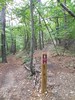 First off was Poor Mountain Natural Area Preserve, known for its population of the hemiparasitic Piratebush (Buckleya distichophylla). I set off down aptly-named loop trail. Some determined peering under foliage turned up two female plants beginning to come into fruit. I also became reacquainted with Galax (Galax urceolata); met a ferny-looking plant that turned out to be Canadian Wood Betony (Pedicularis canadensis); and stumbled across an American Chestnut (Castanea dentata) maybe 10 feet tall.
Buffalo Mountain Natural Area Preserve in Floyd County was recommended by Chris Ludwig as one of the best NAPs to visit in August—he steered me right. I arrived early on a Friday morning, before the tiny parking lot filled up. Oh, so quiet. I heard Ovenbird (Seiurus aurocapilla) (and got a visual) and Scarlet Tanager’s (Piranga olivacea) chick-burr. Not looking for anything in particular, I found a couple specialties of the house: hot pink Allegheny Onion (Allium allegheniense) and Roan Mountain Rattlesnakeroot (Nabalus roanensis) just coming into flower.
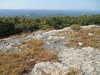
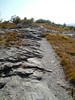 Barrens at the top (about 160 m climb from trailhead) revealed Mountain Ash (Sorbus americana) and an oak that I’m not so sure about.
For fun, I’m trying the state parks trail challenge, so I added two parks to the road trip. Fairy Stone State Park in Patrick County delivered some interesting looks on the Whiskey Run loop: a huge clone of Fan Clubmoss (Diphasiastrum digitatum), Common Elephant’s Foot (Elephantopus tomentosus), and the iNaturalist community pinned down the first robber fly that I’ve found for myself: Red-footed Cannibal Fly (Promachus rufipes).
The trail I intended to take at Smith Mountain Lake State Park was closed, so I followed a trail closer to the lake. The area is very… recreational. But some Blue-fronted Dancers (Argia apicalis) showed up.
Bonus butterfly for the trip, and it proved to be a lifer: On my way home, I pulled up at the Nelson County Wayside south of Charlottesville to stretch my legs and fiddle with the CD player. I chatted with a guy who had stopped to do much the same. But I caught a glint of yellow flickering along the gravel. After the fellow left, I pulled out my camera and snapped away. When I got home, I keyed out my first Sleepy Orange (Abaeis nicippe)!