Stung

Via Utne Reader, Katy Butler interviews Jeff Bridges for the fall 2010 issue of Tricycle:

Movies are a wonderful spiritual playground. The film you actually make is like a beautiful snakeskin that you find on the ground and make a hatband out of. But the making of the movie is the snake itself. That is what I take with me. That includes hanging out with the other actors in the trailer after work, and getting into this position where you’ve empowered another actor to have a power over you, to affect you. That’s a spiritual place to be.

Washington Auto Theater Club

The WATCH adjudication assignments are out for this year. A lot of my shows are still TBA, so I’ll list the places in the metro area I’ll be driving to:

  • Late addition, corrected: Vint Hill, Prince William County, Va.Fauquier County, Va.
  • Woodbridge, Prince William County, Va.
  • Fort Washington, Prince George’s County, Md.
  • Greenbelt, Prince George’s County, Md.
  • Annapolis, Anne Arundel County, Md.
  • Sterling, Loudoun County, Va.
  • La Plata, Charles County, Md.
  • Arlington County, Va.
  • Annandale, Fairfax County, Va.
  • Herndon, Fairfax County, Va.
  • Bowie, Prince George’s County, Md.

In the down under

Two trip reports of illicit underground (sewers, subways, and steam tunnels) explorations of New York by Steve Duncan and Erling Kagge offer different perspectives. Jacki Lyden’s long piece for Weekend ATC is relatively straightforward, albeit with a dose of Radiolab sound effects. Alan Feuer’s diary for the New York Times, on the other hand, takes a hard left turn midway. The story turns into the story of the documentors of the project.

Wednesday, 12:15 a.m.
114 Delancey Street, Manhattan

…there are problems: the entourage has gotten too large. Everyone wants to go into the subways: me and a photographer from The Times; Jacki and an NPR producer; Andrew the videographer; even Will Hunt, the spotter. There were four of us in the sewers; now there are eight. What, I think, has happened to the intimate expedition?

Steve senses the concern and hastily announces that he, Andrew and Erling will go ahead; the rest of us can follow at a distance. I fail to see the point in exploring without the “explorers.” I confront Steve, tell him this is useless. Is this an expedition, or a media event? Disillusioned, I leave.

4:03 a.m.
West 181st Street, Manhattan

From home, I e-mail Steve and Erling: “I understand why you guys wanted to publicize this poetic adventure. … Unfortunately, the thing that wanted to be publicized was slowed down and rendered moot by the distracting number of people you brought in.” I add that it’s become impossible to describe two men on a journey when, in fact, a media army — with sound booms, cameras, video equipment — is in tow. I wish them well, offer no hard feelings.

3:32 p.m.
620 Eighth Avenue, Manhattan

An e-mail and an epiphany. The epiphany: When Ernest Shackleton went to the South Pole in the early 1900s, he himself documented the journey in a diary. Not so, in 2010, in media-soaked New York, where, it dawns on me, the crowd of chroniclers is fitting in its own way.

Another twist in Feuer’s version of the story that is more This American Life than The Gray Lady is the abrupt end to their visit with the woman known as Brooklyn, dweller in the Amtrak tunnel: B.K., her boyfriend, shows up and throws the whole lot of them out.

I’m uncomfortable with Lyden’s lack of reciprocal acknowledgment that another reporter and photographer were accompanying the urban spelunkers.

At any rate, the naturalist in me finds it interesting that one of Duncan and Kagge’s routes follows Tibbetts Brook through the Bronx, a waterway long ago confined underground by pavement.

Sugarloaf Mountain loop

Bands of showers, clouds, and a little sunshine passed over us on Sugarloaf Mountain, on an ANS hike led by Cathy Stragar. Birding on the trail was slow—shreds of mixed winter songbird flocks, a few winter woodpeckers—although a Common Raven (Corvus corax) did oblige by flying overhead and vocalizing. But generally we were able to enjoy the quiet, punctuated from time to time by the patter of some light rain.

Tree life on the mountain is dominated by Chestnut Oak (Quercus montana); there are numerous stands of Mountain Laurel (Kalmia latifolia) filling in the understory. I found a couple sprigs of Spotted Wintergreen (Chimaphila maculata), and Cathy pointed out the first spikes of Skunk Cabbage (Symplocarpus foetidus) emerging from a wet spot.

Cathy set a fairly brisk pace, so we covered the five and half miles of the blue loop trail plus side trip to the summit in 5:15.

hazy viewThis view to the west from the summit is a perspective maintainer, with the gentle curve of the Potomac River offset by the stacks of the coal-fired generating station at Dickerson. Wii juice has gotta come from somewhere.

markerAfter I snapped the landscape, I found one of the survey monuments for the peak at my feet. (Here’s a shinier image of what they look like.)

What should I read next?

Leta mentioned that our friend Amy was looking for scripts to read, just for general background. Everyone else has an idea about what’s important theater to be familiar with, so I figure that I’m entitled to post my own list. Herewith a shortlist of important, entertaining, challenging straight plays (no musicals) from the period 1945 (or thereabouts) to the present. Most were published originally in English. They are marked by psychological complexity and offer staging challenges that can be met in many different ways, depending on the creativity of the team and the resources offered by the performance space. These are in no particular order, just the order that I transcribed them from my scribbled notes.

  • Sarah Ruhl: The Clean House; Dead Man’s Cell Phone
  • Marsha Norman: ‘night, Mother
  • Samuel Beckett: Waiting for Godot
  • Craig Wright: The Pavilion
  • Christopher Durang: Sister Mary Ignatius Explains It All for You
  • Mary Zimmerman: Metamorphoses
  • Lanford Wilson: The Hot L Baltimore; Book of Days
  • Lynn Nottage: Intimate Apparel
  • Jean Anouilh: Antigone (trans. Lewis Galantière)
  • Tony Kushner: Angels in America: Millennium Approaches and Perestroika
  • Arthur Miller: Death of a Salesman
  • Neil Simon: Barefoot in the Park
  • Nicky Silver: The Food Chain; Fat Men in Skirts
  • Harold Pinter: Betrayal
  • Tom Stoppard: Rosencrantz and Guildenstern Are Dead
  • Alan Ayckbourn: “The Norman Conquests:” Table Manners; Living Together; and Round and Round the Garden: I would love to persuade three local community theaters to produce this trilogy in simultaneous or sequential rep
  • Caryl Churchill: Top Girls: fabulous parts for women, something always in short supply in community theater
  • John Pielmeier: Agnes of God
  • Bertold Brecht: The Good Person of Szechwan
  • Richard Greenberg: The Violet Hour

I made my case for a few of these titles and playwrights for inclusion in Silver Spring Stage’s upcoming season. Decisions have not yet been made. We’ll see.

To be free

A slightly belated tribute to Billy Taylor, who passed away this week after a long long career, as reported by A Blog Supreme. Several years ago, I attended a series of “jazz appreciation 101” talks by Dr. Taylor, given in Kennedy Center rehearsal space. He was a welcoming, generous teacher. One of the things I remember is his observation that you can learn a lot about jazz harmony just by mastering Billy Strayhorn’s “Lush Life.”

My year in hikes and field trips, 2010

Lots of botanizing on these various trips, but I did pick up two life birds in the field this year.

2009’s list. 2008’s list.

The year in review, 2010

The first sentence (more or less) of the first post of each month from this blog:

  • 1 January: 11D points to a round-up of recommendations on the whats and the hows of purging books from your library.
  • 6 February: The Birding Community E-Bulletin points to two reports: first, a recent summary by Robert Rice of the Smithsonian Migratory Bird Center on the supply of and market for the SMBC’s branded Bird Friendly® Coffee.
  • 2 March: Language Log contributor Geoff Nunberg explores new crannies of curmudgeonliness.
  • 1 April: Not to be outdone by The Flibbertigibbet in documentary comprehensiveness (although I yield in the area of single-minded devotion to the craft), herewith my theater viewing statistics for the past twelvemonth.
  • 1 May: A local nonprofit company works to bring together two (seemingly incompatible) interests of mine: theater and nature.
  • 5 June: We might be forgiven for wondering why Woolly Mammoth, having built its fabulous proscenium-styled performance space, enables its directors and designers to reconfigure it variously, as in the recent Full Circle and Clybourne Park.
  • 2 July: Just a quick snap to mark my completion of the Fairfax Cross County Trail.
  • 6 August: WordPress 3 and it’s time for a theme change.
  • 2 September: Sweet profile by Lydia DePillis of Greater Greater Washington’s David Alpert.
  • 2 October: The concrete and support columns are beginning to resemble a station platform; conveniently, it’s right where the Wiehle Avenue stop will be.
  • 2 November: My term project for my meteorology class is fairly simple: photograph and identify as many cloud types as possible.
  • 2 December: Wikipedia’s Silver Line entry recently achieved good article status.

The year in review, 2009, 2008, and 2007.

Superior Donuts

Tracy Letts returns to the trope of onstage violence with Superior Donuts, set in a seedy Uptown Chicago neighborhood. And the impressive fight, choreographed by Robb Hunter, is well executed by Richard Cotovsky (as donut shop proprietor Arthur) and Chris Genebach (as small-time criminal Luther). But the acting laurels go to Johnny Ramey in an endearing performance as Franco Wicks, an African-American youth with issues; in the course of working through them, he helps Arthur to master some of his own.

Arthur, a Vietnam-era draft evader who still hasn’t given up his beard and pony tail, has made it his life’s work to keep other people at arm’s length. So perhaps it’s a character choice, or perhaps just the length of the show’s run (it opened 10 November), that Cotovsky in his monologues of remembrance doesn’t take his time and make a connection to us in the audience.

Gregor Paslawsky does well with the character of Max, a neighboring merchant with designs on Arthur’s real estate, shifting from menace to exasperated comedy with ease.

The ground plan of Russell Metheny’s set excellently solves the familiar problem of actors being trapped behind a store counter by turning around the U of display case and seating so that its open section is downstage, placing the street entrance door directly upstage. The scene transition that calls for Arthur’s shop window to be boarded up is also smoothly handled.

  • Superior Donuts, by Tracy Letts, directed by Serge Seiden, The Studio Theatre’s Metheny Theatre, Washington

An alternative

They are the worlds that obey me, kinder and finer worlds: in many of them, for example, I’d have no teeth.

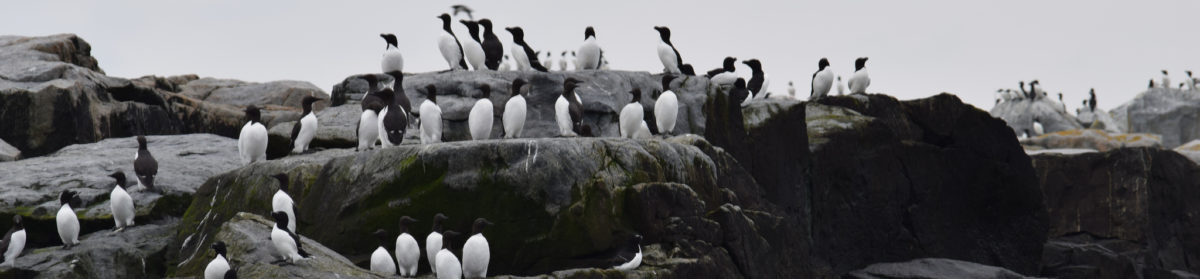
Because I believe I’d do better with a beak. So why not have one? That shouldn’t be impossible. I feel a beak could make me happy, quite extraordinarily content: sporting something dapper and useful in that line—handy for cracking walnuts, nipping fingers, tweezing seeds. Not that I’ve ever fancied eating seeds, but one can’t predict the path of appetite.

And beaks come in different sizes: that’s a plus, along with the range of designs. The toucan would be good for parties, shouting, grievous bodily harm. Ibis: mainly funerals and plumbing. Sparrow: best for online dating and eating crisps.

—A. L. Kennedy, “Story of My Life”