DIY Science

I participated in the inaugural DIY Science day at the Clifton Institute, led by co-Director Eleanor Harris. It’s an adult-tailored version of the Institute’s Young Naturalists program. Not too many rules: explore the field station, formulate a research question, do some science, and present your results. The vibe is a little like the Serendipity Days practice when I was with NPR’s Digital Media.

As I wasn’t sure how the day would play out, I planned a research question ahead of time: roughly, can we measure any differences between two species of oak (White Oak, Quercus alba, and Northern Red Oak, Q. rubra), as sampled as dead leaves from my home and the Institute? The red oaks are well-known for showing more tannins than the white oaks. Is there a way to measure that difference?

So I brought some leaves picked from my backyard, and then at the field station collected some more in the woods. First complication: I was hoping to also analyze another species from the red oaks, Q. falcata, only to find that there are no records of Southern Red Oak at Clifton.

Second complication: methods and materials for measuring tannins were a bit beyond the capabilities of the research station, or so I surmised. However, some follow-up searching suggests some simpler, alternative methods.

specimenAs a result, staffer Bridget Bradshaw suggested some other tests that might yield some interesting results. She also brilliantly suggested a simple way to make equal measured samples from my dead leaves: 10 punches with a paper hole punch from each leaf. No mussing about with weighing something in the sub-gram range. Samples went into small lidded yogurt jars (apparently well-stocked at the research station, and easy handled by the kiddos).

  • Simple chromatography with a bit of acetone and (coffee) filter paper.
  • Measuring acidity of samples steeped in water and set in the sun for 30 minutes.

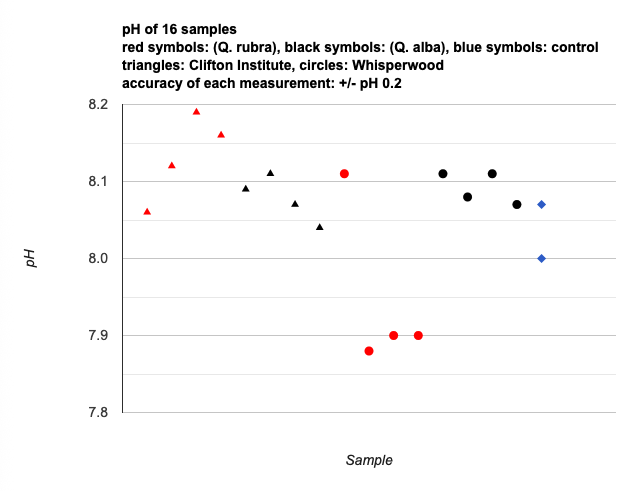
pH samplesThe chromatography didn’t show any results after the hour or so that we had available. But the pH measurement did return some results, on the face of them counter-intuitive. Here’s our 16 pH specimens, sunning on the Clifton Institute porch.

All the White Oaks sampled, as well at the Red Oaks at Clifton, measured more basic than the control (the plain spring water that was used to steep the samples). A possible explanation: fresh oak leaves will measure on the acid end of the scale, but after some decomposition as dead leaves, the acidic compounds leach away preferentially, leaving more basic dead leaf material.

Third complication: the pH meter that we used took several minutes to produce a reading, and readings shifted about as we took our measurements.

For “final presentation” to the group, I drew a quick, crude graph with a Sharpie. I’d like to polish it a bit for presentation here. Update: After some scuffling with the Google Charts API, I managed to produce the following graphic. (It’s a screenshot, not live; the API and vanilla WordPress don’t play well together.)

More research needed: I’d like to try this experiment on some fresh leaves and with a more reliable pH meter.
Some links: 95

New York Botanical Garden

what's the buzztiny whitesA few snaps from my trip to the New York Botanical Garden on a very warm, generally sunny day. The place is huge! I budgeted a good chunk of time in the Native Plant Garden, site of the memorial to Elizabeth Gertrude Knight Britton. A couple of less common plants in flower were a mountain mint, Pycnathemum curvipes (left) (hmm, USDA PLANTS says that this not native to New York, but only to North Carolina and south) and Flowering Spurge (Euphorbia corollata) (right). Newcomb points out that the delicate white flower parts on the spurge are actually bracts, not petals.

cascadeIn the nearby Rock Garden, this engineered cascade is quite lovely.

citizen scienceIn the less-tended bits of the grounds is the Thain Family Forest. An interpretive sign calls out the importance of citizen science, and just a few steps down the trail is a Picture Post.

cycad selfieAfter lunch break, I spent most of my time in the conservatory. I do love me some cycads.

BPP in the literature

It’s very gratifying to read this acknowledgement:

The authors are indebted to the original BPP [Bird Phenology Program] observers and coordinators who collected the extensive data that comprise the BPP and were used here…. Thank you also to the BPP participants from around the globe who have worked to revive those records by digitizing and transcribing them in recent years.

The paper: “Long-Term Trends In Avian Migration Timing For the State of New York,” by Jessica Zelt, Robert L. Deleon, Ali Arab, Kevin Laurent, and Joel W. Snodgrass.

I haven’t transcribed cards for a while; it’s time to get back to it.

One of tens of thousands

Life achievement unlocked: today for the first time I marched in a major political protest on the streets of Washington, D.C. As a member of the March for Science, I walked from the Washington Monument grounds, within sight of the White House, down Constitution Avenue to 3rd Street, on the fringe of the Capitol grounds. Weather conditions at the rally were less than ideal (drizzle and showers), but I stuck to the principle that there is no such thing as bad weather, just inappropriate clothing.

getting ready to marchI walked with a group well-organized by Audubon Naturalist Society (that’s us mustering on the steps of the National Museum of Natural History). ANS’s march leaders had the brain wave of bringing decorative bird spinners as a rallying point. The spinners (and the stylin’ t-shirts) brought us lots of attention, especially from journalists major and minor.

Some links: 72

Many conservation-oriented links piling up on my virtual desk, unremarked—so this needs must be a roundup post.

  • Sharman Apt Russell describes her experiences collecting phenology data for Nature’s Notebook.
  • Caren Cooper summarizes the findings in her recent paper in the Journal of Wildlife Management: birders and hunters alike are more likely to engage in conservation-supporting actitivies. Cooper’s “conservation superstars” are birders who are also hunters: these people are even more likely to donate money for conservation and do other things to preserve our legacy.
  • Jason Goldman sings the praises of shade-grown coffee from an unexpected part of the world: Ethiopia, the land where Coffea was first domesticated.
  • And Goldman summarizes a paper by A.M.I. Roberts et al., working with 222 years of phenology data collected by Robert Marsham and his descendants from the family estate in Norfolk, UK. For certain tree species, “winter chilling” turns out to be a more important factor determining leaf out than the warmth of “spring forcing.”

Into the spotlight

Citizen science has an important role to play in research in a wide range of biological disciplines, as Caren B. Cooper et al. write in a recently-published paper in PLOS ONE:

… the quality of data collected by volunteers, on a project-by-project basis, has generally been found as reliable as the data collected by professionals in community-based research and contributory projects across a wide variety of subjects, including lady beetles, moths, wolves, trees, air pollution, light pollution, plants, pikas, invasive plants, and bees.

However, volunteer data collection is largely “invisible:” in the reports that Cooper et al. examined, citizen science participation was recognized in a paper’s acknowledgements section, if at all. The authors make the case that volunteer data collection should be more widely appreciated for its scientific value. Furthermore, as Cooper says in a supporting blog post by Hugh Powell, participants should self-identify as citizen scientists, not merely as, say, birders or volunteer water quality monitors.

“…people who have been doing a hobby for years have tons of expertise, and they can make a very real contribution.”

The research paper also reinforces the point that volunteer data collection can go where full-time professionals can’t, into spatiotemporal domains spanning decades and land masses. And often, data collected for one area of study can be repurposed to examine some other phenomenon, as we see with various phenology datasets being used to understand climate change.

Back to nature

Joshua J. Tewksbury et al. make the case for restoring natural history’s importance to answering questions of public health, food security, and biology as a whole. They see citizen science projects as an important means of working with big data that can’t be developed in the lab or in silico.

As evidence of natural history’s contribution to public health, they relate the anecdote of a simple means of blunting cholera epidemics: filtering drinking water through the cloth of human garments.

The discovery that Vibrio cholerae has free-living populations associated with copepods and other zooplankton (Colwell and Huq 1994) forms the foundation of model predictions of temporal and spatial changes in human cholera outbreaks, because these models are based on the dynamics of the zooplankton and phytoplankton on which they feed. With this natural history in hand, public health experts now use satellite sensors to monitor phytoplankton chlorophyll as an early-warning system for cholera outbreaks. The same discovery also explains why filtering polluted water through cloth is surprisingly effective in reducing exposure to cholera: although the cloth does not capture V. cholerae individually, it filters out the zooplankton to which most V. cholerae are attached (Huq et al. 1996).

And, in the area of natural history and recreation and conservation, the Federal Duck Stamp program gets a shout-out:

It is often the collective focus on natural history by hunters, fishers, wildlife watchers, and conservationists that allows consensus-based management of fish and game species. The waterfowl conservation movement in the United States serves as an example. This partnership was set in motion in the early twentieth century by observations of large-scale duck mortality caused by botulism brought on by invertebrate die-offs in wetlands and by lead poisoning in high-intensity hunting locations. In both cases, observations by hunters and bird watchers alerted managers to the issue. The initial focus on disease was fortunate, because it provided a common enemy, and, at least for botulism, the most effective management centered on the designation of federal and state bird refuge areas in wetlands (Bolen 2000). More generally, the many groups that came together to change state and federal policies around these issues led to the creation of powerful hunting and conservation groups. These collaborations also led to a hunting license fee structure that supports the more-than-500-unit federal wildlife refuge system in the United States. The success of waterfowl conservation efforts, and the hundreds of other species that they support, comes in large part from the diverse interest groups that recognized the importance of basic natural history in setting management and policy objectives and that created a stable funding stream to support the collection of that information.

Some links: 70

A roundup of conservation and natural history links:

  • A team at Towson University has launched a microsite and apps (for Android and iOS) for tracking the spread of the highly invasive Wavy-leaf Basketgrass (Oplismenus hirtellus ssp. undulatifolius).
  • Janet Fang summarizes a paper by Railsback and Johnson: simulations of coffee plantation activity indicate that 5% land coverage in trees maximizes coffee yields. The overstory of trees reduces the amount of space for coffee shrubs, but it invites birds, who forage on destructive borer beetles.
  • Nancy L. Brill describes the survey that a team of entomologists made of invertebrate life in 50 ordinary Raleigh, N.C. homes. The typical house was host to 100 different species of arthropod.

    Several families were found in more than 90 percent of homes: gall midges (Cecidomyiidae), ants (Formicidae) and carpet beetles (Dermestidae), along with cobweb spiders (Theridiidae), dark-winged fungus gnats (Sciaridae), cellar spiders (Pholcidae), scuttle flies (Phoridae) and book lice (Liposcelididae). Most houses also had dust mites (Pyroglyphidae).

    Pics and interpretation at Arthropods of Our Homes.

  • Tovar Cerulli argues that hunters and non-hunters have more in common than they might think.

    When clashes occur, it is all too easy to fall back on reductive notions about liberal, elite environmentalists and conservative, redneck hunters—the “greens” versus “the hook-and-bullet crowd.” With partisans on both sides invoking stereotypes and the media portraying hunters and environmentalists as opponents, it is tempting to imagine stark lines between the two.

    But such divisions are too simplistic.

  • An American Bird Conservancy post makes the connection between coffee farming… and hummingbirds!
  • The Birding Wire picked up my profile (for Friends of the Migratory Bird [Duck] Stamp) of Quivira National Wildlife Refuge.
  • A leader in Nature highlights a paper by Joshua J. Tewksbury et al., which calls for a revival in the practice of natural history. (I have the Tewksbury paper bookmarked but haven’t read it yet.)

    As natural history has been de-emphasized, molecular biology, genetics, experimental biology and ecological modelling have flourished. But here is the problem: many of those fields ultimately rely on data and specimens from natural history….

    No biology student should get a diploma without at least a single course in identifying organisms and learning basic techniques for observing and recording data about them.

Leta

A milestone: 5

Congratulations to the Bird Phenology Project and its volunteer digital transcribers. Over the weekend, the project’s one-millionth migration record was transcribed to digital format. An observation of a House Wren (Troglodytes aedon) (AOU code 721a) by Vernon Bailey in Tierra Amarilla, New Mexico Territory in September, 1904 was the card that did it.

(Bailey was the husband of Florence Merriam Bailey, in whom I am currently interested.)