 Live from Snowpocalypse ’09: I shoveled out about a foot of accumulation in front of my house, and the snow is still falling. The hour-to-hour forecast says we’re going to get another jolt this evening.
Author: David Gorsline
Prior art
Oh, dear: Samuel G. Bailey is suing Paramount Pictures and other entities, claiming that a screenplay of his was plagiarized in the making of the 2006 film Dreamgirls, as Melissa Castro reports. The story doesn’t indicate whether Tom Eyen is also named in the suit.
TMLMTBGB: 3
The most effective pieces in this year’s offerings (seen on December 8) don’t have much to do with one another. Some depend on Eliza Burmeister’s goofy gymnasticism, like “Zen and the Art of Flight,” or the politically charged “Dear NRA suggestion box: I would prefer not to be shot in the head.” Like comedy’s threes, it’s the third repetition of the final image of this piece, run in slow motion, that is the visceral payoff. Others are more ensemble pieces, like “Windsprints.” Bilal Dardai’s self-referential multi-layered sound soup “With All the Time I’ve Wasted Browsing the Wikipedia…” is another winner. And then there’s Mary Fons’s exuberant performance art “‘Crush’ (with Potato Stamp Stars)” to bring us back to the creative nexus of second grade art class.
Memo to front-row ticket holders: wear something waterproof.
- Too Much Light Makes the Baby Go Blind, created by Greg Allen, written, directed, and performed by The Neo-Futurists, Woolly Mammoth Theatre, Washington
Some lists: 6
Nearby cities that I have never visited (expressways and airports don’t count):
- Atlanta
- Detroit
- Nashville
- Memphis
- Montreal
Late-arriving post card from New York
Leta and I visited her cousin and various family in New York for the Thanksgiving holiday. It was a trip of initialisms: Sam explained all about TBIs; we rode the new R-160s, which are running on the Broadway line under a pilot program, which line Leta has taken to calling the NRBQ line. We found a nifty organic eatery in Brooklyn Heights called Siggy’s (Aliens eat free!); brunch with Dennis at Junior’s.
 Museum stops for the Lower East Side Tenement Museum and the new Rubin Museum of Art in Chelsea: works of art performed for the removal of physical or mental obstacles.
 Various gawping at the streetscape.
Catoctin Mountain Park
I turned in my research report on Catoctin Mountain Park for my geology class last week. Unfortunately, I chose an area to write about that doesn’t have a full geologic map at the 15-minute level in print, so my coverage of the geologic structures is a little thin. And I really didn’t have time to get out to a library to check what resources were available. But I like the snapshots that I was able to incorporate into the report.
Stranger and stranger
Mycoparasitism at Botany POD.
The recipe project: 2
For our family Thanksgiving dinner, I was asked to bring my spicy cranberry chutney. I’m not sure whether this is because it’s about the only holiday dish I know how to make, or because it’s the only one that my friends trust me with. At any rate, I follow this recipe from an old number of Gourmet (November 1987), which rests on the top of a short stack of similar magazines in my kitchen. It’s on the same page as a recipe for tasty cranberries in chocolate sauce that I haven’t made since my Susan days. The chutney doesn’t take too much time to make, especially if you are like me and you skimp on the chopping. I like big chunks of fruit in my chutney. Below, my paraphrase of the recipe:
Cranberry Chutney
- 1 lemon
- 1/2 cup dried apricots, chopped as fine as you care to
- 1/2 cup dark brown sugar, firmly packed
- 1/2 cup raisins
- 1 12-ounce bag of fresh cranberries, rinsed and picked over
- 1 Granny Smith apple, peeled, cored, and diced (1/4 inch or so)
- 1/4 cup crystallized ginger (to be found probably somewhere in the produce section at your supermarket), chopped
- 1/2 teaspoon dried hot red pepper flakes
Grate the lemon rind to make about 1 teaspoon. Squeeze the lemon to make about 1/4 cup of juice.
In a saucepan combine the apricots, the brown sugar, the raisins, and 1 cup water. Bring the liquid to a boil, stirring, and simmer the mixture for 5 minutes. Add the cranberries, the apple, and the lemon rind, simmer the mixture until most but not all of the cranberries have popped, about 15 or 20 minutes. Stir in the lemon juice, the ginger, and the red pepper flakes.
Serve at room temperature or chilled. Makes about 3 cups.
This last time out, I was unsure of the state of my spice rack, so I was inclined to add more pepper. But Leta took a quick taste test and assured me that half a teaspoon of pepper is good.
Inspiring
Quiet, shush, something mysterious is happening, here before us is a fifty-year-old author, on his knees at the altar of art, creating, thinking about his masterpiece, about its harmony, precision, and beauty, about its spirit and how to overcome its difficulties, and there is the expert thoroughly studying the author’s material, whereupon the masterpiece goes out into the world and to the reader, and what was conceived in utter and absolute agony is now received piecemeal, between a telephone call and a hamburger.
—Witold Gombrowicz, Ferdydurke, ch. 4, “Preface to ‘The Child Runs Deep in Filidor'”
Ferber decoded: 4
I came across the following turn of phrase in Chapter 13 of So Big. Dirk has matriculated at Midwest University (one of the few Chicago places that Ferber fictionalizes in the novel, it being an amalgam of Northwestern and the U of Chicago), and has befriended an Unclassified student, a woman in her thirties. The U catalogue describes them:
Persons at least twenty-one years of age, not seeking a degree, may be admitted through the office of the University Examiner to the courses of instruction offered by the University, as unclassified students. They shall present evidence of successful experience as a teacher or other valuable educative experience in practical life… They are ineligible for public appearance… [emphasis in original]
Aha, an early reference to what we would now call academic eligibility. But we’re not necessarily talking about playing football. A number of the Chicago Alumni Magazine from 1907 describes what a public appearance can entail:
Public appearance is defined as any inter-collegiate contest, or participation (1), in an oratorical, dramatic or musical exhibition; (2), in the official management of any other exhibition; or (3), in official service on any publication under the University name, in connection with which any admission or subscription fees are charged.
In another passage, we witness the evolution of pronunciation. Goethe Street in Chicago is pronounced in any number of ways by the locals (including something approximating the original German), GOE-thee being popular, but I’ve never heard this one:
Mrs. Emery was interested in the correct pronunciation of Chicago street names.
“It’s terrible,” she said. “I think there ought to be a Movement for the proper pronunciation. The people ought to be taught; and the children in the schools. They call Goethe Street ‘Gerty’; and pronounce all the s’s in Des Plaines. Even Illinois they call ‘Illinoise.'” (ch. 15)
The Royal Family
Not even a minor technical derailment in the third act can hinder the momentum of this venerable piece of American theater, which first appeared in 1927. This light comedy still has the power to summon chuckles, albeit not guffaws. The first act’s biggest line can perhaps only be played for applause instead of a laugh, as it is in MTC’s production. Kaufman’s gift for mayhem blends well with Ferber’s deep-rooted sense of family tradition—whether she’s writing about Midwestern farmers or here, the Cavendishes, a slightly veiled stand-in for the talented and mercurial Barrymore family of actors at the top of the American twentieth century. It is a play that calls up W-words to describe it: waspish, wistful, wacky.
Director Doug Hughes spins up the tempo to near-farce levels, overlapping as much expository dialogue as he can and more. A booming sound effect for the front door (about which I am ambivalent) sets a bass drum rhythm that keeps the show on pace to stay under the three-hour mark.
Jan Maxwell as Julie, flinging herself about the stage in the first act like the colt she once was, is nicely balanced by Ana Gasteyer as the grasping, talent-free Kitty. In early scenes of bickering with her husband Herbert (John Glover as a graying leading man), Gasteyer’s elastic mug looks like she’s just gulped a glass of vinegar. However, as the frenzy spirals up in the second act, both of the ladies’ performances skate on the edge of caricature.
Reg Rogers brings the swash and buckle as rakish Tony (the would-be John Barrymore), especially in a very good fencing sequence at the top of Act 2 with Rufus Collins.
A meticulous, beautiful two-and-a-half level set by John Lee Beatty is lit by Kenneth Posner (who places countless practicals in this grand New York apartment).
- The Royal Family, by George S. Kaufman and Edna Ferber, directed by Doug Hughes, Manhattan Theatre Club, Samuel J. Friedman Theatre, New York
Fela!
The set (panels of corrugated tin) for Bill T. Jones and his collaborators’ new production spills out into the auditorium of the Eugene O’Neill Theatre (even as far as the exit doors), promising to break the boundaries between performance and viewer. As we enter, the ten-piece band, led by Aaron Johnson, is already rocking. Yes, there will be dancing in the aisles.
What the evening delivers is not quite so revolutionary, but entertaining nonetheless. This review of songs drawn from the work of Fela Anikulapo-Kuti, Nigerian musician and activist, is brought off with high energetic athleticism, heart and soul, and fiery politcal rage. The book for the musical, however, is inconsequential and choppy: Fela is haunted by the ghost of his mother Funmilayo, who apparently died in the course of a government raid on Fela’s compound. It is his mother, we can only conclude, who actually accomplished more towards reform in West Africa in the 1970s. Fela takes a spirit journey (admirably realized with fancy light effects, video projections, and lasers) to reconcile with her, and then the show’s over. (Alas, some of those lighting effects tend to blind us in row Q.)
Jones’s production doesn’t put a face on the corruption against which Fela (on this evening, the charismatically muscular Sahr Ngaujah) militates; there’s no dramatic arc to the work. As an audience member, one always feels vaguely manipulated when asked to stand and perform a bump-along of hip-shaking dance moves. And the jokey passage about crap and marijuana should be cut.
The unseen (but not unheard) star of this show is Stuart Bogie on tenor and percussion, who ghosts the wailing sax played by Fela.
(Disclosure: I saw this production thanks to the generosity of one of the technicians on the production staff.)
- Fela!, conceived by Bill T. Jones, Jim Lewis, and Stephen Hendel, music and lyrics by Fela Anikulapo-Kuti, directed and choreographed by Bill T. Jones, Eugene O’Neill Theatre, New York
Wolf Rock, Chimney Rock
Turkey Vultures were kettling above the toll road to Leesburg as I set out for Catoctin Mountain Park in Frederick County, Maryland on this unnaturally warm and sunny November day. Some hiking, some field work in support of the paper that I am writing about the park for my geology class.
From the visitors’ center, I followed the clockwise loop suggested by PATC trail guides. The trails in the park are not blazed, but are wide and generally easy to follow, even when covered with the hazard of the season, slippery leaf litter. The side trip to Cunningham Falls is perhaps not worth the bother: the way to the falls is popular and boardwalked.
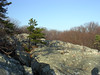
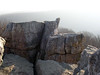 Back on the main circuit, I climbed to the Blue Ridge Summit Overlook (600′ from my starting point), snapping images of the Catoctin metabasalt. Crossing back to the east, I entered the region of the Weverton quartzite, exposed as Wolf Rock (at left) and Chimney Rock. I found a nice small boulder of Weverton conglomerate, too. Mountaintop bird life was sparse: I was a little surprised to find no juncos. A raven quorked along the way; a nuthatch didn’t seem concerned; a Pileated Woodpecker was rattling the doorknobs of a pine tree.
A little pressed for time and daylight, I followed the guide’s backtrack route, getting back to the car in 3:50, covering about 7.5 miles. My notes say that I covered a 8.3-mile circuit in 1995 in 3:30. I guess those were someone else’s legs.
Good intentions
Ariel Kaminer realty-checks volunteering at a soup kitchen for the holidays:
So though [Joel] Berg [executive director of the New York City Coalition Against Hunger] appreciates the thought, he says the best way to contribute is to lend your specialized abilities, such as legal or computer skills.
“The truth is, spending a few hours at a food pantry or soup kitchen helping people apply for food stamps will do a lot more to end hunger than months serving soup or moving cans around,” he said.
Nature is never finished
Randy Kennedy visits Robert Smithson’s Spiral Jetty with conservators from the Dia Art Foundation, who have devised a low-tech way to document the structure’s changing condition year to year.
…the institute, which often works in countries where conservation projects are carried out on shoestring budgets, came up with a remarkably simple solution: a $50 disposable latex weather balloon, easily bought online.
Along with a little helium, some fishing line, a slightly hacked Canon PowerShot G9 point-and-shoot digital camera, an improvised plywood and metal cradle for the camera and some plastic zip ties (to keep the cradle attached and the neck of the balloon cinched), a floating land-art documentation machine was improvised, MacGyver-like.
Submerged by the rising waters of Great Salt Lake in the 1970s, the piece is now exposed to the air, covered with a layer of salt, and subject to alteration by human visitors.