Always good advice: from Elisabeth Sherman with the Whitney:
So, if you have a… negative gut reaction, one of defensiveness or fear or anxiety or rejection, maybe try to move past that and see what’s available afterwards.
theater, natural history and conservation, the utterly mundane, and Etruscan 8-tracks
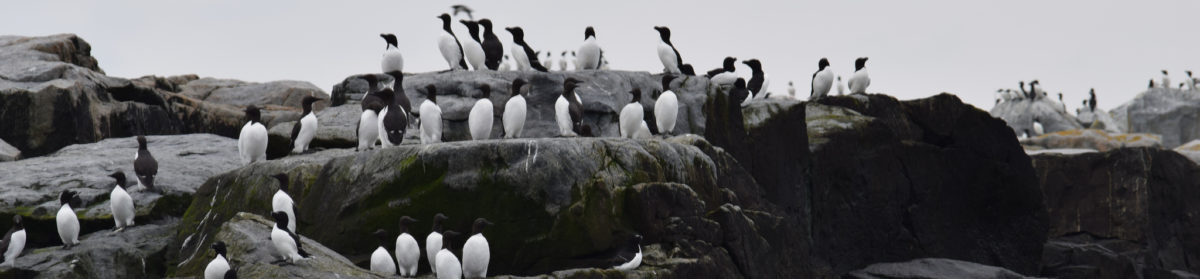
Always good advice: from Elisabeth Sherman with the Whitney:
So, if you have a… negative gut reaction, one of defensiveness or fear or anxiety or rejection, maybe try to move past that and see what’s available afterwards.
Kriston Capps profiles D.C. artist Kenneth Young, one of the Washington Color School painters (Morris Louis, Kenneth Noland, Alma Thomas, and others). He explores an unintended happy consequence:
… the collapse of the Corcoran Gallery of Art, … for better or worse, brought Young and many other Washington painters to greater prominence. The 2014 court-ordered agreement that dissolved the historic Corcoran Gallery of Art and College of Art + Design—handing the collection over to the National Gallery and the college to George Washington University—divested hundreds of paintings by D.C. artists (and thousands of other artworks) to the nation’s official art treasury. When the East Building reopened in September, the new installation of the permanent collection included 43 artworks on view from the Corcoran’s holdings.
Sidebar: a timeline of the Washington Color School.
Pat Padua reports that Artomatic is coming back to Crystal City for 2017.
George Belcher watches the slow fading of New York diner culture.
After the Cafe [at 97th Street and Columbus] succumbed in 2005, I spent months looking for my next “third place.” Diner regulars can be particular. The ambience has to be friendly but not intrusive, the sound level low but not funereal, the smell a little greasy but not cloying, and the décor more utilitarian than fussy. I eventually settled in at the Metro [on 100th Street and Broadway].
How else can we explain the fact that there is no physical unity to the work of art? What does a urinal have in common with a work on canvas, or a song, or a building, or an altarpiece? Artworks are dead in themselves, like mere noise or useless stuff. We bring them to life by putting them to work in thought, conversation, and appreciation. They have power in the way that jokes have power, as moves in a game of communication and reflection. Maker and public jointly undertake the work that makes art possible.
—Alva Noë, Strange Tools: Art and Human Nature, p. 137
I wish that I could put it on my upcoming list, but I will just have to enjoy it from afar: The Floating Piers, by Christo, is installed on Italy’s Lake Iseo through 3 July.
Andy Goldsworthy talks to Terry Gross.
A reason to get back on the Orange Line: Artomatic is coming to New Carrollton at the end of the month, as Bob Niedt reports.
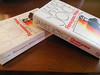
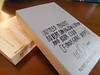 I am one of the newest members of Conrad Bakker’s Untitled Project: Robert Smithson Library and Book Club. My copy of the Wake is the 14th printing (June 1973) of the Viking Compass edition of 1959. As you can see, the cover details are a little different from the one that Smithson owned.
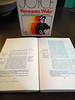 What Bakker’s carved and painted replica lacks in readability, it beats my book for durability. The binding is badly cracked, and I’m not sure that it would hold up to a second reading (I made it all the way through in the summer of 1986).
A lovely simile linking the cinematic, literary, and pictorial worlds, from Anthony Lane’s review of P. T. Anderson’s adaptation of Thomas Pynchon’s Inherent Vice:
As a lyricist of California light, Pynchon is rivalled only by Richard Diebenkorn, who spent some twenty years painting his Ocean Park series in Santa Monica, and I doubt whether any director—dead or alive, Altman or Anderson—could really conjure a style to match the long surge of a Pynchon sentence as it rolls inexhaustibly onward.
In honor of the opening of Washington Dulles International Airport 52 years ago: a stunning gallery of images of the Eero Saarinen-designed airport under construction, photographed by Balthazar Korab, and donated to the Library of Congress.
Book me a motel in the Berkshires: Mass MoCA is set to announce a long-term partnership with James Turrell, setting aside 35,000 square feet of new exhibition space for several of his works.
Carol Vogel reports on the restoration of the Metropolitan Museum of Art’s Adam, a 15th-century marble by Tullio Lombardo, which is again on display. The sculpture was smashed into dozens of pieces when its supporting pedestal gave way, in 2002. Vogel notes “a new attitude adopted by museums around the world to share such innovative work not just professionally but with the public,” although concerns had been expressed (as reported by Randy Kennedy in 2010) about the slowness of the reconstruction as well as lack of media access. In any event, now that the sculpture is back, the museum has produced an impressive suite of videos summarizing the story.
Related: Restoration of a Mark Rothko.
Kriston Capps mounts a thoughtful defense of the unloved, unlovely FBI HQ.
So much of the criticism of Brutalism treats it like a failed quiz—a problem to be solved, a problem for which there are correct answers, not a piece of history that could be preserved and improved upon.