
 Documenting and celebrating Dark Star Park Day in Rosslyn.
Category: Art and Architecture
Some links: 91
- Mr. and Mrs. Pickles have three baby tortoises! Cuter than cute.
- They were gone before I knew what to call them: David W. Dunlap of The New York Times remembers reader ads.
- “I can’t define it, but I’m against it.” Also from the Times, Nate Cohn attempts a definition of woke and what it portends.
… much of what woke is grasping toward: a word to describe a new brand of righteous, identity-conscious, new left activists eager to tackle oppression, including in everyday life and even at the expense of some liberal values.
* * *
In the most extreme case for Democrats, the backlash against the new left could end in a repeat of how New Left politics in the 1960s facilitated the marriage of neoconservatives and the religious right in the 1970s. Back then, opposition to the counterculture helped unify Republicans against a new class of highly educated liberals, allowing Southern opponents of civil rights to join old-school liberal intellectuals who opposed Communism and grew skeptical of the Great Society. The parallels are imperfect, but striking.
- Isobel Novick stans webbing clothes moths (Tineola bisselliella).
These moths, unfortunately for those with infestations, have other behaviors that contribute to their indestructibility. They can metabolize their own water as a byproduct of keratin digestion, so access to water is not a dealbreaker for survival. What kind of organism can create its own water? This moth has evolved to be an efficient, dynamic, super-survival machine. They are incredibly temperature tolerant, with the ability to survive as eggs or larvae for several days at broiling temperatures as high as 95 degrees F and as far below freezing as 5 degrees F. They are attracted to the smell of woolens, and once established, send pheromonal signals to nearby moths to invite them to party. To add to their tank-like nature, webbing clothes moths can digest toxic metals like arsenic, mercury, and lead. They have no problem metabolizing synthetic materials or chewing through soft plastics. They have even been found on mummified human remains and have been around long enough to be mentioned in the Bible.
- 17th-18th century tomfoolery: dummy boards.
Awesome!
What Will Art Look Like in the Metaverse?, by Dean Kissick.
In late-19th and early-20th century Paris, Rousseau and his contemporaries (Paul Gauguin, Georges Seurat, Pablo Picasso, etc.) were busy inventing bohemian modernity, creating new ways of living and of seeing the world. In our century, that visionary role appears to have passed from the artists to the engineers, to Zuckerberg and his ilk. Who else tries to invent new universes? Who dares spin grand utopian fantasies? Artists don’t anymore. It’s Silicon Valley’s Promethean founders who try — and routinely fall short.
Upcoming: 56
I need another trip to North Adams. A James Turrell Skyspace will open at MASS MoCA in May.
Some links: 87
Trees and the three-lettered insects that munch on them:
- To protect Eastern Hemlock (Tsuga candensis) from the Hemlock Woolly Adelgid (Adelges tsugae) (HWA), researchers are exploring natural genetic resistance, biological controls, and forestry techniques: Gabriel Popkin.
- Emerald Ash Borer (Agrilus planipennis) (EAB) is clobbering native ashes (Fraxinus spp.) in the eastern U.S. Could doomed trees be turned into commercially useful building materials? Yes, say Sasa Zivkovic and Leslie Lok.
Upcoming: 55
Artomatic is back this year—this time virtually!
Saffron
Thank you, Christo and Jeanne-Claude, for your gift of The Gates.
Space Coast Birding and Wildlife Festival 2020: 3
 A couple of snaps from the road. I rode the Auto Train south to Florida and drove my car back, swinging wide to Charlotte to visit a colleague for dinner. As an added bonus, I got to ride Charlotte’s LYNX Blue Line in to Uptown for dinner.
 Back in Titusville, I circled back to get a shot of this lovely
 MOTEL sign, calling out for Wade’s Motor Inn on Washington Ave. The M and the L have lost a few lights from their enclosing diamonds, but it’s still a cool sign.
Guidance
Peter Schjeldahl, “The Art of Dying”:
I retain, but suspend, my personal taste to deal with the panoply of the art I see. I have a trick for doing justice to an uncongenial work: “What would I like about this if I liked it?” I may come around; I may not. Failing that, I wonder, What must the people who like this be like? Anthropology.
Within you without you
Jackson [Pollock] had said, “I am nature.” In her paintings, Lee [Krasner] recognized nature as within us, without us, before us, and after us. As a continuum. As a religion. Humankind formed a part of it, but not nearly so significant a part as it imagined. (pp. 631-632)
—Mary Gabriel, Ninth Street Women (2018)
$8.50
Alex Vadukul limns Sir Shadow, artist of the Bowery’s Whitehouse Hotel.
“A man with a million dollars doesn’t have what I have.
“All that matters to me is the next poem,” he added. “The next drawing. And I have to be ready to receive it. All the other stuff? That’s someone else’s problem.”
Oranges
One of the most difficult things of all is not to have the painting be a depiction of the event but the event itself. That is the difference between great art and mediocre art. Most art looks like it is talking about something that happened some other place.
—Grace Hartigan, quoted in Mary Gabriel, Ninth Street Women (2018), p. 487
St. Louis art & tech crawl: add one
 One more building caught my eye: boarded up, carrying signs with a defunct URL, and graffitoed, the Hotel Jefferson patiently awaits restoration and a return to service.
Saint Louis art & tech crawl
I attended the Strange Loop conference in St. Louis this past week. I got a little time to have a look at the city, which I haven’t seen since I visited my departed friend Jim Wilson in University City many years ago. Ted Drewes is still there, although you can buy a concrete from a vending machine in the airport now.
 I found another fallout shelter sign, this one exposed to the weather and badly faded.

 Richard Serra’s quadrilateral Twain is not in great condition, and the landscaping around it is a bit lumpy and wild (perhaps by design?), but this iridescence caught my eye. And the framing of the courts building across the street is too perfect to have happened by chance.

 I was sitting in the hotel, eating my breakfast, idly looking out the window, and I spotted a rather fancy looking building a few blocks away. “Let’s take a closer look,” I thought. “That looks interesting.” Oh, yeah. It’s the Wainwright Building.
 I spent a little time birding for the Saint Louis specialty, unsuccessfully, alas. But I did add a light rail system to my list.
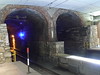 I found the arch, too! This pair of barrel-vaulted tunnels had been abandoned, but were repurposed by MetroLink. This is the south end of the 8th and Pine station.
Upcoming: 50
The Hirshhorn has acquired its first Tino Sehgal performance art piece, This You. Plans call for it to debut on Labor Day weekend.