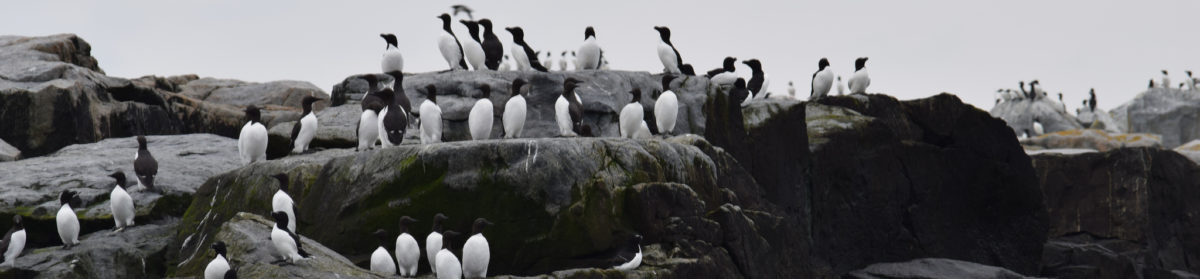
- Bird-friendly coffee is also pollinator-friendly and good for the farmer, too, according to new research from Alejandra Martínez-Salinas et al.
- Jennifer Vanasco’s story about playback of long-unheard mystery wax cylinders buries the lede, in my humble option. The Endpoint Cylinder and Dictabelt Machine also plays back dictabelts, such as would have been used by Sid Sorokin.
- Annie Lindsay and fellow bird banders at Powdermill Avian Research Center devised an air compressor adapted to be a blower for bird feathers. Gently blowing on a bird’s body plumage exposes how much fat the bird is carrying, and is sometimes used for other measurements. Using the machine in preference to the traditional technique (the bander’s own breath) means that COVID-19 prevention protocols can remain in place.
Category: Birds and Birding
Mini guide
I lent a couple of my Hooded Merganser images to Chuck Gates and the East Cascades Audubon Society for their photographic compendium of nests and young birds of Central Oregon.
Christmas Bird Count 2021: Seneca: 2
On Sunday, my plucky team of eight braved winter winds and a brief period of sleet for the sector 14 count. We put up a respectable count of 40 species; next year I hope to squeeze out a bit more (maybe Rock Pigeon at Reston Town Center?). Avian highlight: an adult Bald Eagle (Haliaeetus leucocephalus) being chased out of a Red-tailed Hawk’s (Buteo jamaicensis) airspace above the Gerry Connolly Cross County Trail at Leigh Mill Road. Mammalian highlight: two River Otters (Lutra canadensis) doing their otter thing in Lake Fairfax.
Blue Jay (Cyanocitta cristata) numbers were down, perhaps reflecting the semi-mysterious illness afflicting songbirds in the mid-Atlantic this past summer.
I spent a lot of time scouting, but the team knowledge was perhaps more important, and a little liberating.
More takeaways:
- Plan for a good 20 minutes of logistics conversations at the first meeting point as people trickle in, and especially if you’re going to split the team first off.
- Exchange phone numbers ahead of time. One of my subparties got separated from one another on their way to their first stop.
- Check your batteries for your camera, not just your phone and tablet.
- Use your field notebook, not a copy of the tally sheet on a clipboard. Too easy for the sheet to slip off in a strong wind, and you’re stuck carrying the board all morning.
- The boathouse at Lake Fairfax makes a tolerable windbreak.
Final results for the Seneca circle will be released by the compiler January-February.
Christmas Bird Count 2021: Seneca: 1
I am the new leader for sector 14 of the Seneca circle for the Christmas Bird Count. Our count day is Sunday, 19 December. If you’re interested in helping bird the north half of Reston, Dranesville, and the south half of Great Falls, let me know!
How to identify birds
Gap analysis
Alicia Williams et al. report that there’s still a gap between intentions to buy bird-friendly coffee and actual purchases. Their paper, based on a survey of Living Bird readers, identifies a market segment and suggests some ways to close the gap.
J45264
Bruce Peterjohn bands a female Rufous Hummingbird (Selasphorus rufus) at Annandale’s Green Spring Gardens. John Kelly takes notes.
“She weighs 3.4 grams,” Bruce said. “That’s an eighth of an ounce. You could mail eight hummingbirds with one first-class stamp. Of course, getting eight hummingbirds in an envelope could be difficult.”
Red in tooth and claw
… and beak. Acorn Woodpeckers (Melanerpes formicivorus), it turns out, can be fierce fighters when defending a granary tree.
Each combat site lured up to 50 helper females representing a dozen or more competing coalitions. The birds spread their wings to put on a show of superiority and strength and engaged in incessant bickering; at times the war got bloody. “We’ve seen birds with eyes gouged out, wings broken, bloody feathers, and birds that fell to the ground fighting each other,” Dr. [Sahas] Barve said. “It’s the real stuff.”
Marco
Whistle
Nice mini story from BirdNote about that fine bird, the Wood Duck.
What’s that I hear?
Antonio de Luca, Dave Taft and Umi Syam have assembled a very good primer on birds that you might see in the New York metro (or any eastern city, for that matter). The integration of Donald Kroodsma’s sonograms with the audio playback is a great touch, especially for those of us who really haven’t learned how to use sonograms effectively.
And anyone who reminds us,
And as for that iconic cry: As impressive as bald eagles look, their high-pitched chirps can be underwhelming. When an eagle cries in a car commercial or a cowboy movie, you’re probably hearing the dubbed scream of a red-tailed hawk.
has won my heart.
Bon appetit
 The wren pair in my back yard is now bringing food to nestlings. On the menu: a larva starter, to be followed by a spider main course.
Pair bond
 A pair of Carolina Wrens (Thryothorus ludovicianus) is building a nest in an overgrown plant container at the back of my house. They’ve been working on it since at least Friday, so I’m expecting eggs and incubation (14 days, according to Baicich and Harrison) any time now.
Two ounces
High tech-low tech-biotech: Fitting albatrosses with radar detectors to catch stealth fishermen.
Albatrosses are ideal sentinels of the open ocean, said Henri Weimerskirch, a marine ecologist at a French National Center for Scientific Research in Chizé, France, and the lead author of the new study published on Monday in Proceedings of the National Academy of Sciences. “They are large birds, they travel over huge distances and they are very attracted by fishing vessels.”
Some links: 86
- Converting 35% of the acreage of a coffee farm to shade-grown culture can maximize revenue, according to new research by Amanda Rodewald et al. and summarized by Gustave Axelson. Depending on the premium paid for shade-grown coffee, that percentage can go as high as 85%.
- A smartphone attachment can test for the presence of norovirus in a drinking water sample and produce results in five minutes. The promising prototype comes from the biomedical engineering lab of Jeong-Yeol Yoon. Joe Palca reports.
In the wake of hurricanes and other storms, flooding can cause sewage systems to overflow, potentially mixing with water intended for drinking. Municipal water system managers would breathe easier if they could be certain they didn’t have to worry at all about norovirus contamination.
- How to cross a river. The water at Huntley Meadows Park is never this fast or cold.
- Melissa Errico submits a “self-tape” audition.