Entropy reduction

I’ve just returned from a family business trip that consisted of mostly sorting paper, so I am all fired up to do more of the same here at home. I’m going to deal with the crew of dust nubbins under my monitor; I’m going to ask myself, Do you really need this stack of paper? When I threw out my stack of utility bills from Northern States Power (the electricity company for the Twin Cities) several years ago, I never missed them.

Meanwhile, my connectivity at home is sluggish, especially weekday evenings. My wireless connection to the router cuts out for five seconds at a time, and even wired, I’m seeing timeouts. Maybe the internet has too much clutter in it.

Mixing the bowspirit with the rudder

Well, the team-building exercise part of the trip didn’t turn out to be much, but my director’s unit from the office (software engineering, QA, documentation, and network operations) spent an enjoyable sail on Chesapeake Bay on the Woodwind II out of Annapolis—at least most of us had a good time.

The Woodwind II is a schooner, fitted with two masts and four sails: aft to fore, mainsail, staysail, fisherman’s, and jib. According to lore, the fisherman’s sail evolved from the practice of hanging fishing nets in the area above the staysail on the mainmast and aft of the jib sail at the bow: sailors found that the nets caught some extra wind, and so this space was filled with another sail.

a long spanThe idea of the team-building exercise was that we would split into four teams, two on yards controlling sails, one at the helm, and one navigating. Captain Duncan and his crew would teach each team the elements of the station, and then the teams would rotate around and we would teach each other. This didn’t work out so well in practice, but it did mean that most of us got a turn at the wheel as well as duty pulling rope. The crew were very good-natured about leading a group of clumsy office workers through the necessary tasks, along with fetching blown-away hats. And it probably didn’t hurt that one of us was an experienced sailor (Jody); there was lots of time on this 4-1/2 tour to kick back and swap stories. Captain Duncan kept up a good patter of historical lore (how Bloody Point got its name, for instance), bad jokes, and “tips” like “a stationary object [like a bridge piling] always has the right of way.”

asternthe popular oneWe sailed as far south as Bloody Point light (at left), which marks the shoals at the southern tip of Kent Island, up and down the South River, then a turn at Thomas Point light (at right) and back into port. On my turn at the wheel, I was beginning to get the feel of steering to trim as opposed to steering to course (or to a landmark) as we moved up the South River. I think it was when we crossed a stretch where a scattering of crab pots were set that crew member Rachel took over for me.

Princeton HQ

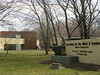
headquarters buildingInto the bus and over the Susquehanna and Delaware with a group of volunteers from the Washington Unit to visit the National Headquarters of Recording for the Blind & Dyslexic in Princeton, N.J. The satellite radio in the bus kept kicking out as we passed under bridges (just as well, ’cause the vocal standards station that our driver chose had far too much Sinatra for my taste), and we spent a few minutes driving around an adjacent office park before we found our building, but getting anywhere in the Northeast Corridor in three hours is a blessing. The one-story building is between U.S. 1 (Brunswick Pike) and the main Amtrak line, on the other side of the Pike from the main university campus.

We were greeted by John Kelly, CEO, and Tom Butler Duncan (Thanks, Kathryn!) and then toured the facility, pretty much every place except the payroll department. John noted that vision-impaired borrowers continue to decline in proportionate numbers: 80% of new registrants are learning-disabled (in other words, somewhere along the broad continuum of characteristics known as dyslexia). The organization’s ambitious goal is to reach 1 million of the estimated 2 million Americans who could benefit from audio-assisted learning.

in Library ServicesThe textbooks that RFB&D records aren’t retained afterward, so the only books to be found were in this corner of Library Services, the acquisitions department, if you will. White stickers on the spines identify each book by a five-character shelf number. The org acquires two copies of each title, one for the reader and one for the director/quality monitor.

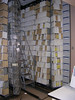
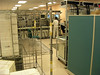
dwindling master tape libraryripping analog tape to digitalAll new recordings are direct to digital, but there is a sizable collection of legacy analog recordings. This storage room (left) was at one time filled with master tapes, but now it’s being cleared out as the tapes are converted to digital format in this area (right). What used to be a big room with analog tape duplication equipment is now largely empty, being backfilled with desks from staffers who had been located elsewhere. Alas, my snaps of the digital production facilities, including four CD duplication machines, are not release-worthy. The data center is onsite, and surprisingly small. But then again, audio doesn’t eat storage the way video does.

More chat back in the conference room before we hopped on the bus for home. The organization will soon be piloting a program of web-based distribution (to augment the current CD mailings) with the possibility of downloads to MP3 players: borrowers are clamoring for this. Volunteers, in the past only used for production, are now being sought for outreach as well. Teachers are especially wanted to help follow up with members to make sure they’re getting all they can out of the program. And I came away with an idea or two to perhaps follow up on.

Action at a distance

Spookiest thing that’s happened to me since I saw the flying saucer on the Pennsylvania Turnpike (but that’s another story):

I was just getting settled in to the recording booth to read Ben Bernanke’s macroeconomics textbook for undergraduates (which promises to be the best such that I’ve recorded) and Kathryn was there to check my recording level. She likes to play back the previous reader to make sure that there’s not a big jump in levels between readers. The previous reader had a nice rumbly, confident baritone; he sounded to be a bit older than me. So his track ran out and I said, “Well, that’s a very reassuring voice.” And then, in a snap, his voice returned on the headphones to say, “Thank you, sir.”

Of course, what it was was his version of “Okay, monitor, we’re finished recording for today.” But Kathryn and I played it back again to make sure that the booth hadn’t acquired a haunt.

Good on ya: 4

Good customer service karma, ultimately, for Audio-Technica’s U.S. operations parts department. I had just started using some new ANC-7 headphones at work (why do I need noise-cancelling headphones at work? good question) when one day my IT guy arrived to do a memory upgrade on my workstation. In the process of pulling the case open, he managed to break the plug at the computer end of the headphones’ cable. (Well, actually it worked just fine, if you’re deaf in the left ear.)

I scampered off to Radio Shack for a replacement cable. Seven bucks, no big deal. Except that the shell of the replacement cable was too fat to fit into the headphones. So after some online browsing turned up nothing different in the way of 1/8 stereo mini-plug cabling, I went back to the source at Audio-Technica. No info on the web site about replacement parts, no e-mail address, but there is a phone number. I called, phone-treed into the parts department, and talked to a real person. I explained the situation and asked what I could do about ordering a replacement cable. He said, “what’s your address? I’ll put one in the mail today.” And at the end of the week, a free replacement arrived, no questions asked.

Some snaps

1959 Chevrolet ImpalaI moved the Mac that has the scanner attached to another place in the house, one more convenient, less underfoot. So of course to test it after relocation I did some scanning. My ostensible purpose was finding a new buddy icon. And that turned into a more general wading through all the family albums. This snap was taken in front of a duplex my grandfather owned and rented out to my mom for a year or two. It must have been after my mother’s fender bender, because you can see the crimp in the Chevrolet logo. I don’t think this image of me looks anything like other pictures of me at the time. Except for the extra cookies I’m carrying around.


cousinsThe two girls in back are my uncle’s first two daughters, Rita and Terri. Rita’s now a journalist in Sacramento, and I think Terri still lives in Germany. That’s my grandparents’ rancher in the background. We’re “sledding” in the open field/backyard of McMakens’ place. I don’t know why we didn’t go someplace with some vertical. The field (maybe an acre?) used to be empty, just some trees in the back, with a gravel drive along the edge. Then McMaken’s Scottish terrier died, and he buried Charlie in the field, with a big marker you could read through the picture window in my grandparents’ living room. I think my grandmother grew roses on that trellis that you can see between the shrubs. I remember learning that word as a kid. Trellis.


parentsMost of the photos in the albums are in pretty shabby shape, and I am not the Photoshop monkey that I used to be, so you’re seeing all the scratches and specks. Especially this overexposed image of my mother and father in Sacramento in about 1952. This must have been before they were married. Maybe it’s because they’re both smiling so broadly.


Williams family reunionI guess I wasn’t at this reunion—according to my notes, I would have been in graduate school by then—but I attended my share of them. The Williams family always met in Fountain Park (somewhat exotic for me, being on the other side of town from where I lived) and rented out the picnic room. I didn’t realize it at the time, but Helen and Wilson (see the image on Flickr for the callouts) were my maternal grandmother’s parents. To me, they were just generalized old relatives from the country. What I particularly like about this picture is that everyone is looking in a different direction. No retakes in 1978.


Easter suitAbout all that I remember of this place on Spring Street is that we had a neighbor named Myers. But in the local dialect, it sounded to me more like “Mars.” Must have been cool to have one of Ray Walston’s compadres living next door. I don’t remember that rabbit, and I certainly don’t remember that suit.

Day off

Somewhat unconventionally, today is a company holiday for me. I made a decision not to schedule anything for today: no checklists, no appointments (except that Leta is coming over after her audition), no chores, no alarms. My bathroom needs cleaning, my to-do list is as long as it ever is, a big chunk of my files hosted at Comcast got clobbered in a recent migration and I will have to restore them, I have message from the resource manager at the Park that I haven’t answered for two weeks, but for today, I Don’t Give a Darn. I choose to celebrate that the backlog pile of magazine stories that must be read is empty, that my WATCH assignments for the year are complete, that I have a month of free evenings ahead of me. I think I’ll even skip reading blogroll today.

Potomac to Occoquan

trail markerSince I’ve already walked, piecewise, some of the longer paved trails in the area—the W&OD, Mount Vernon, the two trails that connect them, and the Capital Crescent—I needed a new project to keep me motivated for outdoor exercise, so yesterday I started the traversal of Fairfax County’s Cross County Trail. The trail, recently completed, covers 40 miles, from Potomac River in Great Falls Park in the north to the Occoquan River in Occoquan Regional Park in the south. It connects with lots of other trails in the county, and shares a track with some in several stretches, and so I’ve already walked some of it without really taking note of the fact.

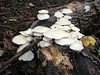
decomposersI started my recordkeeping with a section near to home, a segment of somewhat less than two miles from where the CCT splits from the W&OD and threads through Tamarack Park to an underpass at the Dulles Toll and Access Road. The trail dips in and out of the valley of Difficult Run and shares the Toll Road crossing with the run. Unfortunately if not unexpectedly, the most salient feature of this passage is the plentiful graffiti covering the support columns of the Toll Road. Fairfax County is not wilderness. There is some wildish habitat to be found along the trail, but you’ll also see your share of white-tailed deer munching backyard gardens. And I discovered that carrying a trash bag along with me would be a good idea. There is little elevation change in this section of the trail, but it can be tricky to find your way at times, especially where young pickles have effaced the marker posts.

Ooh shiny shiny

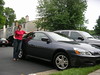
ooh shiny shinySo I bought a new car.

And I can hear what you’re thinking, David, what happened to the perfectly good car you bought in 1993? Three new cars in 24 years: where did this profligacy come from? And you paid cash? Yes, you’re right, but there it is.

Leta and I picked up the as-yet-unchristened vehicle—a 2007 Accord Coupe LX—from Bill Page Honda on Saturday. The dealer did an excellent job of responding to my online request-for-quote with a good price and without a lot haggling and games about extended warranties and extraneous add-ons. As Accords go, it’s the bottom-of-the-line model: the only extra accessory on the car is the mud guards in the rear wheelwells. But it’s one of the scarcer colors, a pearlized graphite gray with some overtones of blue, and it has the nice quality of shining differently in varying lights. It took some persistent questioning on my part to get the dealer to agree to schlep out of the Eastern Shore of Maryland to find one of the right color. Yes, I understand the quote. How much for one in graphite? No, I don’t have a second color choice.

As I said, as-yet-unchristened; the car doesn’t have any mojo yet, let alone any scratches. At least it picked up some road dust during Sunday’s thunderstorms. I’m not even sure yet whether it’s a boy or a girl.

I”m keeping Alberta, the ’93 Explorer, in service for the muddy jobs, the cargo hauling, and the three days of each D.C. winter when 4WD is a really good idea. (Alberta just turned over the double-century on her odometer.) The Accord will be taking over the daily commuting duties and the Beltway crawls to rehearsal, saving a reasonable quantity of gas in the process. It’ll be so nice to stop and go on I-495 with air conditioning that works full-time. Any commute can be fun for a while when you have a new machine to figure out, to find out how it responds.

I gave of lot of thought to buying a Toyota Prius, and I drove my friend Richard’s around the block once, but in the end, a conventional drivetrain, conventional styling, and the right number of doors (two) prevailed. So my driving will not be as squeaky-clean green as it could be, and I’m okay with that. Nor is it one of the luxury rockets that most of the guys I work with drive.

I can’t get over how quiet the car is inside, and I have more legroom that in the Explorer. But, as you might expect, the throw of the stickshift is a lot different. I’m still trying to start from a stop in third and to downshift from fifth to second. I haven’t yet established the TSA policy on liquids in the car: this morning I carefully sipped my coffee from the travel mug only at red lights, and closed it up again before getting underway.

Lafayette trip report: 4

Some non-birding props to hand out:

I had a nice meal, and a very nice couple of glasses of cabernet, at the Blue Dog Café. I had chosen it based on recommendations and its proximity to the hotel, unaware of its connection with the iconic canine of George Rodrigue. Heck, I didn’t even realize that Blue Dog was a Louisiana thing.

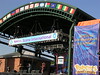
Solas on stageI slipped away from a couple of convention dinners and presentations to the Festival International de Louisiane, which (coincidentally?) was happening the same week as our birding event. Music on multiple stages, vendor booths from around the world, local food for $6 a hit—fabulous! My music choices ranged from local zydeco legends to Celtic and French gypsy-klezmer bands from Europe.

Under the rubric of the festival, I saw a staging of a version of Cody Daigle’s Life/Play, an experimental autobiographical blog-driven piece inspired by Suzan-Lori Parks’ 365 Plays/365 Days. It’s a little raw, some of the playlets are not much more than shoe-gazing, but there are some genuine theatrical moments there. I especially liked the Compliment Fairy, the dance (28 January) that The Guy does the night that his play is presented, and the fact that some of the bits are so unstageable that they work better with The Director reading the stage directions.

Thanks to local chain CC’s Coffee House for providing free wi-fi access.

I saw no pelicans on this trip!? But I did spy two road-killed armadillos on I-12.

Found art

One of the things that annoys me about Tina Howe’s Museum is that it calls for any number of unrealistic behaviors on the part of the museum-goers and guards, specifically (at least in the production I saw recently) for a couple of the viewers to become entranced by the view out the museum’s window. And yet, and yet…

I took a visual break from this year’s Artomatic, held this year on two floors of a Crystal City office building, lately the precincts of the Patent and Trademark Office. (I was particularly taken by Jennifer Foley’s photographs of decaying New England mills.) I looked out the eighth-floor window to the east, onto a parking structure by the airport, bracketed by hardwoods lining the parkway in the foreground and the river and some of the grimier bits of the District in the background. There was something about the sweep of the scene and the flat light of this overcast Saturday. I looked out on the top level of the parking structure, nearly full of cars blue-white-black with a occassional dot of red, none of them moving, the scene a frozen bit of hustle-bustle. The scene had the timeless grandeur of an image by Jeff Wall.

At the park: 6

Well, I thought that the big splash of the morning would be the Wood Duck nest that has been started in the new box hard by the boardwalk, the one that is easy to see but hard to walk to through the cattails and brambles. But other events were brewing. The park staff had designated today Wetlands Awareness Day.

Myra and I worked the upper wetland and then came down to lower Banyard Run. I came up to box #62 and carefully opened the box from the side. I spied the white teardrop-eye of a female Wood Duck. Now when we unintentionally find a hen in a box, she is just as likely to flush through the side door as she is through the entrance hole at the front of the box. So I took a step backwards, in case she went for that route, with optional gut evacuation. I stepped back, and then my world turned into a slow-motion backfall into a foot of water and six inches of mud, as I uttered imprecations all the way down.

Paul (nursing a recently-sutured foot) and Myra were sympathetic, but there isn’t much you can do to help out a guy who’s just found his own awareness of the wetland in the seat of his jeans. I splodged back to the parking area. At least the water wasn’t early-March cold the way it was the last time that I fell in.

Most of my gear is air-drying or in the laundry. Too soon to tell whether my optics suffered any permanent damage.

Why is it that this sort of thing never happens to Annie Dillard?

Lafayette trip report: 1

Greetings from Lafayette, Miss., in the heart of Cajun country, where I am attending the 2007 American Birding Association convention (while Leta house sits back home).

I made the drive down from Reston on Sunday and Monday, with little in the way of mishap. The only construction delays that I encountered came in the vicinity of Cleveland, Tenn., and I noticed something happening there that you never see back home. The merge down to one lane was out of sight, over a couple of hills and around a curve, but no sign was posted to let us know which lane was going to be dropped. Yet all of us politely started lining up in the left lane: some of us, the locals, must have known which lane was closed, while we long-distance travelers figured, “everyone else knows to get in the left lane, so I will, too.” There was no pushing ahead to the merge point, with a line forming for last-minute move-overs. (I say, “all of us,” but there were a few exceptions, including an impatient Greyhound bus.)

Two smells along the drive, both of them overpowering: first, in a couple of stretches in the Shenandoah Valley, the stench of dairy farms (I’ll remember this stink the next time I’m in the butter-and-egg aisle in the supermarket); second, from Laurel, Miss. southward, blasts of perfume from a white-flowering shrub that is in full bloom here already. (There seems to be some confusion about how to identify this plant, which smells like honeysuckle: one trip leader has named it Rough-leaf Dogwood, Cornus drummondii.) (Update: Privet (genus Ligustrum) is probably the correct ID, based on the fragrance match. Trip leader Virginia, who has lived down here, loathes the smell.)

The verges were carpeted with a number of unfamiliar wildflowers, purple, blue, golden, masses of something cloverish with a maroon flower.

Both Alabama and Louisiana’s respective transportation departments should be persuaded to pick a different shield design to designate their state highways. They currently use modifications of the state’s map outlines, with crummy-looking results. Louisiana simplifies the outline by cutting off all the wiggly bits along the Gulf Coast, so we’re left with what looks like a fabricator’s mistake. Alabama’s crime against design is to stretch the outline horizontally to accommodate 3-digit route numbers: Washington state with a burst appendix. And while we’re at it, both Alabama and Mississippi use the state outline for their buckle-up signs, and since the outlines are close to mirror images, it looks like one engineer copied off another’s exam bluebook.

If you would drive cross-country, you would do well to develop a taste for country music, classic rock, and contemporary Christian (which combines the worst features of both). But I did find a couple of fresh college stations around Charlottesville and Baton Rouge, and a great R&B station in Hattiesburg, in what they call the Pine Belt.

(Since I’m reading Agee and Evans’s Let Us Now Praise Famous Men, I was expecting to see long and wide stretches of cotton farms as I rolled south. Instead, I found mile on mile of pine plantations. Generally, the forestry company is smart and leaves a buffer of uncut pine and hardwood understory between the road and the patch that has just been logged. Much better PR than rubbing our noses in the clearcut.)

Anyway, FM radio with Dead Kennedys, obscurer Janis Joplin, and Elvis Costello singing Little Feat with Alain Toussaint: it doesn’t get much better than that.

I’m not sure when I’m going to get to post this, because our hotel’s idea of “available Wi-Fi” means “available for $10 a day.” I may be stuck trying to look up local businesses the old school way, with The Phone Book.

ESTA Festival 2007

Leta and I ran up for the weekend to Ephrata, Pa., to the Eastern States Theatre Association Festival, Leta serving as last-minute replacement techncian for Silver Spring Stage’s entry and I serving as driver and audience member. The Stage returned with an acting award (Toni as Mrs. Popov), while the excellent production of Daniel MacIvor’s Never Swim Alone from Port Tobacco Players (which we saw in Frederick, Md., in January) advanced to the national competition in Charlotte, N.C., this coming June.

Ephrata Performing Arts CenterThe black-box performance space (comfortable, roomy) is built on the bones of a venerable summer stock venue (Ephrata is an easy drive from Philadelphia) organized by John Cameron in the 1950s. Lobby and backstage photos feature Roy Scheider, Dody Goodman, Hugh Reilly, and Stephen Sondheim. The Ephrata PAC now houses a community theater presenting a half-dozen productions yearly. The building is located in a park close to the city center, on the banks of Cocalico Creek.

building detailDowntown Ephrata, in Pennsylvania Dutch country, doesn’t offer too many surprises, but the decorative brickwork ornamenting this pre-1900 building at the city’s zero-point is quite charming.