Changes- Changes- Changes: 1

Great hopping copy editors, the hard copy edition of Washington City Paper has acquired a pair of staples! And color inside! The staples will make it easier to hold the paper together when it’s balanced off the end of the dining room table while I’m chowing down, and I’ll have to modify my one-handed pinch-at-the-spine technique that I once used for flipping through the tabloid on the subway looking for Ernie Pook’s Comeek, but now it’ll be more trouble to pull out the one sheet FilmFest DC schedule for future reference. The new layout hasn’t quite stabilized (I hope): right now it’s somewhat of a typographic pileup.

And the personals have been reduced to two pages of tease, laced with “Many more listings online!” O the humanity! Artist in Hiking Boots, please come back, all is forgiven!

Who’s to say?

When I first read about Gordon Bell’s MyLifeBits project (warning: annoying animation on the front page), I was more than a little torqued.

MyLifeBits is a lifetime store of everything. It is the fulfillment of Vannevar Bush’s 1945 Memex vision including full-text search, text & audio annotations, and hyperlinks. There are two parts to MyLifeBits: an experiment in lifetime storage, and a software research effort.

The experiment: Gordon Bell has captured a lifetime’s worth of articles, books, cards, CDs, letters, memos, papers, photos, pictures, presentations, home movies, videotaped lectures, and voice recordings and stored them digitally. He is now paperless, and is beginning to capture phone calls, IM transcripts, television, and radio.

And when I read an article by Bell and Jim Gemmell in the current Scientific American, I got spun up again (warning: Sci Am links rot quickly). Come on, already: the digitialization of “everything”? How reductionist, how naive.

Bell seems to think that only those items that are convenient to archive are worth archiving. That is, word-oriented documents, and a scanty bit of audio and video. There’s a look-Mom calculation that demonstrates that 60 years worth of accumulation can fit comfortably in a terabyte of storage, and yet this calculation doesn’t provide for any storage of feature-length movies, and for only one MP3 per day.

Bell doesn’t just short-change the other senses, he ignores them entirely. He’s not interested in capturing the smell of just-baked chocolate chip cookies, or of the artificial fog from a Rosco machine, or of an ailanthus tree. He’s not interested in capturing the feel of your cat’s fur, or pine bark, or a hot shower after a morning’s exercise. He’s not interested in capturing the taste of wedding cake, or of a good zinfandel recommended by your cousin from California, or of blood, sweat, or tears.

And for those of us seeking to emulate Bell, it helps to retain a personal assistant; in Bell’s case, the digitizing of past records was accomplished by “several years” of work by hired help.

The Bell and Gemmell article brushes off privacy and security issues with some hand-waving. And yet… and yet… when I read Emily Nussbaum’s story (via Arts & Letters Daily) about the embrace by the under-30 crowd of all things social online, about the “let it all hang out” attitude of high-schoolers, I begin to wonder whether Bell isn’t a visionary just a little ahead of his time. From the Nussbaum piece:

THEY HAVE ARCHIVED THEIR ADOLESCENCE

I remember very little from junior-high school and high school, and I’ve always believed that was probably a good thing. Caitlin Oppermann, 17, has spent her adolescence making sure this doesn’t happen to her. At 12, she was blogging; at 14, she was snapping digital photos; at 15, she edited a documentary about her school marching band. But right now the high-school senior is most excited about her first “serious project,” caitlinoppermann.com. On it, she lists her e-mail and AIM accounts, complains about the school’s Web censors, and links to photos and videos. There’s nothing racy, but it’s the type of information overload that tends to terrify parents. Oppermann’s are supportive: “They know me and they know I’m not careless with the power I have on the Internet.”

As we talk, I peer into Oppermann’s bedroom. I’m at a café in the West Village, and Oppermann is in Kansas City—just like those Ugg girls, who might, for all I know, be linked to her somehow. And as we talk via iChat, her face floats in the corner of my screen, blonde and deadpan. By swiveling her Webcam, she gives me a tour: her walls, each painted a different color of pink; storage lockers; a subway map from last summer, when she came to Manhattan for a Parsons design fellowship. On one wall, I recognize a peace banner I’ve seen in one of her videos.

I ask her about that Xanga, the blog she kept when she was 12. Did she delete it?

“It’s still out there!” she says. “Xanga, a Blogger, a Facebook, my Flickr account, my Vimeo account. Basically, what I do is sign up for everything. I kind of weed out what I like.”

Maybe it’s true, maybe each one of us is nothing more than a list of our favorite movies and a blogroll. Jeez, I hope not.

Theater festival in Frederick

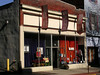
former McCrory's
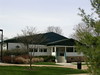
Saturday I rode up with Ted and his team to tech in our shows at the Cultural Arts Center of Frederick County. (The Maryland one act festival performances will be there this weekend.) The Center is lightly converted from a McCrory’s five and dime store; the building wraps around other buildings on the northwest corner of Patrick and Market Streets. As a performance space, the black box theater is long on character. It seats 110 on three sides of a playing area (no stage) about the size of Silver Spring Stage’s, but with the advantage that I can make myself heard in the Frederick space. On the downside, the space is punctuated by load-bearing columns, and lighting designers have to find ways to throw light around them. (This means that if I’m not paying attention, I’ll be standing in the dark on Saturday.)

dressing room
The dressing area is where the luncheonette used to be, with even less soundproofing between it and the auditorium: nothing but a black curtain. But Cindy, Zeke, and Spence ran a tight ship technically, and we got everything done that we needed to get accomplished in our 80-minute time slot, and then some. We’re bringing The Gold Lunch as a showcase, which means that it is not eligible to advance to the regional competition. But that doesn’t mean that it won’t be adjudicated in open session, five minutes a piece from three judges. Leta and I did the math and figured that they will have to talk longer than I will. They’re theater people: they’ll find a way to fill the time.

street name signs and CD
I had a couple of hours to kill until Leta arrived and it was our turn to tech, so I walked around old town Frederick, Maryland. Frederick is undergoing several sorts of transition. I’ve flickr-tagged these images as suburbanMd, and in many ways the town is now a suburb of D.C.: it has its own branch of the MARC commuter service, for instance. But in many ways it’s still an ordinary American small city, a little grubby behind the ears.

old and new
While the Francis Scott Key Hotel is now an office building (you can just make out an old painted sign for it in this image), Carroll Creek Park consists of new and newish brick and stonework lining the channelized Carroll Creek through downtown, just south of Market Street.

footbridge 1
Just the sort of place for open-air arts and crafts festivals, like the one I visited here a few years ago. Very pleasant, with whimsical footbridges.

the back of things
But many of the shop spaces are still under construction and/or are looking for tenants, and new demolition can reveal the tattier backsides of buildings a block or two outside the gentrification zone.

footbridge 2
After our tech rehearsal, Leta and I got dinner at Griff’s, a local institution, and a pretty good dinner it was. Local merchants were observing a First Saturday late closing, the pavements marked with dubious luminaires, so we played with the wooden toys in the toy store and dropped some cash at the funky clothing store that did a side business in Grateful Dead stickers.

All that is left is the schlepping

One of the items on my checklist for the break was to clean up some of the piles of useless crap in the basement and generally make room for more crap. My goal is to end up with marginally less stuff than when the gift-exchanging season began, and I think I’m gonna make it.

My company had a toys for tots box in the lobby, so the bag of leftover toys and party favors that I bought as cast and crew gifts for Goodnight Desdemona eight years ago finally got disposed of. There were a couple of nice (albeit vintage) items in there, like a Wishbone as Romeo and Juliet play set. I also let go of the plastic shopping bags from the Hy-Vee supermark chain that a friend of Leta’s (Clive? Colin?) brought back from Iowa to use as props for Independence. Somehow I was convinced that we were going to revive the show and that the bags would be needed.

I sifted through three boxes overflowing with theater memorabilia, possibly reusable props and costume pieces (you never know when a pair of those geezer sunglasses that look useful only to Geordi will come in handy), desk toys, and miscellaneous junk and reduced the storage footprint to two boxes. I filled a small container with trash, but my super-secret plan is to bring a box of the white elephants to the office and leave it in the break room with a “free to a good home” sign on it. Somebody will want the Harry Potter toothbrush and the transistor radio in the shape of a cartoon pig.

I pulled out one boxful of novels from the shelf to be donated to the library. Leta got first dibs and scored herself paperbacks of Rose Macaulay and Cold Comfort Farm. Except for the Anne Rice, perhaps, no used bookstore will take what’s left. There’s also a couple of books that I in turn bought from a library table to be used as props when I played the psychiatrist in Nuts. One of the titles is rather alarming: a translation from the Russian of a 1959 monograph by G. Y. Malis on mental illness. Chapter Two is titled, “The Effect of the Blood of Patients with Schizophrenia on the Development of the Larvae of Rana temporaria.”

The job that took the longest, surprisingly, was wading through seven years of Interview to clip the passing “what’s up with Laurie Anderson this month?” story or Robin Tunney profile and to pulp the rest. There’s nothing better for re-establishing perspective than to flip through a 90s-era Rose McGowan piece and then drop it into the recycle bin.

Digital Holga

My mother bought me one of these toy digital cameras for Christmas. The packaging disingenuously suggests a retail price of $39.95, but I hope she didn’t pay more than the $10 that seems to be the going rate at Walgreen’s. I’m reluctant to install software drivers from such a flimsy-looking product on my already delicate Windows laptop, so the thing will probably remain in its blister pack until I can do a junk purge.

To Mom’s credit, she found one nice gift: a reprint-house collection of Superman comics from the WWII era.

(Link via robot wisdom.)

Giving thanks

I am thankful that, of all my problems, or issues that I think are problems, I always have some means of controlling the outcome or mitigating the situation.

I am thankful for the printed word. Wherever I am, I can fold open a “clothy brick,” as John Updike would have it, and magically hear someone else’s voice in my head. If it’s a script, I can hear three or four voices. No incompatible technologies, no licensing restrictions, no planned obsolescence.

I am, by nature and necessity, pretty self-sufficient in terms of relationships. But when Leta came into my life, she was the seventh on the top of the major chord that makes it sound all the more resonant. Darn right I’m thankful for her. And her folks, too: family Thanksgiving dinners are something that I actually look forward to, now.

(Inspired by wockerjabby’s wonderful mash note to her husband.)

Return to text

Hey, wow, I was paging through the annual report of my local chapter of Recording for the Blind & Dyslexic, and halfway back, before the thank-you boards for big-bucks contributors and the pictures from the annual fundraiser, I read that I’ve finally made my 1000 hours of service milestone. That puts me on the list of Golden Reels, which is a bit anachronistic since we’ve been all-digital for years now.

The most interesting part of each annual report is the profiles of our borrowers, high school and college students mostly, who need an audio assist with their reading. Dyslexic students predominate (this year a beauty queen and a recent masters degree recipient), along with blind users. But the standout is a now-practicing lawyer who was diagnosed with multiple sclerosis while an undergraduate. The MS caused intermittent vision loss in one eye; the loss was unpredictable and untreatable at the time. RFB&D readers got her through Yale Law School. So, a hat tip to my friend from Texas David G. and to all the other volunteers out there crunching through the law texts.

A mystery

So I went down into the basement yesterday evening to check something in a book (the end of Willie Stark), and then I went over to the workroom side to make sure that the sump pump was working and everything was dry. (A couple days of steady rian for us.) I didn’t turn the light on, but I could see something in the bottom of the utility sink, like a big crumpled up leaf. Now every once in a while a camel cricket will get trapped in the sink. I’ll run the water in the sink, and the cricket will hop around angrily, and I will ignore it. “Hey, you were the one who hopped into the sink.” Sometimes I will feel compassionate, and I will catch the cricket and let it outside.

But this was a lot bigger than a cricket. So I turned the light on, and there in the sink, stiffer than a porn star, was a dead mouse. How did it get there? Did it crawl into the basement to escape the rain? Has it been living in my house for some time? Are there more mice that I need to worry about? How long has it been there? The last time I remember being in the basement was Sunday to do laundry. I think it was Sunday. Was it dying already when it got trapped in the sink? What’s it doing in my utility sink? A dead mouse.

Old Rag

Sometimes it’s good to find out what you really can’t do any more.

The only other time that I’d hiked the Ridge Trail to Old Rag, that craggy outlier of the Blue Ridge in the eastern reaches of Shenandoah National Park, was August, 1992. Back then, the only notation I made in my logbook was my time to complete the 7.1-mile circuit from the upper parking lot: 4-1/2 hours. Now, I remember from that hike that it was a little tricky, and I particularly remember the section where you have to billy goat-hop from one boulder to another. I think it was foggy, and I went on a weekday when there wasn’t much traffic. What I found this past Sunday when I repeated the hike, was a lot harder than I remember. I almost wish that the ranger at the check-in station had told me, “This trail is not for you, out-of-shape middle-aged guy.”

on the way upLet me back up a bit. Old Rag is one of better-known mountains to hike in this part of the country. The north face is a ragged mess of tanker-sized boulders, and the upper reaches of the Ridge Trail are more the idea of a trail than a real trail, at least compared to what we day hikers in the East deal with. Or, as the concrete signpost at the Byrds Nest Shelter says, with unaccustomed albeit understated frankness, “RIDGE TR. IS VERY STEEP AND ROCKY.”

The first half of the climb, about 1000 feet, is not particularly arduous, just a steady climb through the usual Blue Ridge woods, with a smattering of mountain laurel. The biggest hazard you face, at this season, is the steady pelting of falling acorns. After that, things start to get a little crazy. There are three or four narrow, deep cracks that you have to negotiate. Then, at one point, the trail blaze, instead of the usual inch-and-a-half bars of friendly blue paint, is an arrow pointing straight down. I’ve lost a little agility and flexibility in my legs, and I’ve never had any upper-body strength to work with. I’ve made up for it with stronger claustrophobia. As I worked through the first crack, I experienced a twinge of panic, and once I got out of it, I felt the second twinge, when I realized that I could only go up—I was not going back down through that again. Ever.

When I got to the ledge, and couldn’t get over it the first time, I honestly wanted to cry like a little kid, “I cannot do this.” See, there was this ledge, about waist high, that you have to get up onto to continue on the trail. It’s in a crack about four feet wide, and blocked by a pointy stone jutting out about shoulder height. Probably what I did 14 years ago was chimney-walk the wall and jump over, but by this time I was already running at 80% and I didn’t trust my legs. So I pulled myself up on the jutting-out stone and slung myself over. Maybe it was easier the first time with new boots and no mud. Halfway up, I sincerely hoped that I wasn’t going to twist a knee.

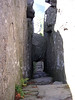
under the rockI think I reached the first of the false summits shortly thereafter. After that, I didn’t so much mind the mini-tunnel that makes you drop to your knees, or the nasty joke of a boulder wedged above the trail made of steps cut into the rock. When I got to the boulder-hopping section, I sort of crawled up the boulders on my knees. I just kept working it, maybe three minutes on, three minutes off to get my breathing and anxiety back under control. I stopped for some food, but the lunch I brought, some poor choices, just sucked the moisture out of my mouth.

from the topI did indeed make it to the top of that G.D. mountain, three hours after leaving the parking lot. The views are fine up there, but the thing with me is that I usually enjoy the process, the climbing, more than I enjoy the summit. I took a picture for three guys hiking together, and I surprised myself by joking with them about the swarm of gnats that rests on the uppermost rocks, waiting for a foolish human to climb up.

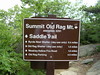
trail junctionGoing back down, the Saddle Trail is a lot easier to take. It would be one of the more severe climbs of the Blue Ridge trails, but it’s still doable. Oddly enough, the Weakley Hollow Fire Road, which connects the Saddle Trail to the parking areas in a long gentle downgrade, is perhaps the smoothest, best-maintained fire roads in the Park that I’ve ever hiked. I had a brief “Big Two-Hearted River” splash in the cold waters of Brokenback Run, a tributary of Hughes RIver.

My time wasn’t too bad: from the lower parking area, which added about 40 minutes to the hike, I made the 9.4-mile loop (2300 feet of elevation change), in 5:40. But I think that’s my last time over the Ridge Trail.

Everybody dance

Ringing mobile phones, simultaneous audio interpretation for slow-on-the-uptake audience members, rackety cleaning equipment upstairs, booming HVAC gear—these are all part of the background rumble of sonic disruptions that have punctuated performances I’ve given or heard. At Woolly Mammoth’s old Church Street venue, the sound of police sirens just outside the door was so common that I’d begun to assume the sound designer had specified them as part of the plot. I’ve had building fire alarms go off twice, once in the middle of my first day room scene in One Flew over the Cuckoo’s Nest. When order was restored about 20 minutes later, our Nurse Ratched (Megan) picked up the scene with a “Now, as I was saying before we were interrupted…” Five minutes of Maura and Ted’s performance of Perfectly Good Airplanes in Geneva earlier this year was played over an insistent, strident alarm, one that was intended to alert every volunteer firefighter in Ontario County. It wouldn’t have been so bad, but the BEEEEP BEEEEP BEEEEP BEEEEP would cut out for half a minute at a time, making us think that the coast was clear and that the Chinese invasion had been called off, before resuming.

The most recent unfortunate sonic event took place Saturday, at a staged reading of several short plays, part of the Kennedy Center’s Page to Stage play development program. The Center packs professional companies into every possible small playing space, who present previews of their upcoming seasons as well as material still in development—sort of a fringe festival with book in hand. Every possible playing space: the two Millennium Stages, the Terrace, even the Theatre Lab gets used as a lab instead of a bordello for the moneyspinner Shear Madness. We were in the South Atrium Foyer (the foyer? I had to check a map to find it), with one set of doors separating us from the lobby of the rooftop restaurant, which had been rented out for a Cambodian wedding. (Are you getting the idea that Labor Day weekend is a slow time at the Center?) When the RATTA TATTA TATTA TATTA of the lion dance began, to celebrate the happy couple (think taiko drums with more attitude), several of us thought that small arms fire was being exchanged.