
Mark Liberman riffs on a word that I like to beat people up with.
Category: Words Words Words
A mystery: 2
In a proper name that includes a numerical designation, when do we (or most of us) pronounce the name as a cardinal and when do we use an ordinal? For instance, we read Elizabeth II as “Elizabeth the second” but Super Bowl II as “Super Bowl two.” Is the distinction just people vs. everything else? Don’t names of ships sometimes use ordinals and sometimes cardinals? How about horses, like Canonero II?
(Prompted by a momentary misreading of Discoverer I as “Discoverer the first” [Only Revolutions, p. 291S.] Conversely, our friend David refers to Shakepeare’s best-known history play as “Henry five.”)
Keycap casserole
Virginia Heffernan worries at the problem of how to quote message board posts.
A job for the Horn Farm Paste Mob
bit-player asks an interesting question: are there any board positions in Scrabble that are stymied, i.e., in which no additional words can be formed? (Let’s stipulate a two-player game, and that only acceptable words are played. As we know, it’s perfectly legal to invent a word and play it, so long as your opponent doesn’t challenge it; it may be in your opponent’s interest not to challenge a bogus word.) I suspect that such a stymied position, if it exists, uses all four of the S’s. This is actually a two-part problem: find a board position and state of the players’ racks that is stymied, and (harder) find a board position that is stymied no matter how the remaining tiles are distributed.
A point of usage
“And your English lakes—Vindermere, Grasmere—are they, then, unhealthy?”
“No, Frau Liesecke; but that is because they are fresh water, and different. Salt water ought to have tides, and go up and down a great deal, or else it smells. Look, for instance, at an aquarium.”
“An aquarium! Oh, Meesis Munt, you mean to tell me that fresh aquariums stink less than salt? Why, when Victor, my brother-in-law, collected many tadpoles—”
“You are not to say ‘stink,'” interrupted Helen; “at least, you may say it, but you must pretend you are being funny while you say it.”
“Then ‘smell.’ And the mud of your Poole down there—does it not smell, or may I say ‘stink, ha, ha’?”
—E.M. Forster, Howards End, chap. 19
Briefly noted
…in last week’s Economist:
- “Nauruan” is probably the only proper adjective that is also a palindrome.
- Dubai is selling the naming rights to some of its metro stations and its two lines.
Dubai Metro Naming Rights offers you unmatched impact and visibility to take your brand to new levels of saliency and success. What’s more, it is an immersive marketing opportunity that allows you to communicate and interact with your consumers at various touch points spread across the station/Metro network.
- A panmictic population is one in which all individuals are potential partners.
But that’s just me
Arnold Zwickly produces two rants after my own heart. First:
Why are people so incompetent at finding e-addresses and web addresses? The hypothesis I’ve developed is that the InterWeb—the conglomeration of the Internet and the World Wide Web—makes people lazy and stupid. Here’s this amazing resource, which allows people to track down all sorts of arcane information within (at most) minutes, yet the users have come to expect that sites will be designed to offer them a single-click route to whatever they want. That’s just lazy. And they seem to have lost the ability to search things out for themselves. The InterWeb has made them stupid.
But, in a subsequent parenthesis, he backs off a bit. Give ’em hell, Arnold! Contrariwise, but making the same point: earlier this week I watched a training video (basically a spoken narration over screenshots of a developer writing code) that involved a side trip to a popular download site. We watched the coder-narrator type the name of the download site into a search box and then click through the search results. Oy vey! Bookmarks and URLs are your friends, people!
Next, Zwickly talks more moderately about the bleed-through of technical language into general use, and the repurposing of common words like normal and mass for technical purposes. He uses a favorite bête noire of mine as an example:
The fact is that ordinary language is pressed into service in a number of ways to provide technical vocabulary, which then has a very specialized meaning in certain contexts, and at the same time technical vocabulary “leaks out” into ordinary language. People get the general drift of the technical vocabulary, but (usually not knowing either the etymology OR the context of its technical use) do their best to interpret what they hear.
And they get a lot of it wrong, from the point of view of people in the technical fields. Epicenter obviously refers to a location (of an earthquake)—to, in some sense, the central point where the earthquake took place. Besides center, there’s an extra element epi-, which clearly must contribute something. So the epi- adds extra stuff, probably something emphatic: the epicenter is, people reason, the EXACT center. (Technically, it’s the location on the earth’s surface OVER the place where the earthquake event happened, underground.) Now, getting all enraged about the common-language use of epicenter for the central point of an event—it seems to be standard now—is just as silly as getting all enraged about the common-language use of vegetables to refer to tomatoes, zucchini, peppers, eggplants, etc., all of which are technically fruits in one scheme of biological terminology.
I take his point, that it’s a question of degree. I don’t get bent about the proper use of fruit the way my agronomist ex probably does, but I haven’t given up on epicenter yet. When epi- changes its meaning from “upon” to “exactly,” something is lost: the ability to make sense of a related word like epidermis (“the layer above the dermis”) or epidemic (“a scourge upon the people”).
Tom Stoppard’s Henry says in Scene 5 of The Real Thing:
[Words are] innocent, neutral, precise, standing for this, describing that, meaning the other, so that if you look after them you can build bridges across incomprehension and chaos. But when they get their corners knocked off, they’re no good any more…. [Words] deserve respect. If you get the right ones in the right order, you can nudge the world a little or make a poem which children will speak for you when you’re dead.
On the record
Something good has come of unfortunate, nonplussed Lauren Caitlin Upton’s on air meltdown: Geoffrey K. Pullum turns it into a teaching moment about the term of art used to distinguish proper names that do not use a definite article (Argentina, Sudan) and those that do (the Argentine, the Sudan, and, as Upton would have it, *the Iraq). They are, respectively, strong proper names and weak proper names.
Boyd and Charlie, 73
Mark Liberman tracks down the etymology of “-30-” as journalists’ code for “end of story.”
Kaplan, again
Via Robot Wisdom auxiliary, Jerry V. Haines is developing the World’s Least Helpful Phonetic Alphabet. I am reminded of a venerable Mike Nichols and Elaine May routine from the early sixties that my mother and I listened to incessantly on LP. Mike is running very late for a very important appointment, and is trying to get the phone number of George Kaplan, his meeting contact, from Information (what became known as Directory Assistance, because people kept using 411 as the public library). Elaine, the operator on the other end of the line, clearly needs to get out more. She repeats back the name he’s looking for:
That is Kaplan, George Kaplan. That is K as in Knight, A as in Aardvark, P as in Pneumonia, L as in Luscious, A as in Aardvark again, N as in Newelpost?
I am only going to say this once
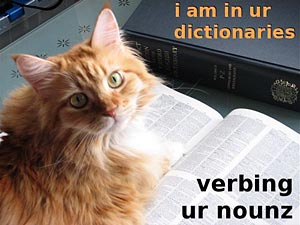
(Via Language Log.)
Look out!
Paul Brians has a list of read-bumps (though he missed the one that always slows me down, even when it’s correct: miniscule* for minuscule). No kidding: yesterday as I was cleaning up someone else’s code, I had to remove an apostrophe from the plural reports.
(Link via Pogue’s Posts.)
Tumblehome and Six Line
Phil Patton reports on the specialized vocabulary of automobile designers.
Now that designers often move around the globe, their language has become more eclectic. Earlier in his career, [Peter] Davis [director of interior design for global compact utility vehicles at G.M.] worked in Europe for Fiat and G.M. In Germany, he learned gummidingers, a name for rubber thingamajigs that have no name. Mr. Davis defined the British-sounding mucketts as “complicated rubber moldings that hide nasty window-door frame areas or direct water drips to appropriate places.”
“In Italy,” he said, “what we call the plenum, the area at the base of the windshield where the wipers sit and run off is directed is called the vasca di pesce, or fish bowl.”
Semper Gumby in your LPCs
Austin Bay introduces his compilation of warrior slang.
Undesecrate that genitive!
Languagehat quotes and comments on a story about the German version of the greengrocer’s apostrophe, Idiotenapostroph.