From April, a nice recap by Dan Charles of the many stickers and labels to be found on a virtuous bag of coffee.
Seeking native speakers
The Washington, D.C. studios of Learning Ally, where I have been recording textbooks for a number of years, handles foreign language texts in addition to English language materials. The studio has put the word out that it is specifically seeking volunteers with proficiency in any of the following languages:
- Khmer
- Polish
- Korean
- Tagalog
- Urdu
Do you speak one of these languages, and would you like to help? Do you know someone else who might be able to assist? Drop me a line, or contact the studio directly.
At the park: 61
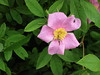 Paul and I checked all the boxes last week and counted eggs for the remaining three nests. Swamp Rose (Rosa palustris) was in bloom, attended by various pollinators and other hangers-on.
The Hooded Mergansers continue to be more successful in our 16 boxes. We saw 7 clutches that were primarily merg, yielding 103 eggs, hatching 92. The Wood Ducks produced 6 clutches, laying 72 eggs but only hatching 48. Of the 13 total clutches, there were eggs of the other species in 4 of them. Our combined species total of 140 ducklings is the maximum over the 30-odd years that we have data for.
The two boxes that were relocated in preparation for the construction project (#77 and #6) were both successful. Box #13 had eggs
laid in it over a period of about 6 weeks, from 1 March to 13 April. In the end, 11 of the 14 eggs hatched.
Stupid Fucking Bird
Aaron Posner’s “sort of” adaptation, the play with the name that many news media won’t reproduce verbatim, takes Anton Chekhov’s The Seagull and feeds it back on itself with the gain turned to 11. Just as William Forsythe hyperextended the classical ballet world’s preparatory steps, Posner injects taboo-word vernacular, monologues that baldly state subtext, and direct address of the audience (in and out of character) into Chekhov’s twisted comedy of artistic ambitions and daisy-chained love triangles—and comes up with something wickedly funny.
The play is Posner’s argument with Constantin Stanislavsky’s “method” of realistic theater. The tension is reflected in Misha Kachman’s set design, which swings from Act 1’s ambiguous, minimal space—a samovar that no one pours from, an exposed flyrail, a clearly artificial back wall, seven bentwood chairs, and a battered piano—to Act 2’s ultrarealistic apartment kitchen, its walls covered with every domestic utensil known to Williams-Sonoma. The argument is made explicit in a tour de force rant for Conrad (frantic Brad Koed), a plea for a new approach to theater in which he heckles playbill-scanning audience members.
It’s an argument with Chekhov’s arcane symbolism, too. I’m still looking for someone to explain to me why Nina thinks she is a (forgive me, birding community) seagull.
Yet, amid all this potty-mouthed Neo-Futurism, Howard Shalwitz’s direction never loses touch with emotional honesty. Rick Foucheux’s aging Sorn (sort of a smoothie blended from Chekhov’s characters Sorin and Dorn) quietly reminds us, “when you see an old guy, you never know,” and the passage is a heart-breaker. Kimberly Gilbert’s Beckettian Mash, so despondent that she can’t utter the word “hope” without three levels of Palinesque quotation marks around it, is pursued by Darius Pierce’s Dev, the sweetest shlub you’ll ever see on stage. And Gilbert shows some mad musical chops on the ukulele.
- Stupid Fucking Bird, by Aaron Posner, sort of adapted from The Seagull by Anton Chekhov, directed by Howard Shalwitz, Woolly Mammoth Theatre Company, Washington
Good for the birds
Good news: coffee specifically labelled as bird-friendly, Allegro’s Early Bird blend, comes to Whole Foods Markets. It’s been a while since the departure of Counter Culture Coffee Sanctuary brand.
Patuxent Research Refuge
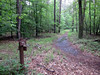 I had a little time before my scheduled meeting at Patuxent Research Refuge/National Wildlife Visitor Center, up the B-W Parkway in the general vicinity of Laurel, and I needed some more field notebook work, so I took a quick loop along the Fire Road and Laurel Trails. The trails here are picture book walks in the woods, very friendly for school trips (of which I am sure there are many in season): duff and pine needles and pea gravel, a little wet in the low spots. And apparently more or less deer-free.
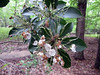 The plants here on the Coastal Plain reflect an acidic soil: some lingering Kalmia latifolia blooms, but mainly fruit; blueberries dominating the herbaceous and understory layers in many places.
 The Goose Pond is a tranquil spot, at least looking in the opposite direction from the water control structure.
At the park: 60
 There’s always something new to see at Huntley Meadows Park. Today I visited with a group led by Jane Huff for my general biology class. I rarely spend much time on the boardwalk in June, so I don’t get to see Buttonbush (Cephalanthus occidentalis) in fruit. Today I saw the buttons.
 Water Pennywort (Hydrocotyle americana) is such a common emergent that I’ve never stopped to really look at it. This image is perhaps more atmospheric than diagnostic, but I like it.
Classmate Tom took one look at the watermarked plant that so bedeviled me last month (and for which I had no good photo) and said, “Here’s Sweet Cicely.” So we can put a name it, Osmorhiza claytonii.
We watched the usual noisy tussle between smaller birds and a Red-shouldered Hawk. But what I hadn’t seen before was an extended interaction between a male Red-winged Blackbird and a Great Egret that, according to the blackbird, was too much in his space. (This was down at the remnants of beaver dam just below the tower, the place that I remember for a tree that used to be there in which I saw one of my first Orchard Orioles.) The blackbird vocalized and flew at the egret, occasionally striking it. The egret seemed to shrug this off, moving a few strides away, but the blackbird persisted, continuing to harass. The blackbird was so insistent that he coaxed a croak out of the egret. Eventually the egret flew off down Barnyard Run. A few minutes later, we saw a second brief fight farther across the main pond—very difficult to say whether these were the same two birds.
Lots of Great Spangled Fritillaries (Speyeria cybele) flying and feeding on the Swamp Milkweed (Asclepias incarnata) that is coming into bloom. We saw one of these butterflies puddling on the remains of some goose poop on the boardwalk.
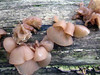 The really interesting find was this jelly mushroom that we came across along the informal trail along Barnyard Run. It keys out to Auricularia auricula, and is apparently edible. An Asian species is called “Cloud Ears;” it is dried and used to flavor soups. Go figure.
Honorificabilitudinitatibus
From time to time, I need to stress test a user interface with a humungously long piece of text: my go-to has always been supercalifragilisticexpialidocious, in observance of Henry Spencer’s Fifth Commandment. But I’ve found something better, even if the word has become obsolete: German’s Rindfleischetikettierungsüberwachungsaufgabenübertragungsgesetz.
Armrest
Five last vocabulary builders from Robbe-Grillet’s La Jalousie. Most of these appear over and over again in the book:
- la fente
- slit, as between the slats of a jalousie
- la pente
- slope
- aplatir
- to flatten
- étendu (p.p. of étendre)
- outstretched, extensive
- l’accoudoir (m.)
- armrest
Public groping
Nathaniel Rich shares my mistrust of airport body scanners. Like him, I consider the scanners personally intrusive and carrying unknown health risks.
…an investigative report in 2011 by ProPublica and PBS NewsHour concluded that the X-ray scanners, then still in use, could cause cancer in 6 to 100 United States airline passengers every year, and that the European Union banned those machines because of health concerns.
(I was unaware of the “cancer cluster” associated with Logan Airport that he mentions, but I’m not surprised.) More to the point, I think they are an egregious misplacement of resources. Like the security bollards that sprang up around federal buildings in the 1990s, body scanners a splendid example of “fighting the last war” thinking.
The way I look at it, if the TSA is going to waste time and money to invade my space, let’s make it personal. Someone has to lay hands on me. Bring on the patdown. Rich’s gambit of trying to pick the line with the metal detector doesn’t work for me.
Contrary to his experience, in the few times that I have “opted out,” as they say, my inspector has always been respectful and prompt. No one has tried to argue me out of my decision. It remains my quiet protest against the forces that would slide us into a state of constant fear.
Dark Hollow Falls
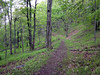 A return to a section of Shenandoah National Park that I had visited not too long ago. This time I spent a lot more time trying to puzzle out plants (even though there were many that I passed by), so I covered the 3 miles out the horse trail, down the fire road, and back up from Dark Hollow Falls in a lazy 3:35. I was struck by the way some of the steeper slopes were dominated by ferns in the herbaceous layer.
I found several small patches of Houstonia caerulea. One of the common names for this wildflower is Quaker Ladies, and it’s appropriate, because the blooms come together in one place, but each flower retains its uniqueness.
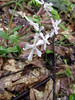 My attaboy comes from working out this Wild Pink (Silene carolinensis), of which I found only a few instances. The flower is actually a little pinker than in the image: my optics aren’t quite up to the task of rendering this color.
Several mystery plants that I took snapshots of—maybe I can figure out one or two later.
I heard and saw a few American Redstarts (Setophaga ruticilla). Or “yellowstarts,” if one is to judge from the colors of the female.
Meadowside Park and Nature Center
Another Saturday, another field trip: this time for class, at Meadowside Park and Nature Center in Montgomery County, led by Jane Huff. Meadowside is one of the “green fingers” of the country, following the valley of the North Branch of Rock Creek. From my end of town, the best way to get there is via the distinctly off-the-beaten-track Avery Road, connecting to the lateral Muncaster Mill Road. The park is a nice size, and offers both upland and riverine habitat.
I saw two new butterflies, a Red-banded Hairstreak (Calycopis cecrops) that classmate Tom found, and several Zabulon Skippers (Poanes zabulon), the first of which I found. The group may also have found a Peck’s Skipper, but I didn’t get a good look for myself.
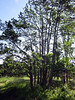
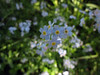 We walked down to the pond, passing an interesting stand of Sassafras (Sassafras albidum) (probably clonal) and a drift of Forget-Me-Nots (Myosotis sp.). (We didn’t linger to key them out between the native and introduced species.)
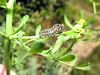 At the reconstructed cabin site, there is a garden plot. We found this Black Swallowtail (Papilio polyxenes) caterpillar there, munching on some Common Rue (Ruta graveolens). The black-white-yellow coloration suggests a Danaus butterfly like a Monarch, but the swallowtail lacks “horns” and the colors are spots, not stripes.
We saw lots of crane flies (Tipulidae), including one pair intent on making more crane flies. Dr. Huff turned over a far-gone rotting log to reveal an Eastern Brown Snake (Storeria dekayi). We saw lots of recent windthrow: 100-foot tall Tuliptrees snapped off two-thirds of the way up. Dr. Huff suggested an association between waxwings and junipers that I would like to follow up on.
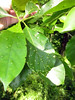 Some nice galls on the leaves of a Black Gum (Nyssa sylvatica).
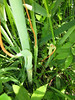 Best bird of the trip was a House Wren (Troglodytes aedon) hanging out around the martin house near the pond. Best plant of the trip was Green Dragon (Arisaema dracontium), a Jack-in-the-Pulpit congener found in one clump next to the creek. Its field marks are the long orange extension of the spadix, and the 5 to 15 leaflets.
No Man’s Land
WSC Avant Bard gives us a treat: a fine production of one of Harold Pinter’s less-produced plays of menace in an enclosed space, No Man’s Land (1975). Pinter’s fascination with abrupt shifts of dominance and usurpation is one of the strongest themes of this production: it’s never clear from one moment to the next whether Briggs (Bruce Alan Rauscher) and Foster (Frank Britton) are housekeeper and secretary to Hirst (ever-powerful Brian Hemmingsen) in his well-appointed Hampstead home, or his jailers. Imagine Veronica’s Room with more homoeroticism and even more peeping.
The opening scene springs from Hirst’s inviting Spooner (Christopher Henley) in for a drink. Twenty-five minutes later, Hirst is falling-down drunk and the scene unspools into slow-motion slapstick. Henley makes the most of Spooner’s weediness, with a sick little smile and a delight in uttering words like periphrastic and sequesteredness as if they were much smuttier than they are.
Rauscher’s second act monologue plays to his strengths: he’s a bemused thug telling the story of how he once gave directions to Foster about how to get to Bolsover Street (in Rauscher’s dialect choice, this sounds more like the so-appropriate Balls-Over Street).
One can read the coda section of the second act as an explanation of this enigmatic sequence of meetings, or as one more mystery to unpick.
- No Man’s Land, by Harold Pinter, directed by Tom Prewitt, WSC Avant Bard, Theatre on the Run, Arlington, Va.
Puff is moving to Twitter
Not content with last year’s mastery of the television airwaves, Leta has moved on to conquer radio.
At the park: 59
I took a walk through the park “on my own,” as it were, unencumbered by monitoring duties but looking to make some field notes as homework for my current class. I was halfway there before I missed my point-and-shoot, so I had to make do with my tablet for images.
I haven’t been down the Cedar Trail for a couple of years or so, and I don’t spend much time this later in the season, so I found several puzzlers. The stretch of the trail that I used to think of as “Woodpecker Alley,” with lots of dead trees, is filling in with Sweetgum and lots of other green things.
I keyed out Rattlesnake Weed (Hieracium venosum), a yellow-flowered composite without noticeable disk flowers, petals pinked like a member of Caryophyllaceae, and minimal stem leaves like Goodyera.
I snapped some images of a mystery plant, already in fruit with 5 siliques, and with watermarked leaves like a waterleaf. Still working on that one.
The Snapping Turtles (Chelydra serpentina) were all over the place, at least eight in the main pond. And one, about 50 meters from anything wet at all, crossing the Cedar Trail, very interested in the cavity at the base of an uprooted tree.
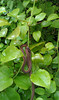 I looped through the woods up to the tower, exchanged some information and pleasantries with a couple of guys from the Shenandoah Valley, and headed back to the car on the boardwalk. Right at the wetland’s edge, I came across this Thamnophis sp. snake, either an Eastern Ribbon Snake or Eastern Garter Snake. The image that I acquired doesn’t quite show the detail of the stripes needed to separate these two species, at least to my eye.