Sarah Ruhl remembers Max Ritvo.
When we find the right friend at the right time in our life, or the right teacher, or the right student, our lives are changed forever. Max was the voice that answered back. And he still is.
theater, natural history and conservation, the utterly mundane, and Etruscan 8-tracks
Sarah Ruhl remembers Max Ritvo.
When we find the right friend at the right time in our life, or the right teacher, or the right student, our lives are changed forever. Max was the voice that answered back. And he still is.
Eric Rosen directs an effective production of Paula Vogel’s confidently theatrical, ensemble-driven meta-play, telling us the story of Sholem Asch’s play The God of Vengeance, from its early productions in Yiddish-speaking Europe after the turn of the century to its suppressed Broadway production of 1923. Vogel’s script finds a way to feed us the key snippets of Asch’s play, while keeping the action skipping along. In the cast, Ethan Watermeier stands out, having drawn most of the cards for playing heavies: an Irish policeman assigned to close down the production, a rabbi speaking against the “indecent” material of the play. A scene of the play’s production in a 1943 Warsaw ghetto, using found space and all the actors wearing Jewish stars, is particularly powerful, a testament to the resilience of art in the face of repression.
75 dancers, 300 solos of work by Merce Cunningham on his 100th birthday, livestreamed.
Jim McGlone and Rita Urbanski led walks on Mason Neck for Fairfax Master Naturalists. Rita focused on wetland adaptations, while Jim workshopped basic tree ID with the class. He mentioned the economic value of Quercus alba in cooperage, particularly with respect to aging wines and whiskeys. Planks made from red oaks can’t be made watertight, unlike white oak lumber.
 He pointed out a winterberry in fruit, Ilex verticillata (we’re out of range for I. laevigata),

 as well as a jinx plant that I cannot form a good search image for, serviceberry (Amelanchier sp.). I’ll keep trying.
Jim also noted a native Euonymus that had already burst.
 Tovi Lehmann led a fungus walk centered on the nature center in Rock Creek Park on a very windy Sunday morning. We found some interesting stuff: Mycena sheltered in a well-decayed log and stump.
 Lentinellus ursinis, with its serrate gills.
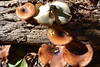 Also long-persisting, Picipes badius.
We talked about the associations among Cerrena unicolor (Mossy Maze Polypore), a wood-boring wasp (Tremex columba), and an ichneumonid parasite of the wasp (Megarhyssa spp.). Now, we found Cerrena growing on a log with two species of Stereum, including S. ostrea. But only the Cerrena was covered with algae, a common sight. Tovi didn’t have an answer to my question about why the algae preferentially used Cerrena as a substrate.
Rudyard Kipling, it would seem, believes that “rub-a-dub” refers to a way of ringing a bell. Dan and Harvey are trawling in a small dory, when heavy weather blows up unexpectedly:
“Take a-holt here, an’ keep ringin’ steady,” said Dan, passing Harvey the lanyard of a bell that hung just behind the windlass.
Harvey rang lustily, for he felt two lives depended on him….
“Clang! cling! clang” Harvey kept it up, varied with occasional rub-a-dubs, for another half-hour.
Captains Courageous, chap. III
However, my researches have turned up only the nursery rhyme, which comes dripping with the usual smarmy gossipy backstory from the 14th century.
Now, a close reading might suggest a sniggering joke on Kipling’s part (and indeed, he uses the word “tub” several times in the passage, referring to containers of trawling gear), but I am not sufficiently familiar with his work to infer whether he is capable of slipping one in, as it were.
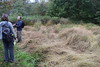 Charles Smith led the botany basics workshop at Ellanor C. Lawrence Park for Fairfax Master Naturalists. (I studied the eastern section of this park for a class in 2014.) We met a lot of old friends from the plant world. Charles pointed out a non-native invasive that I had not seen before, Small Carpetgrass (apt name, that) (Arthraxon hispidus).
In the meadow, Charles pointed out Beaked Panicgrass (Panicum anceps). I need to look at this plant a few more times before I can grok it. A tip for learning sumacs: fruits hang down from Winged Sumac.
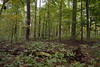 On the west side of Walney Road, we did a very short ascent of the Ridge Trail to a patch of woods that has been left alone by White-tailed Deer. Charles describes this view a “what a good forest looks like.”
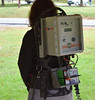 In the afternoon, Chris Ruck and his team electrofished a short reach of Big Rocky Run. Again, this was not a complete, protocol-compliant survey, but rather some cherry-picking so that we could see what species could be found in the stream. Forgive me for geeking out on the equipment, but it’s pretty cool.
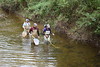
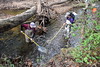 A circuit is established between the anode, the pole in Danielle’s right hand, and the cathode, the cable in her right hand. Fish in the water are stunned, and can be scooped up in a net for study, as Chris is doing in the image at right. Voltage and other electrical characteristics can be adjusted for water conditions. You want rubberized waders for this job; if you’re wearing breathable waders, you will probably feel an unpleasant tingle, or worse.
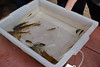 Some of the catch, ready for identification.
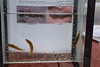
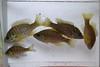 We turned up 13 of a possible 20 species or so, according to Chris’s accounts. We spent a lot of time with the keys and the minnow representatives (family Cyprinidae). A little easier to ID were these Fantail Darters (Etheostoma flabellare) at left, and these four sunfish species (at right).
All theater-themed links today!
His principal concern, though, was that the scene’s most stirring moment, in which an actor leaps from a balcony, occurs too early in the sequence. “Rudolf Nureyev”—the late Soviet ballet dancer—“taught me never to open all your Christmas presents at once,” Barry said….
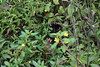 I got a leg up on understanding the mystery yellow flower that I’ve seen blooming in the marsh. According to the trip co-leader, Alonso Abugattas, it’s an aggressive non-native water-primrose. I would like to come back and check it more closely, but if he’s correct that it’s the non-native, that would make it Ludwigia grandiflora ssp. hexapetala.
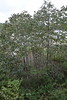
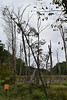 The surprise plant was Common Persimmon (Diospyros virginiana). I’ve looked out from the tower many a time but never at a time when I could see these trees in fruit.
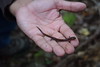 We were trying to focus on herps, but the plants and insects caught our attention, too. Alonso found a few Eastern Red-backed Salamanders (Plethodon cinereus).
Co-leader Mary Benger showed us the birds to be found. A couple of shorebirds passing through, a handful of Great Egrets. Red-headed Woodpecker made an appearance.
 One more building caught my eye: boarded up, carrying signs with a defunct URL, and graffitoed, the Hotel Jefferson patiently awaits restoration and a return to service.
I attended the Strange Loop conference in St. Louis this past week. I got a little time to have a look at the city, which I haven’t seen since I visited my departed friend Jim Wilson in University City many years ago. Ted Drewes is still there, although you can buy a concrete from a vending machine in the airport now.
 I found another fallout shelter sign, this one exposed to the weather and badly faded.

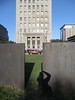 Richard Serra’s quadrilateral Twain is not in great condition, and the landscaping around it is a bit lumpy and wild (perhaps by design?), but this iridescence caught my eye. And the framing of the courts building across the street is too perfect to have happened by chance.

 I was sitting in the hotel, eating my breakfast, idly looking out the window, and I spotted a rather fancy looking building a few blocks away. “Let’s take a closer look,” I thought. “That looks interesting.” Oh, yeah. It’s the Wainwright Building.
 I spent a little time birding for the Saint Louis specialty, unsuccessfully, alas. But I did add a light rail system to my list.
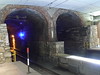 I found the arch, too! This pair of barrel-vaulted tunnels had been abandoned, but were repurposed by MetroLink. This is the south end of the 8th and Pine station.
Debugging the set for the Met’s Ring production.
When the giant planks spun into new positions — moving swiftly, say, to transform from the forest where the young hero Siegmund is being hunted to the fateful house where he seeks shelter — a whooshing sound could sometimes be heard. Officials dubbed it the “rainstick effect.”
Now, the linden, it turns out, is a radical tree, as different from an oak as a woman is from a man. It’s the bee tree, the tree of peace, whose tonics and teas can cure every kind of tension and anxiety—a tree that cannot be mistaken for any other, for alone in all the catalog of a hundred thousand earthly species, its flowers and tiny hard fruit hang down from surfboard bracts whose sole perverse purpose seems to be to state its own singularity.
—Richard Powers, The Overstory, p. 72
Twenty Thousand Hertz goes into the booth with a loop group.
Bess Wohl’s rewarding, at times challenging play drops six seekers (four strangers and one couple) of varying degrees of attainment into a five-day meditation retreat somewhere in the mountains of the East Coast. What not all of them were aware of when they signed up for this exploration, but what is explained to them by the Teacher (Timothy Douglas) early on, is that the retreat is to be conducted in silence.
The “small mouth sounds” of the title no doubt refer to the productions of the Teacher (who does speak, at length, during the proceedings). Offstage and closely mic’d, we hear every lip smack, sniffle, and popped P. It’s enough to make a sound engineer weep, but it’s in the service of this gently satiric play. Douglas’s Teacher is enlightened, in his own way, but he is also digressive, bemused, and distracted. Wohl captures the paradox of this way of teaching, while stepping back from the edge of parody.
Because the onstage actors are mostly silent, it’s an interesting challenge for us to follow their intentions and perhaps fill in some of their backstories. Most interesting are the scenes where the six sleep more or less communally. We watch their parallel stories as they retire and arise, with an overload of finely built details: sun salutations and bad breath and noisy illicit crunchy snacks.
Michael Glenn, as Ned, gets an opportunity to shine in the one extended monologue given to the sextet, a rambling question for the Teacher that unravels into an autobiography of pain and disaster. Details again: notice how Andrea Harris Smith’s Judy finds the death of Ned’s parents on the L.I.E. hilarious, but she is devastated in the next breath to learn that Ned’s dog has died, too.
Maboud Ebrahimzadeh brings a great physicality to the role of Rodney, the more-Ashtangi-than-thou student. He even finds the hardest way possible to slip on his shoes.
The writing of the later scenes for the Teacher is forced, but the overall experience of the play is positive. Yes, we do live on a charnel ground that we call the World, or the Now; but some of us get a glimpse of something greater.
