It’s been a while since I watched broadcast TV that featured ads from local meatpackers, so I missed the passing (I don’t follow the AP style book) of Nathan Mash in 1998. Something I read or heard reminded me of his customary spiel, which was two parts talking about ham curing and one part cryptic crossword puzzle setting, so I looked up his obit.
Orobranche uniflora
Back in New York, Dave Taft offers this botanical and etymological love note to one of the broomrapes.
Mortal coil
Mark Memmott has one of the most important jobs in our newsroom: he’s the designated noodge who makes sure that we get our facts right (as ombudsman Elizabeth Jensen details) and our language unvarnished and clear. He quotes Rick Holter from member station KERA on avoiding euphemisms for death:
“Any time you use one of those euphemisms on air or online (except in a direct quote) to ease the pain of the family or respect the person, you’re basically saying this death is different from others; it could be heard or read as this person’s death is more sensitive or valuable than others.
“We shouldn’t be making those judgments.
“Also, we follow Associated Press style, which is unequivocal about this:
“‘Don’t use euphemisms like passed on or passed away except in a direct quote.’
“So remember: People die. And we respect all those deaths equally.”
Thank you, Mark, for keeping us in line.
The scoop
The photograph of the Munsell soil color chart book pulled me up short. As I read Richard Schiffman’s piece, my thoughts bounced around from “wow, this is cool that soil scientists are getting profiled in the Times” to “New York has a soil brokerage clearinghouse so that good fill dirt from a construction site can be used to rebuild a wetland? That’s bananas—no, that’s brilliant!”
While the idea might seem obvious, Dr. [Dan] Walsh maintains that this is the first soil exchange anywhere in the world that is run by a city government. It is currently being watched by officials from New Orleans and Los Angeles as well as municipalities in Germany, China and Australia, which are considering implementing similar programs.
* * *
“We’re essentially matchmakers,” Dr. Walsh said. “We don’t stockpile the soil, so both a donor and a recipient have to be ready at the same time. Our job is to coordinate the transfer.”
The NYC Urban Soils Institute has plans to establish a soil museum in Brooklyn’s Green-Wood Cemetery—something for my to-see list in New York.
Contemporary American Theater Festival 2018: 5
A young woman carries a heavy portable crib up a flight of stairs, bumping it on every other step; her actions echo those of a teenager seventeen years before, banging a suitcase down a different flight of stairs (metaphorical baggage reified). Two young women have an uneasy reunion, a decade and half after a shattering trauma that destroyed a family has split the two of them apart; they interchange playing scenes with their younger counterparts.
In a program note, playwright Amy E. Witting says that we all are living in a “post-traumatic stress environment.” In this play, the most effective and challenging of this year’s festival, Alexandra (Joey Parsons) and Frankie (Jessica Savage) and their younger selves Alex (Sam Morales) and young Frankie (Ruby Rakos) hold up a mirror so that we can see ourselves generally and the specific impact of this particular trauma.
It is clear from the early moments of the play that broody Alexandra has endured some sort of loss, to be revealed in the course of the narrative. What is more subtle is the impact of those past events on Frankie; she is, in a sense, the forgotten victim.
Does the unfolding of the play provide the healing to Frankie and Alexandra that they want, or the healing that they need?
A quibble: the play’s climax, the big reveal by Alexandra, a chthonic explosion by Parsons, is played on that staircase, halfway up from the main playing space to an unseen second story. So there’s a good reason for director Ed Herendeen to put her there. But as a result, sightlines for some of us during this sequence are less than optimal.
- Contemporary American Theater Festival at Shepherd University, Shepherdstown, W. Va.
- The House on the Hill, by Amy E. Witting, directed by Ed Herendeen
Contemporary American Theater Festival 2018: 4
Providing an origin story for a prison work song (Berta, Berta) is a wobbly foundation for a full-length play. The actors are skilled and committed (Jason Bowen as the haunted Leroy and Bianca Laverne Jones as Berta); the stakes are high (a murder); the dressing of Luciana Stecconi’s set is first rate; but there’s something missing. Perhaps the piece relies too much on Leroy’s tell-not-show accounts of why he’s on the run, and of the heavy injustice laid on him that was the driver of events. It’s a risky business to suggest recasting an artistic work into another medium, but opening up this play as a film would strengthen the story that it wants to tell.
Playwright C. A. Johnson says her program interview,
Maybe Thirst is about politics, maybe it’s about gender, maybe it’s about special preferences, maybe it’s all of these things… or maybe, it’s just a play about how hard it is to let go.
And it’s the play’s stubborn refusal to decide what it wants to be about that is a challenge. Once again, the stakes are high: in a post-apocalyptic landscape still bursting with violence, Samira (Monet) and Greta (Jessica Savage) care for their adopted son Kalil (newcomer Jalon Christian). The local warlord Terrance (Ryan Nathaniel George) has risen to power because he controls the water supply, and water in this community is a precious resource indeed. The rub: Terrance and Samira were once married, and his entrails are still consumed with rage that she is now with Greta. Is is because Greta is a woman? Because she is white? Or just because she is someone else? Terrance is incapable of telling us.
Terrance explodes with gunplay, against his better judgement and surely not in the best interests of his people or himself. (A leader with doubtful skills, thrust onto the public stage, behaving irrationally to a bizarre degree? Why, that would—oh, never mind.)
There is a loose end introduced towards the end of the play, that is never picked up or resolved, i.e., a suggestion that the water supply has been contaminated.
Jessica Savage has the juicy opportunity to show us how excruciating it is to suffer a close-range gunshot wound, and she makes the most of it.
- Contemporary American Theater Festival at Shepherd University, Shepherdstown, W. Va.
- Berta, Berta, by Angelica Chéri, directed by Reginald L. Douglas
- Thirst, by C. A. Johnson, directed by Adrienne Campbell-Holt
Contemporary American Theater Festival 2018: 3
From the other side of the Iron Curtain comes this timebending story, set in multiple places and times in the Soviet Union: in Kruschchev’s era, and before and after the rise of Stalin. Stalin’s purges take on a particular specificity in this work.
In the 1930s, Alexei (David McElwee), synesthete and memory savant, is a newspaper reporter, and apparently a poor one, because he takes no notes. He doesn’t need to, because he can remember speeches word for word. This becomes problematic for him, when certain speakers he has heard (Bukharin, Kirov) are dropped into Russia’s Memory Hole.
He himself disappears from official records, but a 1950s-era bureaucrat (Kreplev, Lee Sellars) takes a special interest in his case and in the psychologist who treated him (Joey Parsons)—a treat for us to see two beloved CATF regulars together on stage.
There are two frames around the story, one of them a rather odd carnival act whose significance will be made clear, and the other a (sometimes distracting) direct address to us by Kreplev. Ultimately, the play is Kreplev’s journey, as he learns the personal cost of “accommodation,” both in the form of forgetting and being forgotten.
Gregory gives Alexei’s synesthesia a poetic turn. The color magenta, for him, has the roar of a train; a politician’s words bounce around meaninglessly like so many rubber balls.
- Contemporary American Theater Festival at Shepherd University, Shepherdstown, W. Va.
- Memoirs of Forgotten Man, by D. W. Gregory, directed by Ed Herendeen
Contemporary American Theater Festival 2018: 2
There’s much to like in Michael Weller’s solo piece for John Keabler, irrespective of what you think of the evolving political views of Ronald Reagan—from admirer of FDR to speaker for Barry Goldwater in 1964. Keabler has the mannerisms and physicality, playing Reagan as much as a gangly kid as statesman.
The framing device for the play is an imagined interview for a magazine, while the last moments of Reagan’s life slip away from him on his hospital bed. (In Reagan’s fever dream, he is still the good-looking young man who is Keabler.) This allows Reagan to control the flow, so his story unspools as a greatest hits compilation, with good mini re-enactments of his film roles. That is to say, when Reagan’s late life dementia allows him to remember. Unfortunately, the interview trope gets in the way, requiring Reagan for much of the work to maintain focus on the interviewer, who seems to be sitting in the aisle of Studio 112’s seating, about two rows back.
Weller’s script is salted with nuggets of current affairs irony, as when Reagan rails against the idea of a wall (in his case, the one in Berlin) being the solution to security problems, or when he despairs of Russians in D.C. guiding policy.
People and places from Reagan’s past are subtly suggested by monochrome screen projections by Christopher Erbe and Taran Schatz—very fine work.
- Contemporary American Theater Festival at Shepherd University, Shepherdstown, W. Va.
- A Late Morning (in America) with Ronald Reagan, by Michael Weller, directed by Sam Weisman
Contemporary American Theater Festival 2018: 1
Bekah Brunstetter’s sugary, crinkly comedy could not be more contemporary: Jen (the effervescent Kelly Gibson), a young woman living in Brooklyn, returns to her family home in North Carolina. Engaged to the more bottled-up Macy (the poised, not strident Monet), Jen hopes that her wedding cake will be prepared by family friend and bakery proprietor Della. Della (the adventurous Erika Rofsrud), even more family than friend, holds to her traditional Christian religious mores; she has been brought up to “follow the directions until I die.” She balks at creating the confection—this despite her professed belief that the solution to war is to bake a personal cake for each combatant.
The Cake takes all of its principals through emotional journeys and change (for that matter, Lee Sellars’ dour Tim the plumber goes through some changes himself), but most strongly changed is Della. Her late monologue is harrowing, finding deep notes of aching and repressed feelings of shame. Della also gets the best comic lines of the show. No fan of gluten-free baking, she once tasted such a cake and says that it made the back of her mouth feel like it did after a good cry. And this, quoted by audience members in the lobby: when challenged by Tim that lesbianism is not natural, she replies, “Neither is confectioner’s sugar.”
- Contemporary American Theater Festival at Shepherd University, Shepherdstown, W. Va.
- The Cake, by Bekah Brunstetter, directed by Katha Kissman
A milestone: 7
I happened to be checking a report and discovered that I had recently passed an important (to me) milestone with Learning Ally (formerly Recording for the Blind & Dyslexic, formerly Recording for the Blind): 2,000 volunteer hours, the equivalent of one year of 40 hours/week service. It took me almost 24 years to get there, and I’m pretty chuffed about it.
I started with open reel analog recording, made the transition to digital, and moved into virtual studio recording. And the new editions of textbooks keep coming.
On to 2,500 hours!
At the park: 96
My final report for the ducks and mergs team this season:
Well, our box score for the season shows a lot of at-bats but not too many runs across the plate. The mergansers started 10 clutches but only hatched 4; the Wood Ducks started 5 but only completed 1. We had evidence of predation in only 1 box (raccoon, #60). A possible hypothesis to explain the high rate of nest abandonment by the mergansers is simply that there were too many birds chasing scarce resources.
The egg and hatchling counts are similarly depressed: 139 eggs laid by the Hooded Mergansers, with 52 hatched (37%); 34 eggs laid by the Wood Ducks, with 7 hatched (21%). Summary worksheet from our monitoring.
A recap of the boxes: I applied some insulating foam to patch gaps in boxes #1 and #3. Boxes #4 and #7 should be replaced. A map of nest box locations.
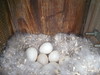
Tiny little box #5 was put to good use this year! It was the site of our single successful Wood Duck nest. During (10 June) at left and after (24 June) at right.
Monitors, thank you for all your help!
Maine birding recap
I put together a cumulative list for my two Maine birding festivals this year, and it’s not bad: 89 species. A surprising number of flycatcher species (six) and a respectable count of wood warblers (fourteen).
Botticelli in the Fire
Woolly closes its distinctly uneven season with the sound Botticelli in the Fire, a fantasia on the life of 15th-century Renaissance painter Sandro Botticelli. In Jordan Tannahill’s reimagining, Botticelli (company rising star Jon Hudson Odom) is rampantly bisexual, carrying on with both his patron’s wife and a young gifted painter from Vinci named Leonardo. Sumptuous period costumes intermingle with overt anachronisms—text messages, peanut butter sandwiches.
Cody Nickell is well placed as the rich and powerful Lorenzo de’ Medici, while Craig Wallace is even more powerful as Girolamo Savonarola, imagined here as a street preacher elevated to savior of Florence, from the twin depredations of plague and licentiousness. Indeed, the power games played by both characters have unsettling resonances with current events.
Forced by Savonarola to choose between art and love, Botticelli makes the expected choice. But there’s something missing here, in the text or elsewhere: Leonardo is young and beautiful and talented, granted, but his gift seems insufficient motivation for Botticelli’s sacrifice.
Christian Frederickson’s excellent sound design is matched by Colin K. Bills’ chiaroscuro lighting.
- Botticelli in the Fire, by Jordan Tannahill, directed by Marti Lyons, Woolly Mammoth Theatre Company, Washington
Acadia Birding Festival 2018
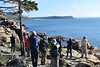 Jeepers, a great number of guides for ABF events to thank: Don Lima, David Ladd, Doug Suitor, Fyn Kynd, Fred Yost, Michael Retter, Bill Sheehan, Margaret Viens, Ed Hawkes, George Armistead, and the crew and staff of the Friendship V—as well as all the other guides aboard the boat.
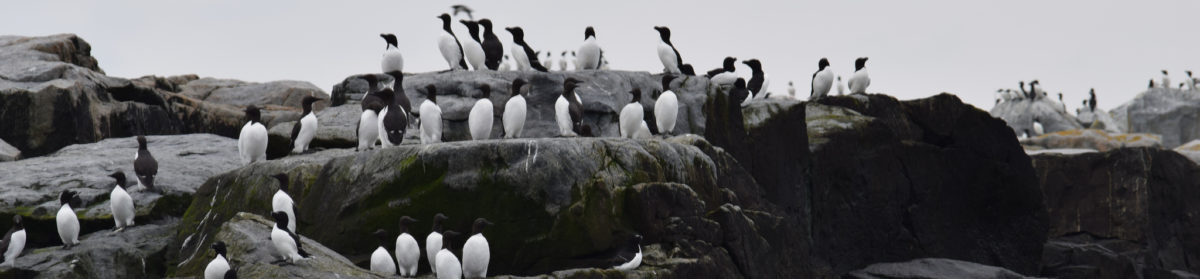
 Our target birds for the pelagic trip out of Bar Harbor were pretty much the same as those for the trip out of Cutler the week before, and the alcids duly made their appearances. Guides also spotted a lone Black Tern (Chlidonias niger) at Petit Manan Island (lifer), and Marsall Iliff found a Brown Booby (Sula leucogaster) on the way there (tropical mega-lifer).

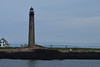
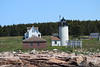 On the return, we scooted past Mount Desert Rock (its light, at left) and Great Duck Island (its light, at right).
 With a little time before lunch, to continue the theme, I drove my car down to Bass Harbor Head to photograph its light.
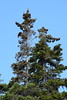 Near to Otter Cliffs, we picked up a couple of female Red Crossbills (Loxia curvirostra). I am gratified to report that I first saw (but did not identify) the birds fly into these White Spruces (Picea glauca), which look a little raggedy at the top with cones but no green branches. Apparently that was exactly the sort of tree the hungry birds were looking for.
 I saw a lot of Bracken Fern (Pteridium aquilinum) and eventually got the jizz of this rather common plant, with its single bare stem rising two and a half feet before sending out any leaves.
 More bogs and bog specialty plants! This sketchy image of Cottongrass (Eriophorum sp.), a sedge, is from Orono Bog.
On the whole, the weather was very cooperative for both trips. I didn’t see rain until a layover in Boston on my return drive. Now that I look back at my trails map of Acadia National Park, I realize that I saw a lot of Mount Desert Island, but there’s still so much more to explore. I added nine birds to my ABA Area life list, running my total up to 423. Missed the Spruce Grouse, and I was disappointed not to find a Black-legged Kittiwake.
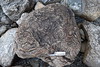
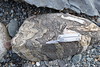 Ooh, and some Friday Fold candidates for Callan Bentley. These boulders were on the shore of Western Bay in the Indian Point Blagden Preserve.
Enroute: 16
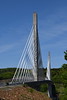 I should bumper-sticker Della with the warning, “I brake for cable-stayed bridges.” This is the Penobscot Narrows Bridge: I’m standing on the approach on the Verona Island side; Prospect is at the other end. You can just make out the windows of the observation deck at the top of the far tower.