Silver Line progress report: 34

somewhat prematureA couple of months ago, signage in existing stations that the Silver Line will service began to be updated. In some cases, the line and its soon-to-be terminus are already identified, as here at East Falls Church, which is where it will join the Orange Line.

ready to unwrapElsewhere, signs are temporarily covered in Metro-brown wrappings (I suspect at underground stations where the adhesive isn’t exposed to the elements). But you can just pick out the “East” part of the station name, thanks to the bright light of my camera’s flash.

Great Falls Park ramble

Leta was a good sport and went along with me on a New Year’s Day walk in Great Falls Park. I hadn’t expected that the trails would be muddy (we were just wearing sneakers, on our way to a party at Tel’s), so we picked our way more carefully than usual. And once we’d been to the Matildaville ruins (always a bit of a letdown), I hadn’t expected that Leta would want to scooch down the river trail. But we did, and I found some nice patches of Wild Oats to show her. And I think that my mystery plant, still in fruit, was Sweet Cicely.

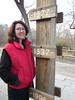
playing alongShe liked the floods marker post.

On deck: 11

only one shelf (for now)The backlog has been reduced a bit, but there are new titles here (thanks, Leta!) and some more volumes on order. The play collections are probably the longest-tenured books on the shelf. I started the Kate Atkinson, hence I removed the dust jacket, but I only got about three pages in before something else tempted me more.

At the park: 63

almost doneI dropped by the park to check on the progress of the wetland restoration project. To my untrained eye, it looks like the builders are almost done with the new dam. New plantings are in place, and deadfall has been dragged into strategic positions. The scattering of Green-winged Teal and Northern Pintail in the main pond seemed unconcerned. The clashing of Common Grackles that would fly over from time to time likewise.

strugglingThe surprise for this trip was this spindly, feisty Common Persimmon (Diospyros virginiana), spotted in a wet spot near the “phoebe bridge” where the trail begins to cross the wetland via boardwalk. Despite the fact that it’s in the process of being strangled by a blue-berried climber (Japanese Honeysuckle, perhaps), it has managed to produce fruit: look at the extreme right edge of the image for ripening persimmons, as well as a cluster left where the branches are obscured by the much larger lichen-covered maple.

Wakefield Park grasses

Alan Ford led a workshop on grass ID at Wakefield Park for the Potowmack Chapter of the Virginia Native Plant Society. Tips and reminders of some training that I took from Cris Fleming a couple of years ago. Grasses are sneaky hard to get into good focus with my happy snap camera, so most of my images remain on my hard drive.

Five gleanings:

  • Look for a bend in the awn to identify Indian Grass to species, Sorghastrum nutans.
  • When you see arundinacea or its derivatives in a species name, it’s a hint that the organism is large, with a reference to the large Bamboo Orchid, Arundina sp.
  • Broomsedge (Andropogon virginicus var. virginicus) is an early colonizer. When you see it give way to Little Bluestem (Schizachyrium scoparium) (purple sheaths alternating with green internodes), you’re dealing with a well-established meadow.
  • Leersia virginica is a lookalike for the invasive Japanese Stilt-grass (Microstegium vimineum). The stilt-grass pulls up out of the ground easily, but Leersia does not.
  • Look and feel for stiff horizontal hairs on the sheath of Deer-tongue Grass (Dicanthelium clandestinum). Some of the panic grasses have recently been moved into the genera Coleataenia and Dicanthelium (twice-flowering [each year]).

not so purple nowI did get an acceptable image of the jizz of the delicate open panicles of Purple Love Grass (Eragrostis spectabilis), a species that many people love and that I have trouble recognizing.

At the park: 62

whacking and hackingtoo much of a good thingA different sort of management project at the Park today: the central wetland has an overabundance of Cattail (Typha sp.). This is definitely a native, but it can be invasive. And it’s not as if we are facing a monoculture; it’s just that we have a lot of the stuff. With the rearrangement of ponding as a result of the wetlands restoration project, the professional management staff is concerned lest the well-established patch expand into the nearby woods that will soon be flooded. So they asked the RMV team to help out. The objective of today’s work was not to reduce the patch, but rather to discourage it a bit—to keep it in check.

two of manyWe spent a couple of hours clipping the tops of the plants, removing the mature fruits, many of which are already distributing seed. Good weather, great snacks as always from M.K., and many, many bags of cattail heads.

Longwood Gardens

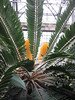
conservatory cutiewaiting for a friendLeta and I spent most of our time at Longwood Gardens in the controlled environment of the conservatory, while the rain washed the outside. One of the destination plants of the conservatory is this single individual bread palm, Encephalartos woodii; the species is extirpated in the wild. Each of this cycad’s bright orange cones, each larger than a loaf of bread, is a pollen strobilus.

Unboxed Ware

boxed Wareunboxed Ware 1My copy of Chris Ware’s Building Stories has been sitting on a shelf—well, lying on the floor propped up against a shelf—for months, too pretty to unwrap. This afternoon I finally had some time to clear off the coffee table and take a few snaps of the unpackaging.

unboxed Ware 2Also solved today: I made horizontal space on a shelf where I can store the book once I’ve finished devouring it.

unboxed Ware 3I like big books and I cannot lie.

WalkingTown DC 2013

My job as volunteer assistant on my two WalkingTown DC tours today called for logistics, crowd control, and passing out evaluation forms—and it kept me busy, but I did grab two quick snaps of inside Washington.

pluginsFirst, Steve Livengood pointed out the communications equipment that TV people use for their standups outside the Senate side of the Capitol, nicely concealed by a low barrier wall, and out of frame when the cameras are rolling.

unlovedCarolyn Crouch took us through the good, the bad, and the dismal of the 1960s-era L’Enfant Plaza urban renewal project. Perhaps the low point of the dismal is this stairway that connects D Street, S.W. to the elevated L’Enfant Promenade. As we ascended the weirdly-treaded steps, vague noises of something like sandblasting could be heard from the behind the tarps that you see. Or perhaps they’re concealing a hellmouth.

Silver Line progress report: 32

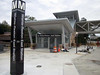
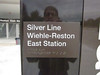
coming soon to your towninadvertent selfieSandbox John gave me the tip that signage was in place at the Wiehle station. The typography appears to be a mix of the heavier-weight Helvetica that has been used in the system from the start (over the station entrance) and a lighter weight on the pylon. I’m also seeing this fresh-looking lighter weight in new platform location signs along the Blue and Orange Lines downtown; the signs set aside empty space for the Silver Line route information to be added when the Line goes live.

John also reports:

The north end of the pedestrian bridge at the Wiehle-Reston East station is a little interesting. It just ends at the corner of the plaza of the Comstock Partners Reston Station property. No sloping canopy like at the bottom of the escalators at the entrance pavilions. There also is no entrance pylon marking its purpose. Adjacent to the end of the pedestrian bridge is a set of stairs that descend to the loading dock access road to the buildings that have not been built yet. Not sure why it is there, best guess is it there to allow access to the north side of the station from the location where the fire trucks would connect fire hoses from the fire hydrant to the dry standpipe.

The Cloisters

ripeningstill poisonousI thought I could leave the botany alone for a week, but apparently not. I found Quince (Cydonia oblonga) ripening in the medieval herb garden at The Cloisters (left) and Castor Bean (Ricinus communis) (right) also coming into fruit.

(By the way, the Cuxa Cloister is now on the list of my favorite quiet places in New York. Truth to tell, any of these quadrangular spaces would be a great place for contemplation.)

Crossing Central Park from museum to museum, I found a very tall Solomon’s Seal (Polygonatum biflorum) (or possibly a cultivar or import) bearing fruit.

Virginia Native Plant Society 2013

Three very satisfying field trips at the Virginia Native Plant Society annual meeting, hosted by the Jefferson chapter (Charlottesville).

heterotroph? me?a bit raggedSaturday morning we looked mostly at mushrooms with Mary Jane Epps at Preddy Creek Trail Park. Notice the word “trail” in the property’s name: we often found ourselves making way for mountain bikes, as well as one rider mounted on a horse. We found Old Man of the Woods (Strobilomyces floccopus) mushrooms, an nondescript and unidentified slime mold, a tiny rove beetle on a Lactaria mushroom, some fine examples of Pinesap (Monotropa hypopithys) (at left), and Polyporus mori (at right).

N.A. championIn their walks, both Devin Floyd and Tom Dierauf emphasized the subtle shifts in species composition that can be attributed to aspect and drainage, as when an oak-hickory forest on one side of a slope gives way to an ash-tuliptree forest on the facing side. Devin (co-founder of the Blue Ridge Discovery Center) took us through the Secluded Farm tract of the Monticello property. Bonus champion tree for this walk: the North American champion Blackhaw Viburnum (Viburnum prunifolium), mistaken for many years for an apple tree. Counterintuitive fun fact: Slippery Elm (Ulmus rubra) leaves are not slippery, but rough as sandpaper.

Back to the north side of Albemarle (a two-syllable word in the local parlance) County for a visit to Ivy Creek Natural Area with Tom. Tom’s looks at the woods with a forester’s eyes, so we looked at a lot of trees in various stages of growth and decay, and we forgave his references to “Yellow Poplar.” He pointed out several examples of Red Hickory (a/k/a Oval Pignut Hickory) (Carya ovalis), a tree that he describes as very common in Virginia, and often overlooked. It’s certainly been overlooked in my prior field instruction, as we only had learned C. tomentosa, C. cordiformis, and the closely related Pignut Hickory (C. glabra). He gave me the idea for a little field experiment to perform in my weedy back yard: an oak cut back to the ground can resprout from its root underground, but a maple can’t. Tom showed us a single Paulownia tomentosa tree, in the process of being shaded out by taller trees, and spoke of the tree’s economic value rather than its potential invasiveness. He’s much more concerned about the depredations of Oriental Bittersweet (Celastrus orbiculatus) at Ivy Creek.

bark detailAn atmospheric image of the bark of an older Black Birch (Betula lenta) beginning to peel. Tom took a small scraping from a younger tree: the inner bark smells intensely, wonderfully like Clark’s Teaberry gum.

cutWe did take a look at the herbaceous layer. This Cut-leaved Grape Fern (Botrychium dissectum) was quite nice.

Doyles River loop

one more to make Brett enviousFriday, on my way down to the Charlottesville area for the Virginia Native Plant Society annual get-together, I took a side trip to Shenandoah NP and a loop hike from the Doyles River parking area to Browns Gap and back. The Appalachian Trail in certain sections was almost completely overrun by smartweed.

I hadn’t planned on looking at butterflies, so I did not bring my field guides—and so I had some interesting (if common) lepids to look at. Making field notes and taking photos of what turn out to be Cabbage Whites and Eastern Commas is a character-building experience. What there was to see I did get good looks at, however, thanks to some new gear. I’m not given to fanboying about optics, but the close focus (50 cm!) on my new Pentax Papilio 6.5x21s is just awesome, and ideal for butterflies. These binoculars work fairly well over my eyeglasses, and I’m tempted to use these inexpensive field glasses as my all-around birding optics.

Doyles River itself was just a trickle, so I passed up a side trip to the falls. The PATC-mapped short circuit took me 2:40. The altimeter in my watch pooped out (low battery), so I’ll have to use the PATC’s estimate of a 900-foot elevation change; my sore muscles today will confirm that.