For our second field trip to look at invasive non-native plants of the mid-Atlantic, Carole took us to Rachel Carson Conservation Park, a darling gem of 650 acres in northeastern Montgomery County.
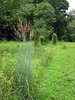 Most of what Carole had to show us were success stories about the restoration of this former agricultural land. In the meadow, warm season grasses like Indian Grass (Sorghastrum nutans) have been planted and are thriving. Autumn Olive (Elaeagnus umbellata) is generally under control.
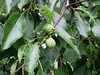 Naturally occurring Persimmon (Diospyros virginiana) (ripening fruit at right) is avoided by the deer, for some reason. Goldenrod is also making a comeback.
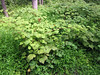
Unfortunately, at the forest edges, Polygonum perfoliatum is still running wild, just barely checked by the Japanese Beetles that find it as tasty as home cooking (which it is, for them). Carole is less concerned about the non-native Foxtail Grass (Setaria sp.), whose nodding heads you can see in the background above.
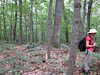 In the woods, we found two of my favorite plants. Spotted Wintergreen (Chimaphila maculata) was showing some fruit. I like this plant a lot, because it’s fairly easy to spot and identify. At a ridgeline, Chestnut Oaks (Quercua prinus) were in control. I like its chunky bark and its disdain for the good soils of the bottomlands.
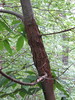 At the end of the ridge, Carole showed us a mature American Chestnut (Castanea dentata), blighted yet nevertheless putting out flowers and fruit. It is likely to succumb eventually, but it continues to throw out suckerish regrowth.
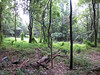 There are patches in the woods, however, that are still works in progress. This old farmstead was ablaze with Oriental Bittersweet before Carole’s machete-wielding team attacked. Now the battle is against the sprawling Polygonum.
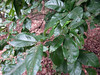
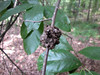 Heading down into the stream valley, the trails show evidence of scouring. But in a section that has been reclaimed from the big vines, Carole was able to show us Shingle Oak (Quercus imbricaria) along with its characteristic galls, formed by a cynipid wasp.
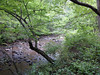 The Park’s east-west axis is the Hawlings River, which rises west of the park and flows to the Patuxent. The group spotted several little patches of Cranefly Orchis (Tipularia discolor)—in flower but long before the autumn emergence of its two-toned leaf. We looked at some additional restoration work; Carole likes to use Christmas Fern (Polystichum acrostichoides) (what a jawbreaker of a name!) because it stabilizes the soil and deer don’t like to eat it. Back in the meadow, we smelled two species of mountain mint (Pycnanthemum spp.) and a Monarda.
Bird life in the park sounded good: we heard Wood Thrush, Acadian Flycatcher, Common Yellowthroat. Eastern Bluebirds were hanging around, perhaps influenced by the nest boxes that were mounted in the meadow.
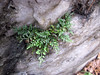 Bonus plant for the trip was the tiny Asplenium montanum, a Montgomery County rarity.