
Via Michael Perkins and Greater Greater Washington, the Coalition for Smarter Growth is collecting online signatures in support of funding of Metro’s operating, maintenance, and capital budgets. I support that cause, and if you live in the D.C. metro area, I think you should, too.
Author: David Gorsline
Some lists: 5
Fine slideshow of a dozen or so of the paintings borrowed by the Obama White House from local museums. Among the honored artists: Richard Diebenkorn and Washington Color School ally Alma Thomas.
Ferber decoded: 3
I have yet to make much of this passage in A Peculiar Treasure:
One of my delights was to have [Grandpa Neumann] take me on his knee and tell me stories of Edelvard and Kunigunda. (p. 25)
I suspect that the personages were Neumann’s own invention.
Tracking down Cutler-Hammer, to which Edna Ferber refers as an important employer in the upper Midwest, is much easier. Although the electrical and electronic products supplier was acquired by Eaton Corp. in 1978, the brand maintains an identity, albeit diminished, to this day.
Hawksbill Mountain circuit
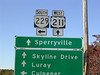 Through Virginia horse and wine country (every time I come through there’s a new winery offering tastings) to the big Park straddling the Blue Ridge, with a pause for this wonderful combination of wayfinder signs using “Freeway Gothic” and Clearview together.
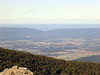 I devised a bowtie circuit starting from the Hawksbill Gap parking area: up the steadily steep trail to the Hawksbill Mountain summit, down the Salamander Trail to the Appalachian Trail, the AT north to the stables at Skyand, returning via the bridle path, Limberlost Trail, and Crescent Rocks Trail, with a quick side trip to my special place on the Ridge, Betty’s Rock. I’m estimating the mileage at 8.0; I went around in 4:20, and made the 680-foot climb of the mountain in about 25 minutes. Yay me.
 Except for the climb, the trails are fairly level, and the AT is not too rocky, at least mostly. Fall colors are still developing: I saw yellows and golds stirred into the pale green, with the occasional maple or sumac or poison ivy to provide a shot of red. Ravens and juncos constituted most of the bird life. One mixed flock of songbirds with a mystery warbler—perhaps a parula. A nuthatch calling very fast, in a ank-ank/ank-ank/ank-ank rhythm. Ground squirrels were very conspicuous, though they tried not to be.

 On the northwest side of the ridge, thriving in the poor soils of the talus fields, I found several stands of Mountain-ash, probably American (Sorbus americana), though the fruits are definitely red, not orange (per Petrides).
Conservation defined
At the heart of the Park idea is this notion: that by virtue of being an American, whether your ancestors came over on the Mayflower or whether they just arrived, whether you’re from a big city or from a rural setting, whether your daddy owns the factory or your mother is a maid: You, you are the owner of some of the best seafront property this nation’s got; you own magnificent waterfalls; you own stunning views of mountains and stunning views of gorgeous canyons. They belong to you. They’re yours. And all that’s asked of you is to put it in your will for your children, so that they can have it, too. Hopefully, you won’t let it be sold off, you won’t let it be despoiled. Hopefully, you’ll provide for proper maintenance of this property that is yours. But that’s all you’ve got to do. Now that’s quite a bargain.
—Dayton Duncan, The National Parks, a film by Ken Burns
Some links: 41
It turns out that Adolph Cluss’s handsome Franklin School, which I had noticed during a commute last spring, is the focus of some controversy, per reporting by Jonathan O’Connell. The city is seeking redevelopment partners for the site.
The school served as a homeless shelter until a year ago when [Mayor Adrian] Fenty closed it as part of his plan to restructure the city’s supportive housing services. The closure prompted protests from advocates for the homeless and Fenty did not hold a press conference to announce the solicitation as he has for other development plans.
The Laramie Project epilogue: an update: 2
We received the nearly final final draft of the script today, and we so we spent a chunk of this evening’s scheduled rehearsal scrambling to assign people to some of the new bit parts that have been created. Scenes have been sliced and diced and rearranged, to the good, I think. In one of my sections, in particular, the point that my speaker is making is much stronger, more sharply focused. Of course we already miss some of the little moments and characters from the earlier draft that we’ve become attached to.
It’s challenging—our production will be lightly staged (midway between the full productions and the readings from music stands that we’re hearing about), with our cast of fourteen seated in two rows of chairs when at neutral position, standing and coming forward to play the moments—to adapt to the rearranged script. We have only three more meetings scheduled between now and the 12th, and that’s probably the only date when all fourteen of us are in the same room together. But what an opportunity to be part of the evolutionary development of this text, to try to ride this bronco of a script.
A small online community of participants in the project has also sprung up.
Upcoming: 17
Via Round Robin, something worth a side trip to San Francisco on my next California trip: Maya Lin’s gramophone horn-influenced installation What Is Missing?, a plea for habitat and biodiversity conservation. A short video gives an idea of the experience.
Ferber decoded: 2
Edna Ferber refers in her autobiography to “ten-twenty-thirty repertory” theater as a turn-of-the-century popular entertainment of the upper Midwest, but she doesn’t tell us what the numbers mean. J. Richard Waite, in his Ph.D. dissertation (James R. Waite: Pioneer of “The Ten-Twenty-Thirty” Repertory) provides an explanation:
Even before he organized his own company, Waite believed the reason that so many touring companies were having little success was that they were charging too much admission. “James R. Waite, known as ‘The Barnum of Repertoire’, professed to follow the motto of ‘honesty, energy, and ten, twenty, and thirty-cents’.” [William Lawrence Slout, Theatre in a Tent, 1972)] Waite himself described his adoption of the popular prices:
The presidential elections of 1884 had precipitated bad business, and, determining to inaugurate popular prices, I jumped from Lincoln, Nebraska to Michigan and opened at ten, twenty, and thirty-cents. The immediate prospect was not pleasing, but the new schedule was continued, as it has been ever since. Confining the attraction for a few years to the smaller towns, I then began to improve the company and play better places. [New York Dramatic Mirror, 22 May 1897]
The general plan was to charge thirty-cents for the seats downstairs that were closest to the stage, twenty-cents for those back seats downstairs, and ten-cents for the gallery. Waite sometimes held “dime matinees” in which all seats sold for ten-cents, but most often he charged ten and twenty-cents for matinees. In a few cities Waite cut the admission to matinees to five-cents when that business became light. “The curious part of it is that this large and highly talented organization play at such popular-prices. As the manager said, there is nothing cheap about it except the price of admission.” [Portland (Me.) Daily Eastern Argus, 26 December 1894] Waite also varied his admission price by selling a special ten-cent ticket to ladies that admitted them to a thirty-cent seat. He used this advertising ploy particularly for opening nights, and tickets had to be picked up before 6:00 P.M. in order to get the cut rate. (pp. 73-75)
Surgery or bricklaying
Thanks to a reminder from The Writer’s Almanac, let us remember the birthday of William Faulkner. From Faulkner’s 1956 Paris Review interview:
Let the writer take up surgery or bricklaying if he is interested in technique. There is no mechanical way to get the writing done, no shortcut. The young writer would be a fool to follow a theory. Teach yourself by your own mistakes; people learn only by error. The good artist believes that nobody is good enough to give him advice. He has supreme vanity. No matter how much he admires the old writer, he wants to beat him.
Chafing
My example concerns a young woman patient who, in spite of efforts made on both sides, proved to be psychologically inaccessible. The difficulty lay in the fact that she always knew better about everything. Her excellent education had provided her with a weapon ideally suited to this purpose, namely a highly polished Cartesian rationalism with an impeccably “geometrical” idea of reality. After several fruitless attempts to sweeten her rationalism with a somewhat more human understanding, I had to confine myself to the hope that something unexpected and irrational would turn up, something that would burst the intellectual retort into which she had sealed herself. Well, I was sitting opposite her one day, with my back to the window, listening to her flow of rhetoric. She had had an impressive dream the night before, in which someone had given her a golden scarab—a costly piece of jewellery. While she was still telling me this dream, I heard something behind me gently tapping on the window. I turned round and saw that it was a fairly large flying insect that was knocking against the window-pane from outside in the obvious effort to get into the dark room. This seemed to me very strange. I opened the window immediately and caught the insect in the air as it flew in. It was a scarabaeid beetle, or common rose-chafer (Cetonia aurata), whose gold-green colour most nearly resembles that of a golden scarab. I handed the beetle to my patient with the words, “Here is your scarab.” This experience punctured the desired hole in her rationalism and broke the ice of her intellectual resistance. The treatment could now be continued with satisfactory results. (pp. 511-512)
—C.G. Jung, “On Synchonicity,” trans. R.F.C. Hull, collected in The Portable Jung
Sparks flying
Via DCist, Barry Farm (Re)Mixed posts images of rail being laid (at long last!) for the Anacostia streetcar line.
Clean: an update: 1
I almost let it pass without mention that Clean, by Audrey Cefaly, featuring Erika Imhoof and Nello DiBlasio, directed by Leta Hall, assisted by moi, has been selected by Silver Spring Stage to represent the company at the annual Maryland community theater one-act festival in January.
The Laramie Project epilogue: an update: 1
Saturday we spent a great day with Greg Pierotti of the Tectonic Theater Project. Greg was in town to workshop with the University of Maryland, Reston Community Players, and other groups in preparation for the simul premiere of an epilogue to The Laramie Project (which I performed with RCP in 2004).
We read a draft of the script (one from September 1) in sections, a third of the play at a time, and then Greg offered notes and other information that will color the performances. Since Greg did a lot of the interviewing for the material in this draft, he was invaluable as a resource to find out what this character sounds like or where another is coming from. He made it clear that one of the roles I will be reading on October 12 has the biggest, most emotional arc, and is also his favorite role of the 50-odd. No pressure.
Greg also went into some detail about the company’s process of building up a play from “moments.” Each 1- to 20-page scene starts out as a proposal and presentation by a company member. Once there are sufficient moments, polished to a certain degree, the writers assemble them into a running order, sort of in the way that tesserae are assembled into a mosaic (my image). Once so ordered, the moments begin to interact with one another and may require rearrangement and rewrites. Thus, in this draft we have evidence of the shuffling, as a speaker carries forward from one moment to the following but is reintroduced unnecessarily by a narrator. There’s also an incident that Russell Henderson refers to in this draft, and the draft doesn’t make it clear that it happened after the 1998 killing of Matthew Shepard—this will be fixed. At any rate, Greg reminded us that the closing line of each moment is a button, a question to be considered, a thought that tinges the way we watch subsequent moments, a challenge that may be confirmed or contradicted by the next moment.
While the company definitely has a story that they want to tell with this script, Greg says that they are fine-tuning the emotional temperature of the material, lest the enterprise come off like a crusade by the “Gay Avengers.” He gave some specific advice on how to play a specific laugh line (the joke is at his expense, no less): the writers are eager to inject as much lightness into this production as possible, as the last third of the play is rather rough sledding. “Laugh whore,” I think he called himself. More advice from my notes: play against the thoughtful quality of the text. More than once he told me, “X is very clear about what he is saying; avoid rumination and the naturalistic searching for your thoughts.”
He offered several anecdotes to illustrate the deep empathy shown by Fr. Roger Schmit, who echoes Greg’s own charge to find the inherent dignity in each and every one of these people.
Directory Andy and the cast will put this material on its feet with some simple staging, starting with a rehearsal on Friday. Maybe with a new draft of the script?
Kill your television?
Jad Mouawad and Kate Galbraith review U.S. residential electricity consumption. While standards for white goods like clothes washers have reduced usage substantially, the consumer electronics industry has resisted calls for producing more efficient gear.
The biggest offender is the flat-screen television. As liquid crystal displays and plasma technologies replace the old cathode ray tubes, and as screen sizes increase, the new televisions need more power than older models do. And with all those gorgeous new televisions in their living rooms, Americans are spending more time than ever watching TV, averaging five hours a day.
As a result, televisions and set-top boxes accounted for 6% of electricity use in the residential sector in 2005, six times that for computers. A 42-inch plasma device consumes 275 watts.
Make no mistake: other, less sexy equipment still eats a lot of watts. Air conditioning (18%), lighting (16%), and refrigeration (9%) are the biggest wedges of the consumption pie.