Author: David Gorsline
Peirce Mill river herring 2018
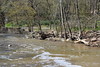 Neil Fitzpatrick and Bill Yeaman led a walk to Rock Creek and the fish ladder established in 2007 to enable migratory river herring to swim around the man-made barrier of the dam at Peirce Mill. And our luck was great! Despite some muddy conditions in the stream, many Gizzard Shad (Dorosoma cepedianum) could be seen, working their way upstream. Alas, no acceptable photos acquired. (Note to future self: bring a longer lens and a little more patience.)
On our walk down the somewhat trippy Melvin Hazen Trail, the group spotted a single Louisiana Waterthrush (Seiurus motacilla).
At the park: 94
From my report for last Sunday:
The birds appear to have hit the snooze button in response to the variable weather conditions. None of the nest has hatched out yet, while three new nests have started. Ever-popular box #62 is still incubating.
Unfortunately, it appears that the nest in box #67 has been abandoned. And the predator guard for box #60 was no match for a determined Common Raccoon (Procyon lotor), who consumed the eggs in the box. Box #60 is set rather low to the ground, on the bank of the channel; we should think about raising it or otherwise repositioning it.
We chased some paper wasps from box #67. I was cautious about seeing a wasp with yellow bands on the abdomen (as well as some wasps showing the more common all-black coloration), but it seems that several of the Polistes wasps in our area may show that feature, including the introduced P. dominula.
Fall zone
Benjamin Strauss et al. present a harrowing quiz: outline maps of various coastal states under one possible climate change scenario, in which sea level rises by 170 feet over the coming millennia. The geophysical boundary between Coastal Plain and Piedmont is unmistakable; farther south, other states would be obliterated.
Still ticking
I wrote up some notes on A Portable Cosmos, by Alexander Jones, a summary of what 120 years of studying the Antikythera Mechanism (one of my obsessions) have revealed to us.
Angular
Cecil Taylor’s passing reminds me of my favorite passage from Craig Lucas, from scene 2 of Blue Window. It’s a good thing that I have a printed copy to refer to, because my recollection of the dialogue, from a production I saw 22 years ago, is faulty.
At a small gathering/party of friends, Tom has put a recording of Cecil Taylor on the sound system.
TOM. But I don’t know if you can hear it, but I mean, he’s literally rethinking what you can do with melody. He’s changing all the rules from the ground up.
* * *
TOM. Like a painter. He’s breaking it up, you know, and putting some parts of it in front of where they belong and he’s splitting up tonalities and colors, shapes —
ALICE. Splitting up did you say?
TOM. Splitting.
ALICE. No, I know, I was…
TOM. He’s literally challenging you to hear it, you know, rehear it. What is music?
GRIEVER. No, I know, but this isn’t like a famous melody? Or –?
TOM. Why not?
GRIEVER. I mean it isn’t like “Raindrops on roses and whiskers on kittens” backwards or something.
TOM. No…
For some reason I always want to remember that as “‘Mairzy Doats’ upside down and backwards.”
The Pavilion
The Hub’s simple staging well serves Craig Wright’s wistful, spiritual three-hander, using a single movable set piece (a bench attached to pair of dock railings) to achieve some variety and levels. Helen R. Murray’s Kari shows some flintiness; but she takes her time with Kari’s tender, giddy closing monologue (“Do you remember that day in the spring of junior year…?”) and the result is masterful. Nora Achrati is called upon to embody a gaggle of different Pine City, Minnesota denizens, and she does a good job with the more naive characters like Pudge and Lisa, but she lacks the gravel and venom that Carla needs. Her second act opening monologue is quite thoughtful and fine.
Director Kelsey Mesa has chosen to present the show without the scripted intermission, blunting the force of Kari’s explosive first act closer.
- The Pavilion, by Craig Wright, directed by Kelsey Mesa, the Hub Theatre, Fairfax, Va.
Deep shadows cast by the house lights make this black box performance space a bit too literal.
No thanks
Elizabeth G. Knight, writing in the Bulletin of the Torrey Botanical Club, 11:11/12 (November-December 1884), p. 134:
Salisburia adiantifolia Smith. [a synonym for Ginkgo biloba] — Although it has been known for several years that the ginkgo fruits abundantly each year in Central Park, yet, as a recent copy of Henderson’s “Handbook of Plants” states, that “there has been no fruit borne in this country,” and as Josiah Hoopes in “The Book of Evergreens” does not note the fruiting of any of the trees he knows, I venture to say to all who are interested in seeing the fruit and desire to obtain specimens that they will be supplied upon application to me at the Normal College, N. Y. City.
Another source
Richard Conniff makes the case for a carbon tax on beef.
Agriculture, including cattle raising, is our third-largest source of greenhouse gas emissions, after the energy and industrial sectors.
* * *
Beef and dairy cattle together account for an outsize share of agriculture and its attendant problems, including almost two-thirds of all livestock emissions,….
* * *
The emissions come partly from the fossil fuels used to plant, fertilize and harvest the feed to fatten them up for market. In addition, ruminant digestion causes cattle to belch and otherwise emit huge quantities of methane [a much stronger greenhouse gas than carbon dioxide].
* * *
The way feedlots and other producers manage manure also ensures that cattle continue to produce methane long after they have gone to the great steakhouse in the sky.
I’m on the TV with Puff
Potomac River
Cathy Stragar and Stephanie Mason led a walk Sunday down the C&O Canal towpath from Point of Rocks to Monocacy, rescheduled from a rainy February day, and it was worth the delay: enough sun, not too cool, calm winds. And surprisingly birdy: I had 29 species on my list, and I think that the group detected a couple more. Top birds were a resting Barred Owl (Strix varia), spotted while we went off trail to measure the circumference of a 90-year-old Silver Maple; swarms of clean white-and-black Ring-billed Gulls (Larus delawarensis) drifting over farm fields; and skeins of migrating Tundra Swans (Cygnus columbianus), extremely high in the sky, identifiable only by voice. We nearly ran the table on mid-Atlantic woodpeckers, missing only (as you might expect) the Red-headed.
TIL the broken and peeled twigs of Silver Maple (Acer saccharinum) smell (to me) like stale bittersweet chocolate.
 Up and down the trail, the flowers of Virginia Bluebells (Mertensia virginica) were just starting to peep out from their shielding foliage.
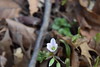 Cathy pointed out winter stoneflies that were starting to emerge, and she found the single Spring Beauty (Claytonia virginica) that had opened up.
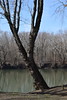 At river’s edge, a venerable Silver Maple was holding on. We covered the six miles in about 6:45, which is fast for this bunch of naturalists.
Uncommon lucidity
Google, his mother says. The new new found land. Not so long ago it was only the mentally deranged, the unworldly pedants, the imperialists and the naivest of schoolchildren who believed that encyclopaediae gave you any equivalence for the actual world, or any real understanding of it. And door-to-door salesmen sold them, and they were never to be trusted. And even the authorized encyclopaediae, even them we never mistook for or accepted as any real knowledge of the world. But now the world trusts search engines without a thought. The canniest door-to-door salesmen ever invented. Never mind foot in the door. Already right at the heart of the house.
—Ali Smith, Winter, pp. 192-193
Nom nom nom
Jawbreaker OTD. Myxomycetophagy: drawing nutrition, as in some beetles, from slime molds, both their spores and plasmodia. In Novozhilov et al., “Ecology and Distribution of Myxomycetes,” in Stephenson and Rojas, Myxomycetes (2017).
At the park: 93
Monitoring of nest boxes for Wood Duck and Hooded Merganser has commenced at Huntley Meadows. We had planned to get started on 25 February, but we were rained out. From my first report:
As I expected, we already have nests started in the boxes. What I didn’t expect was that we have FIVE nests started, 4 Hooded Merganser and 1 Wood Duck. First out of the gate was the merg hen in box #67, already with 10 eggs.
Paul reported that box #13 may need some additional (unspecified) maintenance….
Interesting birds of the day included a Northern Harrier and one of our new regulars, Red-headed Woodpecker.
For Leta: 7
Dara Weir’s “in the still of the night” at Poetry Daily.
no crickets, no crickets singing