Before checking boxes yesterday, I gave a short presentation to P. J. Dunn’s birding class about the nest box monitoring program at Huntley Meadows Park.
Oh, dear, I just realized that I never mentioned the bluebird boxes.
theater, natural history and conservation, the utterly mundane, and Etruscan 8-tracks
Before checking boxes yesterday, I gave a short presentation to P. J. Dunn’s birding class about the nest box monitoring program at Huntley Meadows Park.
Oh, dear, I just realized that I never mentioned the bluebird boxes.
A really strong workshop, with four good speakers, hosted by Virginia Native Plant Society at the University of Richmond. A theme emerged: interactions of plants with other organisms in the landscape, be they herbivorous White-tailed Deer (Odocoileus virginianus) (as discussed by Henry Wilbur, emeritus at the University of Virginia), or pollinating Eastern Tiger Swallowtails (Papilio glauca), who pick up pollen from Flame Azalea (Rhododendron calendulaceum) on their wings (only the second such association known, as discovered by Mary Jane Epps, postdoc at North Carolina State University [her work will soon be published]), or the unexpected linkage (through soil pH) of invasive Garlic Mustard (Alliaria petiolata) and the tiny arthopods known as springtails (Collembola), brought to us by Anne Alerding of Virginia Military Institute.
For me, the most interesting talk (and most challenging to follow along with) was Karen Barnard-Kubow‘s explication of her dissertation research on the genetics of American Bellflower (Campanulastrum americanum). This species has a range from the Virginia Coastal Plain to the breadbasket Midwest. Barnard-Kubow’s work has identified distinct clades: one in the East, one or two in the Appalachian Mountains, and one in the Midwest. Cross-breeding experiments on these populations suggests that the plant might be in the process of speciation. Her work also indicates that genetic material in the plant’s chloroplasts is sometimes inherited from the male parent, rather than strictly from the female, as received wisdom has it.
I posted some notes on Perfecto, Vandemeer, and Wright, Nature’s Matrix: Linking Agriculture, Conservation, and Food Sovereignty (2009) to my Goodreads account.
Looks like I won’t have to travel as far as L.A.
#isTooAKitty
Our feeling is that triple certification [of coffee] has great potential. Consumers might have a short attention span, but they’re not stupid. If presented in short, cogent messages that explain the connections between the social and the environmental arguments, the average coffee drinker can undoubtedly understand the triple certification concept—and if you think about those groups that are “target audiences” for such messages (social action groups in churches or labour unions; vegetarian and organic devotees; birder associations, etc.) then the message may be even more palatable and likely to be heard.
—Ivette Perfecto, John Vandermeer, and Angus Wright, Nature’s Matrix: Linking Agriculture, Conservation, and Food Sovereignty, p. 156
 The team faced down the sleety weather this morning to start the rounds of checking nest boxes.

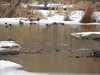 Following such a cold February, the wetland was substantially iced over, with only the main channel of Barnyard Run free-flowing. Which meant two things: first, we got some closer looks at wintering ducks than we otherwise might have.
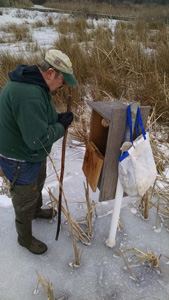 Second, the effort of walking up to the boxes was much easier. Most of the boxes were surrounded by firm ice (see guest photo by Kat). This also meant that we weren’t working over our heads—always a challenge for the more diminutive members of the team. It was only at the edges of open water where the ice would suddenly break through, threatening to tip the unwary monitor into the cold, cold water and mud.
The end result is that we made our tour in an hour and half No dawdling to look for birds (though we did see a Bald Eagle and a couple of Pileated Woodpeckers), no fussing with the hardware. Back to the cars before the next round of frozen stuff falls from the sky.
What we did not see, somewhat surprisingly, were any merganser eggs. Usually they get a least one box started ahead of us, somewhere in the last days of February.
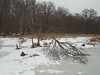 This windthrown maple is having a bad winter.
Lenika Cruz reports that The Powerpuff Girls will get a reboot on Cartoon Network next year. Let the heinie whupping recommence!
Wilson set his agon in the back yards of three Pittsburgh row houses. By contrast, the set for this production is spare, with nary a building in sight: nearly the only nod to realism is the patch of stony ground where King tries to grow flowers. To a certain extent this abstract approach works: Stool Pigeon’s opening prologue is given to the rest of the characters, who generally remain onstage throughout the evening. One gets the sense of a ritualistic retelling of a Greek tragedy. And the squared-off space of the Fichandler is the perfect setting for King’s Act 1 closing monologue by Bowman Wright, lightning escaping from the bottle. Would that the ring speeches on the pro wrestling circuit could be as terrifying.
E. Faye Butler produces some powerful, throaty vocal colors in her reading of Ruby. And André De Shields gives us a clear-headed Stool Pigeon. Thrust into the role of the community’s savant (now that the multicentenarian Aunt Esther has passed), their Teiresias manqué, Stool Pigeon never falls into the trap of mere mumbling craziness.
So, picking up some vibration in the air or other, I recently watched Keep On Keepin’ On (2014), Alan Hicks’s documentary about the relationship between veteran jazz trumpeter Clark Terry and the young pianist Justin Kauflin. The film was thin in the areas I was curious about, namely Terry’s career in the 1940s and onward—his departure from the Duke Ellington orchestra gets only an offhand mention, for instance—but it does a good job of telling the story it wants to tell. Terry was an influence on so many players, and he continued to nurture talents like Kauflin’s into his 90s. His body ravaged by diabetes, Terry kept on teaching.
My familiarity with Terry’s work is rather limited, but he was a gateway drug for me, like Dave Brubeck. I have a vinyl recording of Terry performing live with the Ohio State University Jazz Ensemble; this would be early 1970s, as I bought it after then band played a high school assembly for us. His work with the horn impressed me less than his vocal work, especially his signature piece “Mumbles,” an encore bit of rhythmic whimsy.
Anyway, it came as a slight shock to learn that Terry had died just this past week, as Reuters reports. Another one gone, but we have his recordings (more than 900 of them!) and his students.
The songbirds were exceptionally chatty on this rather cold day, so I was able to rack up a nice 22-species total for my count down along the Glade stream valley. And unless I’m mistaken, this is the first time that I’ve seen a Yellow-bellied Sapsucker on the count. One of the resident Red-shouldered Hawks was hunkered down, roosting in a tree with three crows, all of them trying to stay warm.
 I usually stop first at Lake Audubon to check on possible waterfowl. Nothing much happening today in the partly iced-over lake, just a half dozen Canada Geese at the edge of binocular range.
Colonel Cathcart was impervious to absolutes. He could measure his own progress only in relationship to others, and his idea of excellence was to do something at least as well as all the men his own age who were doing the same thing even better. The fact that there were thousands of men his own age and older who had not even attained the rank of major enlivened him with foppish delight in his own remarkable worth; on the other hand, the fact that there were men of his own age and younger who were already generals contaminated him with an agonizing sense of failure and made him gnaw at his fingernails with an unappeasable anxiety that was even more intense than Hungry Joe’s.
—Joseph Heller, Catch-22, chap. nineteen
In the past, when I’ve posted about shade-grown, bird-friendly coffee (for instance, here, here, and here), the research focus (by scientists like Ivette Perfecto and Russell Greenberg) has been on Central American farms and neotropical migrants. New research indicates that birds in Africa and Eurasia also benefit from shade cultivation in Ethiopia (the cradle of all domesticated coffee), as Brian Clark Howard reports. Ethiopian coffee farmers are under the same pressures to convert to intensive “sun coffee” production that their New World counterparts face.
“Importance of Ethiopian shade coffee farms for forest bird conservation” is now in press. Co-author Cagan H. Şekercioğlu
suggests that the Smithsonian Migratory Bird Center or the Rainforest Alliance, which certify bird-friendly coffee from other countries, should consider extending their programs to Ethiopia. Certification allows farmers to recoup a price premium, which can help deter the impulse to convert farms to full sun or otherwise develop their land.
Emily Graslie and Ernesto Ruelas go birding by ear (and occasionally, by eye) in the western Amazon.
So that’s what a toucan sounds like.
Many strong D.C. area actors combine to perform this this play of historical fiction, written in 1800. The payoff comes in the second half, a meeting in the woods of the two royal antagonists, Queen Elizabeth of England (a bottled-up Holly Twyford, until she explodes) and the eponymous Queen Mary of Scotland (Kate Eastwood Norris, beaming with paradoxical purity). And it’s a good payoff, but perhaps not enough to redeem the first half, laden with exposition and little lyricism, a challenge to the actors’ breath control. Rajesh Bose presents an interesting take on Lord Burleigh, hard-line adviser to Elizabeth who counsels her to execute Mary posthaste: he parks himself on stage and avoids superfluous movement. One is put in mind of a 16th-century Jabba the Hutt.
It was given to me, in the nineteenth century,
to spend a lifetime on this earth.
Along with a few of the sorrows that are appointed unto men
I have had innumerable enjoyments;
and the world has been to me, even from childhood,
a great museum.—Lydia Davis, “Our Village,” adapted from a manuscript by Sidney Brooks (1813-1887)