A mystery: 11

In the course of researching the life of Laura Lyon White (Mrs. Lovell White), I came across an interesting turn of events concerning LLW’s estate.

Laura’s husband, Lovell, a banker, died in 1910. Laura died in 1916. Their one surviving son, Ralston, married Ruth Boericke. The terms of Laura’s will specified that, if Ralston and Ruth had no children, a third of the estate was to be held in trust by the Savings Union Bank and Trust Company, later the American Trust Company, to build a monument to Lovell “typical of banking development in the State of California”. This provision seemed reasonable enough in the prosperous years before 1929. However, Ralston and Ruth’s financial circumstances declined during the Great Depression. Thus, when Ralston died in 1943, at his urging, Ruth contested the provision for the memorial.

Ruth lost her case, as far as I can determine, in a appellate court decision handed down in 1945. But if so, American Trust should have erected something. Yet I can find no evidence that a monument was built. I’ve written to a couple of knowledgeable sources, but so far have found no plaques or statues.

Now, in the old California Academy of Sciences, there once was a Lovell White Hall of Man and Nature. It was so designated by 1953, and still went by the name Lovell White Hall in 1986. The original Earthquake Theater was installed there. But Lovell White Hall would have come down in the 2008 rebuild; there is no such place in today’s California Academy of Sciences.

Did LLW’s money go to the CAS? I’m still following some leads.
Lessons

… there’s a second way to look at this. The violent opposition to the Vietnam War and the particular violence of May 4 [, 1970] also played a major role in ending the draft and thus insulated students and young people generally from many of the issues that had spurred such activism in the 1960s. Waging war today is a matter of finding the right price point at which sufficient numbers of young men and women will be tempted to risk their lives in service to their country. Arguably, too, it’s a matter of fostering economic conditions—underpaid and underemployed youth, hyper-expensive higher education—that make military service an attractive choice. What’s apparent, though, is that American troops have been in combat somewhere in the world almost continually since November 2001 with barely a whimper from the campuses that led the opposition to the Vietnam War.

—Howard Means, 67 Shots: Kent State and the End of American Innocence (2016), p. 220

Some links: 71

Catching up on a lot of bookmarks, so this will be a bit of a link dump.

  • Reduced-meat or meatless diets (Mediterranean, pescetarian, vegetarian) are both better for your health and more sustainable for the environment, as David Tilman and Michael Clark find in a recent paper, and as Elke Stehfest summarizes.
  • I am loving Nature‘s new sharing tools. Susannah Locke explains the journal’s move toward more open access.
  • Emily Dreyfuss signed up to give Wikipedia six bucks a month.

    …Wikipedia is the best approximation of a complete account of knowledge we’ve ever seen.

    It’s also the most robust. The most easily accessed. And the safest. It exists on servers around the world so, unlike the library at Alexandria, it can’t be burned down.

    You should chip in, too. kottke.org

  • The Biodiversity Heritage Library has opened an online exhibit dedicated to women in science who began working before 1922. Some of my recent subjects are there, including Florence Merriam Bailey and Mabel Osgood Wright.

I am relieved

The states of North and South Carolina are completing the resurvey of their common boundary, using high- and low-tech means, as Stephen R. Kelly notes in a recent op-ed and Kim Severson reported some time back. The colonial-era border was intended to consist of two straight lines, the 35th parallel and a diagonal crossing up from the coast. But 18th- and 19th-century surveyors made a hash of it, resulting in today’s rumpled compromise.

The rework was not intended to smooth out any of the coarse wrinkles, like the wobble around the city of Charlotte, but rather to replace the notched trees, now dead, and wandering survey monuments (including one moved by a golf course in order to impress golfers [?!]) that had originally marked the boundary.

But rest assured! South of the Border is still where it “Otto B.”

Mens sana in corpore sano

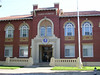
crispOn my way up and down J Street (so you know I wasn’t in downtown D.C.) to visit Mom I passed this charming brick and terra cotta edifice, which turns out to be the Sacramento Turn Verein, now a German language and culture society.

sound mind sound bodyRiding the wave of German immigration in the mid 19th century, the American Turnerbund movement established athletic clubs in Cincinnati; Philadelphia; Columbus, Ohio; and elsewhere. It had its roots in a nationalistic yet democratic student movement in the early 1800’s, founded by Friedrich Ludwig Jahn.

Jahn’s nationalistic spirit contributed to his role as a promoter of “patriotic gymnastics,” recognized as a strong force in Prussia’s liberation. The gymnastic exercises that he introduced were intended to infuse his students with a patriotic love of freedom that would make them capable of bearing arms for their country, in the name of war of liberation.

American Turners opposed slavery and served in the Union Army in the U.S. Civil War.

What’s cooking?

The New York Public Library has launched another crowdsourced digital transcription project of analog source materials, similar to the North American Bird Phenology Program. The NYPL is seeking volunteers to extract information from its store of historical restaurant menus. So far, data on more than 170,000 food items offered for sale has been pulled from more than 2,800 menus. There is lots of work yet to do:

With approximately 40,000 menus dating from the 1840s to the present, The New York Public Library’s restaurant menu collection is one of the largest in the world, used by historians, chefs, novelists and everyday food enthusiasts…. The New York Public Library’s menu collection, housed in the Rare Book Division, originated through the energetic efforts of Miss Frank E. Buttolph (1850-1924), who, in 1900, began to collect menus on the Library’s behalf. Miss Buttolph added more than 25,000 menus to the collection, before leaving the Library in 1924. The collection has continued to grow through additional gifts of graphic, gastronomic, topical, or sociological interest, especially but not exclusively New York-related.

A sign of the times

sign onesign twoSeveral years ago I noticed these old fallout shelter markers on the apartment block at 1901-1907 15th Street, N.W. There are at least four affixed to the exterior. These Cold War mementos are badly faded now; it’s hard to know whether a capacity was ever marked on the signs.

I always meant to do some research and write up the story of these yellow and black sentinels. But it turns out that Bill Geerhart did a much better job than I ever could have done. See also this photo gallery of signs still visible in Milwaukee and elsewhere.

Roger, Twan

Via kottke.org, awesome annotated transcript of the last half hour of audio communications between Houston and the Eagle LM during its descent and landing on the Moon. I didn’t realize that an important part of the astronauts’ navigation was watching how fast objects moved past scribed marks on the craft’s window, as means of computing velocity. Sort of like watching tell-tales.

I remember staying up to watch the first walk, my Instamatic in hand to take a snapshot off the TV screen.

A couple of years later, when Apollo 15 landed at Hadley Rille, I thought it would be a fine idea for the city of Oakwood to rename its Hadley Avenue for the lunar feature.

On behalf of H.M. Government

Noël Coward acted covertly on behalf of the British government in the early years of World War II. Coward kept mum about his involvement, but the recent publication of his letters, with commentary by Barry Day, has “pulled a fair amount of the covert nitty-gritty out of the archival murk,” as Stephen Koch writes.

Being Noël Coward, he also partied—notably with the recently abdicated pro-Nazi Duke of Windsor and his more intelligent and even more pro-Nazi wife. The Windsors may have looked like Coward’s type, but Coward had always privately despised the former king. In 1936, he wrote, “I’ve known for years that he had a common mind and liked second-rate people, and I am sure it is a good thing for England that he abdicated.”

By 1940, the Windsors had graduated from mediocrity into real menace. One factor in the abdication had been that the prime minister had been told, reliably, that the woman inflaming the king’s already fascistic sentiments was a friend of Ribbentrop and the next thing to a Nazi agent. After the abdication, the Windsors were married in the residence of a Nazi collaborator. As the Battle of Britain approached, British intelligence believed—correctly—that Hitler, assisted by Ribbentrop, planned to restore the duke to the throne as a quisling monarch. Worst of all, intelligence suspected that the couple may have been complicit in this treachery….

We can only speculate whether Coward was keeping unofficial tabs on the couple.

Fallout

Via Ward-O-Matic, Conelrad is “devoted to ATOMIC CULTURE past and present but without all the distracting and pedantic polemics.” A featured multi-page article provides the production history of “the Citizen Kane of of Civil Defense,” Duck and Cover.

A few years ago, I noticed some apartment blocks on 15th Street that still carried the black and yellow CD signs indicating the presence of a fallout shelter. The last time I was in that neighborhood, I couldn’t relocate the signs. I’ll keep a lookout.