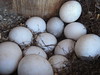
Park staffer Kat checked on our nest boxes last week. This year, with volunteer monitoring on hold, we probably won’t have sufficient observations to get good estimates of laying and hatch dates, but we’ll take what we can. She reported six active nests, three nests that had hatched out, and three that are abandoned (including that early starter, box #5).
Category: In the Field
Sky Meadows State Park
Virginia state parks are still open for day use! A staffer directed me to a spot in the overflow parking area at 10:30 on a pleasant, gusty Saturday morning.
I made a loop with the North and South Ridge Trails, about 3 miles in 3:15. That 700-foot (or so) climb just gets harder every year, but I can still do it, a few minutes at a time. Not too busy on the trails, mostly couples and small groups.
Among the butterflies, Eastern Tailed-blues were out, along with a few Zebra Swallowtails. A quick glimpse of an anglewing. Trees had not leafed out, so there were some spring ephemerals: Spring Beauty on the warmer, lower slopes; Bloodroot at higher elevations; a bit of Early Saxifrage; Cut-leaved Toothwort was fairly common; Rue Anemone always confuses me the first time I see it for the year.
Field Sparrows and Eastern Meadowlarks singing in the pastures.
I may have missed it the last time I was in the park: the American Chestnut Foundation has a baby orchard planted along the Boston Mill Road.
At the park (not): 109
This week’s message to my team:
I believe that all the team has received word from Halley that volunteer activities at the Park remain suspended. Quite disappointing, but necessary.
I hope, but don’t expect, that the siege will be lifted and that we can get at least one work day in at the end of the season, maybe mid-May or later.
’til then, as a thin compensation, I’ll offer a couple of YouTubes: Wood Ducks hanging out and 23 (!) ducklings exiting a box.
Stay safe, thanks for your patience, and wash your hands!
At the park: 108
From this week’s report:
No new nests started this week. We’re watching box #5, which has a full clutch of eggs but no evidence of incubation. Chris rescued my stick, which went for an extended swim in the new pool by the observation tower.
We plan to work again next week, 22 March. We will keep an ear out for guidance from the Park.
At the park: 107
First week of nest box monitoring. From my report:
Earlier and earlier! We have eggs in three of our boxes already: 12 Hooded Merganser eggs in #5 (on the remains of last year’s songbird nest), 13 Hooded Merganser eggs in #7, and 4 Wood Duck eggs in #1 — all subject to recheck and confirmation.
We did not fill boxes #68, #60, and #13 with chips, in anticipation of their replacement. Box #13 is the priority for replacement: the term of art applied was “hot mess.”
Bonus bird sighting was a flock of 500+ Common Grackles (Quiscalus quiscula) moving across lower Barnyard Run.
Protip: your walking stick serves double duty as an icebreaker.
Great Backyard Bird Count 2020
Rather pleasant weather for February, and a typical species count of 19. I found a nest for the RSHAs that hang out in this stream valley. HAWO was perhaps the surprise species. 3 AMCRs were giving a FICR what for. No ducks on the lake.
Space Coast Birding and Wildlife Festival 2020: 2
I took a break from the birds to look at some specialties of Floridian flora with Jim Stahl. We walked the grounds of the Merritt Island NWR visitor center (some of the greatest hits had interpretive signs), as well as the oak hammock trail not far from there.
We learned some quick keys for distinguishing between two very common native palms: the shrubby Saw Palmetto (Serenoa repens) and the tree-sized, covered with “boots,” Cabbage Palm (Sabal palmetto). Saw Palmetto has flat fronds and those prickles, while a Cabbage Palm leaf has a central vein that causes the leaf to form a V, and an older leaf will split along this vein. Cabbage Palm also shows brown stringy bits. On a Saw Palmetto, the fronts radiate from the distal end of the petiole, while a Cabbage Palm is costapalmate: the petiole extends farther into a midrib, forming sort of a teardrop shape.

Jim pointed out two myrsine species, Marlberry at left and “Rapanea” at right.
We saw far too many examples of the non-native invasive Brazilian Pepper (Schinus terebinthifolia), one of six species on the refuge’s hit list. The tree was in bright red fruit in January.

The heavy, ruddy streaks of sori on Swamp Fern (Blechnum serrulatum) are quite distinctive.
Florida has a very large fern with pinnae that suggest our local Christmas Fern; it’s Acrostichum danaeifolium. Perhaps now I can remember the back half of the scientific name of our fern, Polystichum acrostichoides.
Space Coast Birding and Wildlife Festival 2020: 1
I returned to Florida for the first time in far too many years for my first SCBWF. I twitched 120 species, give or take, including 10 new birds for me. Many of my lifers were Florida specialties, including Snail Kite (Rostrhamus sociabilis) and the introduced Purple Swamphen (Porphyrio porphyrio). Compared to the similarly-colored Purple Gallinule, the swamphen is huge.
I did some pre-birding in Ocala NF before the festival opened, hoping to find a Florida Scrub-jay (Aphelocoma coerulescens) for myself. No bird, but I did walk the Florida National Scenic Trail for about 100 meters.
Many very early mornings, but absolutely worth the missed sleep. Here, sunrise on the St. Johns River.
On a special trip to St. Johns NWR, we heard Black Rail (Laterallus jamaicensis) responding to a recording (habitat photo at left). Then, a couple days later, a few of us at Merritt Island NWR got a fleeting visual of the bird!
Somewhat more conspicuous on Merritt Island was the Vehicle Assembly Building on the Kennedy Space Center campus.
Trip leader David Simpson likes to call Anhinga (Anhinga anhinga) the flying Cuban sandwich, because of its appressed body.
Chasing sharp-tailed sparrows in Shiloh Marsh, we had some extra company: a Canadian film crew collecting footage for a documentary. They were following Paul, seen here at the extreme left in the photo.
I was excited to see a few birds that weren’t new to me, but might as well have been, since I see them so rarely: Mottled Duck (Anas fulvigula), Orange-crowned Warbler (Vermivora celata), Sora (Porzana carolina), Stilt Sandpiper (Calidris himantopus), Black-bellied Whistling Duck (Dendrocygna autumnalis). Over on iNaturalist, I have posted some observations of the easier-to-spot Limpkin (catching an apple snail) and Tricolored Heron, as well as a couple butterflies: White Peacock and Long-tailed Skipper (missing its long tails).
Our pelagic trip results were somewhat subdued (it’s entirely possible that our bad luck was due to the banana that someone brought on the boat), but we had some fun scooting around the shrimp boats. The captain will drop small “try nets” to sample the waters, haul them in and count the shrimp that have been caught, then toss the bycatch back. That’s when our birdy friends swing into action. Here, the Miss Lynn is hauling in a try net.
On our return from the Gulf Stream, about 30 miles offshore, our chum attracted a couple of kleptoparasitic Magnificent Frigatebirds (Fregata magnificens), who put on quite the show harassing the terns, gulls, and pelicans just trying to catch an honest meal.
Every festival is a little different. Perhaps the most comfortable difference of Space Coast was the extra room in our buses for the longer trips. I had a double seat to myself for all three trips.
My year in hikes and field trips, 2019
Here in the mid-Atlantic:
- Riverbend Park wildflower and salamander surveys, Fairfax County, Va.
- The Glade, Reston, Va.
- Rock Creek Park, Washington, D.C., first walk of the Mason and Bailey Club (and scouting)
- Brookside Nature Center, Montgomery County, Md. (scouting)
- Little Bennett Regional Park for butterflies, Montgomery County, Md., led by Tom Stock (and separate walks led by Sujata Roy for wildflowers and Stephanie Mason for just enjoying the meadow)
- Woodend Sanctuary for summer mushrooms, Montgomery County, Md., led by Serenella Linares
- Dark Hollow Falls loop, Shenandoah National Park, Va.
- Rachel Carson Conservation Park, Montgomery County, Md., second walk of the Mason and Bailey Club (and scouting 1 and 2)
- Virginia Master Naturalist conference, Harrisonburg, Va.
- Potomac River, Montgomery County, Md., led by Stephanie Mason
Plus several trips to my home park, Huntley Meadows Park, Fairfax County, Va.
And in Iceland:
My iNaturalist and Flickr maps look very unbalanced.
2018’s list. 2017’s list. 2016’s list. 2015’s list. 2014’s list. 2013’s list. 2012’s list. 2011’s list. 2010’s list. 2009’s list. 2008’s list.
My year in iNaturalist, 2019
I started recording observations in iNaturalist as part of a wildflower survey for Riverbend Park. Since then, I’ve used it casually, capturing the unusual that I can identify, and the usual that I can’t. Thus, my iNaturalist year in review. The map of observations by time period is rather interesting, if a bit stalkerish.
Walk among the Giants
Stephanie Mason led a small group through very changeable weather this morning. This is a regular loop for her, following the River Trail from the C&O Canal NHP visitor center and returning along the canal towpath. Because this stretch of floodplain has some majestic trees, among them 200-year-old sycamores, she has styled this trip Walk Among the Giants.
Stephanie pointed out some abundant drifts of the basal rosettes of Golden Ragwort (Packera aurea). I need learn that not all winter rosettes in the floodplain are Gill-over-the-Ground or Garlic Mustard.

We stopped for a Shumard Oak (Quercus shumardii), an uncommon tree for the metro area.
At this point, my camera’s power gave out. But we did have some interesting discussions and opportunities for follow-up. I confessed a distaste for the messy suckerish habit of Box Elder (Acer negundo), yet Stephanie mentioned the tree’s food value for overwintering wildlife, and the rather attractive clusters of samaras persisting on the tree’s branches.
The question of where non-native invasive Wineberry (Rubus phoenicolasius) came from came up (it’s native to Japan-Korea-China) and when it was introduced. Sources indicate that it was brought into North America in about 1890 as breeding stock for other blackberry cultivars.
It is used today by berry breeders to add specific genes to berry varieties or species. Wineberry is an example of one man’s flower being another man’s weed. Given containment, wineberry has desirable and useful qualities, but due to its invasive nature, it is considered a significant pest of agricultural and natural ecosystems.
We saw a good ten or twenty Bufflehead (Bucephala albeola) feeding and loafing on the river.
At the park: 106
Better late than never, here’s the graphic of nesting success for the spring season. The Wood Duck number is a minimum. We had two nests for which we never took a good count of eggs, and a third nest that perhaps was predated. I did not count these nests in the year’s total.
The Hooded Mergansers were 40 for 51 (78%) and the Wood Ducks were 32 for 86 (37%). First estimated hatch date for the hoodies was 4 April, and the last estimated hatch date for the woodies was 29 June.
Some links: 86
- Converting 35% of the acreage of a coffee farm to shade-grown culture can maximize revenue, according to new research by Amanda Rodewald et al. and summarized by Gustave Axelson. Depending on the premium paid for shade-grown coffee, that percentage can go as high as 85%.
- A smartphone attachment can test for the presence of norovirus in a drinking water sample and produce results in five minutes. The promising prototype comes from the biomedical engineering lab of Jeong-Yeol Yoon. Joe Palca reports.
In the wake of hurricanes and other storms, flooding can cause sewage systems to overflow, potentially mixing with water intended for drinking. Municipal water system managers would breathe easier if they could be certain they didn’t have to worry at all about norovirus contamination.
- How to cross a river. The water at Huntley Meadows Park is never this fast or cold.
- Melissa Errico submits a “self-tape” audition.
VMN conference 2019
Three interesting workshops at the conference, formally the Virginia Master Naturalist Program Statewide Conference and Volunteer Training, held this year in Harrisonburg.
Michael Pelton and David Kocka talked about the natural history of American Black Bear (Ursus americanus)—which comes in four color morphs, including the blue-gray “glacier bear” found in the Pacific Northwest—as well as problems in human-bear interactions. Fun fact: bears actually do eat Bear Corn (Conophilus americana).
Emily Thorne’s dissertation research consists of understanding the Virginia habitat preferences, distribution, and genetics of Eastern Spotted Skunk (Spirogale putorius). She’s recruiting VMN volunteers to set up and monitor game cameras pretty much statewide; it’s known from the Blue Ridge west, but could be found east of the mountains as well. This little critter does a handstand as a defensive warning behavior—very cute.
Chelsey Faller, Wildlife Disease Biologist with DGIF, is spreading the word about Chronic Wasting Disease (CWD) in White-tailed Deer (Odocoileus virginianus) in Virginia. 69 cases have been reported in the state since its arrival in 2009. It’s particularly prevalent in Frederick County, and a Disease Management Area has been established for Frederick, Shenandoah and two adjacent counties. Inspections of deer harvested this season in Shenandoah County are mandatory.

For a hands-on exercise, we learned how to perform the dissection to obtain specimens for lab testing. Although CWD is a prion disease that affects the nervous system, in White-tailed Deer it can first be detected in the lymphatic system. So the dissection removes the retropharangeal lymph nodes (behind the voice box).
How to age a deer? Pry open its jaws with this gizmo and check the dentition.
Chelsey is also looking for volunteers at check stations.
Mason and Bailey: 3
The group, post-walk, all of us well shod. Lovely weather, some nice butterflies to watch. Kris found Beefsteak Plant (Perilla frutescens) in bloom, as well as a goldenrod bunch gall. That Red-shouldered Hawk kept squawking.