Last Saturday’s field trips took us to two freshwater wetlands in southern P.G. County, one well-known among naturalists, the other decidedly off the beaten path.
We met M-NCPPC ranger Chris Garrett at Suitland Bog. Chris is an accomplished trip leader who knows his park and what’s important to see, how to move the group along, and when to just take a moment and look and listen.
The park lies in the watershed of Henson Creek, a small trib of the Potomac. It’s actively managed: one of Chris’s great challenges is preventing the bog (technically it’s a fen, as much of the water comes from seeps) from drying out under the pressure of encroaching maples and willows. And there is Microstegium at the doorstep.
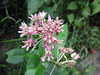 Several of the orchids on the plant list printed in the park brochure are probably extirpated, but Chris was able to point out Green Wood Orchis (Platanthera clavellata). He also found for us Ten-Angled Pipewort (Eriocaulon decangulare), the tiny Spatulate-leaved Sundew (Drosera intermedia), Halberd-leaved Greenbrier (Smilax pseudochina), and Red Milkweed (Asclepias rubra). We also got good looks at Netted Chain Fern (Woodwardia areolata), this time in fruit—alas, my snapshots were not satisfactory.
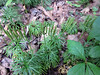 On the slopes leading down to the bog (sorry, fen), a Common Wood-Nymph (Cercyonis pegala) was on the wing (a first for me), and Chris showed us a fine patch of Lycopodium, including patches with sporangia.
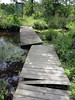 Chris and the class moved south to Cheltenham Wetlands Park, a 200-odd acre tract next door to a Homeland Security facility. The park is sometimes likened to a better-known park across the river as “Huntley Meadows Park without the people,” or the amenities, for that matter. There is no visitor center, parking is on the outside of a locked gate, and those fellows from DHS might give you the stink-eye. The budget for keeping the boardwalks in trim is also lacking.
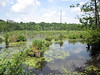 But it’s a charming little wetland, all the same. Stories differ as to how the water showed up in the wetland to begin with. The property was once home to an array of radio antennas (like HMP) (you can see remnants of the supporting poles here and there) and was managed by the U.S. Navy. One story is that a brass hat ordered the low spots to be dredged to support bass fishing; another is that the access road to the radio antennas formed a dike that retained water from periodic floods of Piscataway Creek.
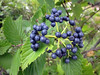
 Bird life at late morning was stil jumping: I counted 18 species heard or seen. Swallowtails of various sorts were numerous, and the Eastern Kingbird we saw was likely snacking on them. Arrowwood Viburnum (Viburnum dentatum) was in fruit, and Buttonbush (Cephalanthus occidentalis) flowers were starting to mature. The destination plant for this scrub-shrub swamp is Common Bladderwort, with its itty-bitty yellow flowers emerging from the water above a haze of fine brown roots below the surface.