“Have iPhone Cameras Become Too Smart?,” by Kyle Chayka. I really want to quote the whole piece as a blockquote, but I will just pull out:
We are all pro photographers now, at the tap of a finger, but that doesn’t mean our photos are good.
theater, natural history and conservation, the utterly mundane, and Etruscan 8-tracks
“Have iPhone Cameras Become Too Smart?,” by Kyle Chayka. I really want to quote the whole piece as a blockquote, but I will just pull out:
We are all pro photographers now, at the tap of a finger, but that doesn’t mean our photos are good.
A much warmer and more successful morning.
More nests started, and five are incubating! Eight boxes are active. Our first Wood Duck box is #1, in the pool by the tower.
We repaired the hardware cloth on box #68. Access to #84 remains a problem: as mounted, the lid won’t open sufficiently. Next week we plan to repaint the number for box #67 and clean up trash around the tower.
Some splashes of Spring Beauty, with most buds tightly closed in the mid-morning.
Until next week! Arigatoo!
Small disaster. Last week’s cold snap and snow left the ponds iced over on Sunday. Ordinarily, we can break through the ice with our sticks, but the ice was just thick enough that instead, I tried following C’s footsteps out to box #2, the first box off the boardwalk— walking in an area that I didn’t know very well. Almost immediately, I lost my balance and caught some serious mud from the wetland. As a result, we cut the work day short. We’ll get ’em next week.

 Fortunately, I had my chest waders on. My jacket got the worst of it.
After 40 years of work, Guinea worm disease is nearing eradication, but we’re not there yet. A reservoir in other animals is a hindrance to getting rid of it entirely.
Neonics aren’t just bad for pollinators. As Shauna Stephenson reports, aquatic invertebrates are also adversely affected, which is bad news for fish.
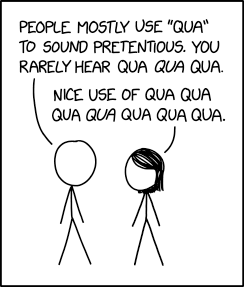
Sam Beckett has an answer to that.
Oh, a very much useful annotation unearthed by M. Paul Shore: recte.
For the last four-and-a-half decades of my life, from late teens to early sixties, I’ve had the nagging feeling that there ought to be a Latin scholarly expression that one could use when presenting the correction of an erroneous word or words in quoted material alongside the error itself.
Another Sunday’s report:
Nests continue to develop. Box #68 added 7 eggs, just as if the hen was reading the calendar. My notes say that we have 4 eggs in #7 and 4 eggs in #77 — I will double check. And the 14 eggs in #6 are now incubating. It’s a little difficult to get a good count for this box.
We screwed together boxes #7 and #77. We also tried to adjust box #84, but in the process, the pole snapped off. It had rusted at the former waterline. So we did what we could, but the box is now low to the ground and a little wobbly.
K and C will leave some hardware cloth in the shed so that we can patch the duckling ladder in box #68.
I was responding to a query from a Friend of Little Hunting Creek: that group is looking to install some nest boxes, and I was sharing some of our experiences. And I realized that I didn’t have a previous blog post to direct them to on the subject of raccoon-resistant box closures. In fact, I couldn’t remember the name of one of the pieces of hardware that we use. So let’s rectify that missing information.
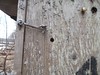 In some cases, a hook-and-eye on a spring has been sufficient.
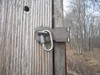 For the more tenacious critters, we’ve gone to a hasp closed with a quick link. Links come in various sizes, so make sure you have one to fit the hasp. The link looks something like a carabiner, but it doesn’t squeeze open. Rather, you have to twist the hexagonal part. After a few years in the elements, you will need to give the link a bit of lubricating oil.

 Finally, after a dark and cold winter, some color in my Winogradsky column project. The streaks of rusty red are perhaps iron oxidizers, or purple non-sulfur bacteria. And perhaps at the bottom of the column I see some blobs of purple, evidence of sulfate reducing bacteria.
Water levels are very high in the main wetland and down Barnyard Run. Where there was once a discernible channel is now just flat water. From my e-mail report to the team and staff:
Our merganser friends continue get the jump on us: we have 14 eggs in box #7 and one egg in box #68.
Small problems: the roof is loose on #77, and the back of #7 is held on with a latch. I’ll bring a power screwdriver and we’ll see whether we can tack them back together.
Larger problems: the soil around box #4 has washed away, so we can’t access the box effectively. Stilts, maybe? New box #84 (thank you box makers!) has a roof opening, but because of the way it’s mounted, we can’t access the box interior.
Bonus observations: multiple Red-shouldered Hawks (Buteo lineatus), including a pair being mobbed by American Crows (Corvus brachyrhynchos) in the main wetland and a juvenile seen at close range, feeding on perhaps an Eastern Ratsnake.
I didn’t go out until the weather cleared and warmed up. I visited my usual patch along the Glade, plus I visited a new-to-me patch in Great Falls called Lexington Estates Park. This park is in my Christmas Count sector, but we did not visit it in 2021. There are no amenities, not even any signs, just a bit of shoulder to park on. Part of the property is mapped as a school site. A single unmarked trail more or less connecting two cul-de-sacs running along some bottomland; a small impounded pound that turned up two Mallard pairs, a Wood Duck pair, and an Eastern Phoebe. The space is big enough to support Red-shouldered Hawk and Pileated Woodpecker, so that’s good. On the downside, the biggest individuals of Leatherleaf Mahonia (Berberis bealei) that I’ve ever seen. Combining the two sites, I had a nice species count of 27, for 2:35 of birding time.
An excellent piece by Nick Roll on a different example of intercropping: “Farmers in Senegal learn to respect a scruffy shrub that gets no respect.” In this case, it’s Guiera senegalensis, in the Combretaceae (white myrtle) family. In a reversal of shade-grown coffee’s pattern, target crops (like millet) grow above the shrub, which brings up water into the millet’s root zone. Research indicates that Piliostigma reticulatum, a legume found in wetter parts of the Sahel, can also pull off this hydraulic redistribution trick.
This is the kind of digital-only (no audio) work that I wish we did more of. Not every bit of journalism needs to be in a podcast.
Noreen Malone captures the mood of the moment:
The act of working has been stripped bare. You don’t have little outfits to put on, and lunches to go to, and coffee breaks to linger over and clients to schmooze. The office is where it shouldn’t be — at home, in our intimate spaces — and all that’s left now is the job itself, naked and alone. And a lot of people don’t like what they see.
And even closer to home:
It wasn’t just the bad sexually harassing bosses who were fired but the toxic ones, too, and soon enough we began to question the whole way power in the office worked. What started out as a hopeful moment turned depressing fast. Power structures were interrogated but rarely dismantled, a middle ground that left everyone feeling pretty bad about the ways of the world. It became harder to trust anyone who was your boss and harder to imagine wanting to become one. Covid was an accelerant, but the match was already lit.
WATCH assignments are out for the calendar year, and after a run of 2002-2019, I do not have a year’s worth of shows to judge. I am sitting out until the COVID-19 situation calms down, if it ever does. Hard same from two of my other judges, and my fourth has departed the metro for Albany. Fortunately, through the grapevine I’ve been able to recruit four judges for Silver Spring Stage. I remain ambivalent about all this: the last thing we should be doing is sitting in a box with a bunch of strangers projecting. Anyway, among other shows, my team will be seeing A Little Night Music (Sondheim/Wheeler) and Prelude to a Kiss (Lucas).
I lent a couple of my Hooded Merganser images to Chuck Gates and the East Cascades Audubon Society for their photographic compendium of nests and young birds of Central Oregon.