
Ride it while it lasts: The D.C. streetcar “system” is set to be phased out.
At the park: 154
Overall, fledging success has been good, but we have had direct observations of Black Ratsnakes in three of our sixteen boxes, plus an additional box from which all the eggs removed/consumed by an organism unidentified. From this week’s report:
Snakes alive! Yet more Black Ratsnake activity in the boxes. We checked box #7, which was hatching on 26 May, and estimated 9 fledglings. Box #6 had reports of snake activity in the period of 26 May to 2 June. Nevertheless, we found 9 WODU eggs in the box, but they were not yet being incubated. Box #1 now has 14 eggs incubating, with an estimated hatch date of 4 July. And N. and I. found a snake in Box #3. Too much drama.
So we have four remaining boxes with possible activity: #6, #1, #3, and #60 (estimated hatch 24 June).
Let’s do a work day on Sunday, 6 July to cover those four boxes, 8:30 AM as usual. Again, we won’t need to whole team: let me know whether you can come. We’ll try to keep cool.
Floyd Collins: addendum
A follow-up to my notes on the Lincoln Center Floyd Collins: the new production lightens the tone a bit, and gives Floyd more music. The discordant, clashing music for “I Landed on Him” is shortened, now being just an underscoring of Skeets’ tale. Floyd now has the songs “And She’d Have Blue Eyes” and “It Moves.”
Operation Mincemeat
As the drop curtain flies out, the first thing we see is a pair of black patent leather wingtips belonging to Ewen Montagu (Natasha Hodgson, possessor of a righteous growl), arrogantly propped up on a desk. A little over the top, you say? Oh, just wait. This fizzy poly-character musical comedy, based on the true story of a misinformation operation designed to mislead German defenders of Sicily in World War II, hardly gives one time to breathe—the patter songs are that fast, the glitz has glitter all over it, the physical schtick goes to extremes, the character switches flash by in an eyeblink. The show doesn’t just effervesce, it hypervesces.
I’ll call out Jean Leslie’s (Claire-Marie Hall) Beyonce-level song, “All the Ladies,” and Hester Legatt’s (Jak Malone) quiet “Letter to Bill.” Hester is fabricating a letter from home to a British flier (in order to build up the subterfuge), and her heartbroken subtext elicits some snuffles in the audience. Malone also appears as an American pilot, with all the Yankee doodles.
Highly recommended.
- Operation Mincemeat, book, music, and lyrics by David Cumming, Felix Hagan, Natasha Hodgson, and Zoë Roberts, orchestrations by Steve Sidwell, directed by Robert Hastie, John Golden Theatre, New York
See Brian Selbert’s piece for the Times for a peek at the backstage magic.
New York May 2025
Sited art and found art in NYC.

 Details from the stunning Abstract Futures, by Hilma’s Ghost collective (Sharmistha Ray and Dannielle Tegeder), 3rd Avenue entrance to the 7 train.

 P???man Building, 350 W. 31st Street. Maybe “Postman,” as it is home to a postal workers’ union and is right across the street from the Farley post office.

 Looking through Tony Smith’s Throwback at a proffered plaza between 45th and 46th Streets. The marker has a hilariously detailed catalog of what the plaza has to offer:
This plaza contains: 78 linear feet seats with backs, 606 lf planter seats without backs, 134 movable chairs, 35 trees, 1 drinking fountain, 3 bicycle racks, 160 cubic feet litter receptacles, 1 drinking fountain, 1 water fountain, 1 artwork
 The view from the 16th floor of the Marriott Marquis. At center, the relatively diminutive St. James Theatre on 44th Street, surrounded by rooftop water towers.
Antony and Cleopatra
For the most part, the most effective passages of this newish piece are the orchestral interludes: the marriage of Antony and Octavia, the battle at Actium, Rome’s celebration of victory over Cleopatra and Antony’s forces. A significant exception is the chilling scene of Octavian’s (Paul Appleby) victory speech, staged as a radio broadcast by a certain Italian leader of the 1930s-1940s.
A hammered dulcimer/cimbalom in the orchestration adds an exotic note.
There’s just something about the character dynamics of Shakespeare’s play that fail to make a compelling story.
- Antony and Cleopatra, composed by John Adams, libretto adapted by John Adams from William Shakespeare, directed by Elkhanah Pulitzer, The Metropolitan Opera, New York
Floyd Collins
The new production at Lincoln Center is a luminous reading of Adam Guettel’s Floyd Collins, a musical inspired by the true story of the titular Kentucky caver who found himself trapped, while a media circus sprang up above ground. Lighting by Scott Zielinksi catches Floyd in follow spots as he spelunks; backlighting sharply delineates townspeople in silhouette tableaux against the cyc.
Guetell’s twisty music likewise follows Floyd up, under, over, and around during “The Call” sequence. When Floyd (Jeremy Jordan) is joined by his younger brother Homer (Jason Gotay) for the duets “Daybreak” and “The Riddle Song,” the results crackle with electricity. The Reporters’ patter song “Is That Remarkable” is all one could wish for.
Floyd’s set contrivance on which he spends much of his time supine has perhaps been modified: it doesn’t quite resemble the lounge chair that bothered some critics. Maybe a lounger as designed by Gerrit Reitveld.
Monochrome costumes (Anita Yavich) and props for “The Dream” foretell Floyd’s demise.
- Floyd Collins, music and lyrics by Adam Guettel, book and additional lyrics by Tina Landau, orchestrations by Bruce Coughlin, directed by Tina Landau, Lincoln Center Theater at the Vivian Beaumont, New York
TK: Notes on differences in the performed music from the recorded original cast album.
Dead Outlaw
Rollicking is a word perhaps falling out of use, but it’s a good one for Dead Outlaw, an ensemble and country rock band comic musical about the preposterously improbable life and afterlife of Elmer McCurdy, feckless bank robber of the early 1900s whose mummified corpse was a sideshow attraction into the 1940s. Oh, and promotional device for 1930s exploitation filmmaker Dwain Esper.
The show-stopper song is “Up in the Stars,” sung and swung by Thom Sesma as Los Angeles County Cornoner Noguchi, a medical professional who’s seen a thing or two. Ring-a-ding-ding! Andrew Durand is McCurdy: it’s the only time that you’ll read “stiff” as complement for an actor. Carrying the narrative ball of wax through time and space is good ole boy Jeb Brown as narrator and Bandleader.
Props to the technical crew, who manage to bring a loaded concrete mixer onstage for Elmer’s final rest, and to deftly turn the quick striking of a set piece into a sight gag.
- Dead Outlaw, music and lyrics by David Yazbek and Eric Della Penna, book by Itmar Moses, orchestrations by Della Penna, Dean Sharenow, and Yazbek, directed by David Cromer, Longacre Theatre, New York
Some links: 108
- D.C. Circulator buses find new homes far from the city
- Fact-Checking the ‘President Who Follows Science’ on his environmental record
- An Inside Look at the Subway’s Archaic Signal System in NYC
- An Open Letter to Robert F. Kennedy Jr., Who Thinks My Daughter Is a Tragedy, by Anaïs Godard
Your version of the future has no room for her. Thankfully, she doesn’t need your permission to belong. She’s already here.
- Leo Mazzone is still rockin’: An Old-School Pitching Coach Says I Told You So
“All anyone in the majors watches now is how damn fast a guy can throw,” he told me, rocking on his heels. “Grunt and heave, grunt and heave. It’s not pitching; it’s asinine.”
- Oh, lovely, first the Colorado and now this: A Crucial River Treaty Is Tangled in Trump’s Feud With Canada
Negotiations over the Columbia River basin could affect the environment in Canada and electrical generation and flood control in the United States.
- Damn, those things are much bigger than I realized: a rubber bullet in the Museum at the Times
Hmm, the Times and the Post have different headline casing styles.
At the park: 153
The nesting season for our Wood Ducks and Hooded Mergansers has been a bit topsy-turvy:
Good news, bad news, what’s new? We have at least 3 new Wood Duck clutches started in the past 10 days or so. So part of the bad news is that we’ll probably be working in July. More bad news is that we lost at least one clutch to predation, and another to abandonment. Back on the plus side, 3 boxes hatched out in the past week, for a total of 6 for the season. And C and N found young in Box #7, which will make 7 boxes.
For our next work day, we’ll only need to check 5 boxes: #2, #7, #6, #1, and #3. Let’s set that date as Sunday, 8 June. We won’t need the full complement of the team. Let me know if you can make it on the 8th.
Then, depending on what we find on the 8th, we might go in late June or early July….
Vielen Dank!
NC-VA Coastal Plain 2025
 I took my first birding trip with Victor Emanuel Nature Tours (VENT), running up the coast from Wilmington, N.C. to Norfolk, Va. Kevin Burke was our excellent guide, always making sure that everyone got on the bird at hand—not to mention handling the driving (always ready to give an extra lift not on the tour), lodging logistics, and finding tasty restaurants. We were five participants; here’s Kevin in the lead of the other four on the beach near Oregon Inlet.

 I rode Amtrak to get to Tidewater, but since the tour was one-way, I needed to bridge the gap between the cities. I hopped a Greyhound/FlixBus for the first time in decades. While the coach was quite comfortable, I needn’t have paid for a double seat because there were few riders. As I expected from the barebones stop at Union Station here in D.C., most bus stations these days are tragically spartan, with no options for food or toilets. We pulled in to parking lots and abandoned gas stations. Here’s one exception: a spiffy new transit hub in Greenville, N.C. Ha! Closed on Saturday.
 Sunday was our first day out birding. Kevin had scouted a little-known corner of pine forest where Red-cockaded Woodpecker (Dryobates borealis) could be found, answering its wake-up call at 07:15. At Orton Pond, a very cooperative Prothonotary Warbler (Protonotaria citrea) turned up, as well as an American Alligator (Alligator mississippiensis) that slunk through the water. Down the road my first lifer for the trip arrived, Bachman’s Sparrow (Peucaea aestivalis).
After lunch, I started to learn the handful of seaside plants, among them Coastal Water-pennywort (Hydrocotyle bonariensis), American Sea Rocket (Cakile edentula), and Saw Greenbrier (Smilax bona-nox).
The next day, Kevin improvised a ferry trip to Shackleford Banks, where I found a beautiful new tiger beetle for me, Eastern Beach Tiger Beetle (Habroscelimorpha dorsalis) (woot!) (likely ssp. media), and a robber fly that predates on the tiger beetle, Sand Hammertail (Efferia albibarbus) (woot-woot!).
And then, mostly a travel day to Hatteras on two care ferries, but we did stop at a boat launch access road for another lifer and long-tormenting nemesis bird, Least Bittern (Botaurus exilis).

 Wednesday was scheduled for a pelagic trip, but the weather had other plans, as the surf at Avon Pier illustrates. So once again Kevin cooked up some good birding, including a visit to Bodie Island Lighthouse. The Dancing Turtle in Hatteras is a good place for early morning coffee and pastries, but skip the bagels. (David’s new rule: Don’t order bagels in a shop without “bagels” in its name.)
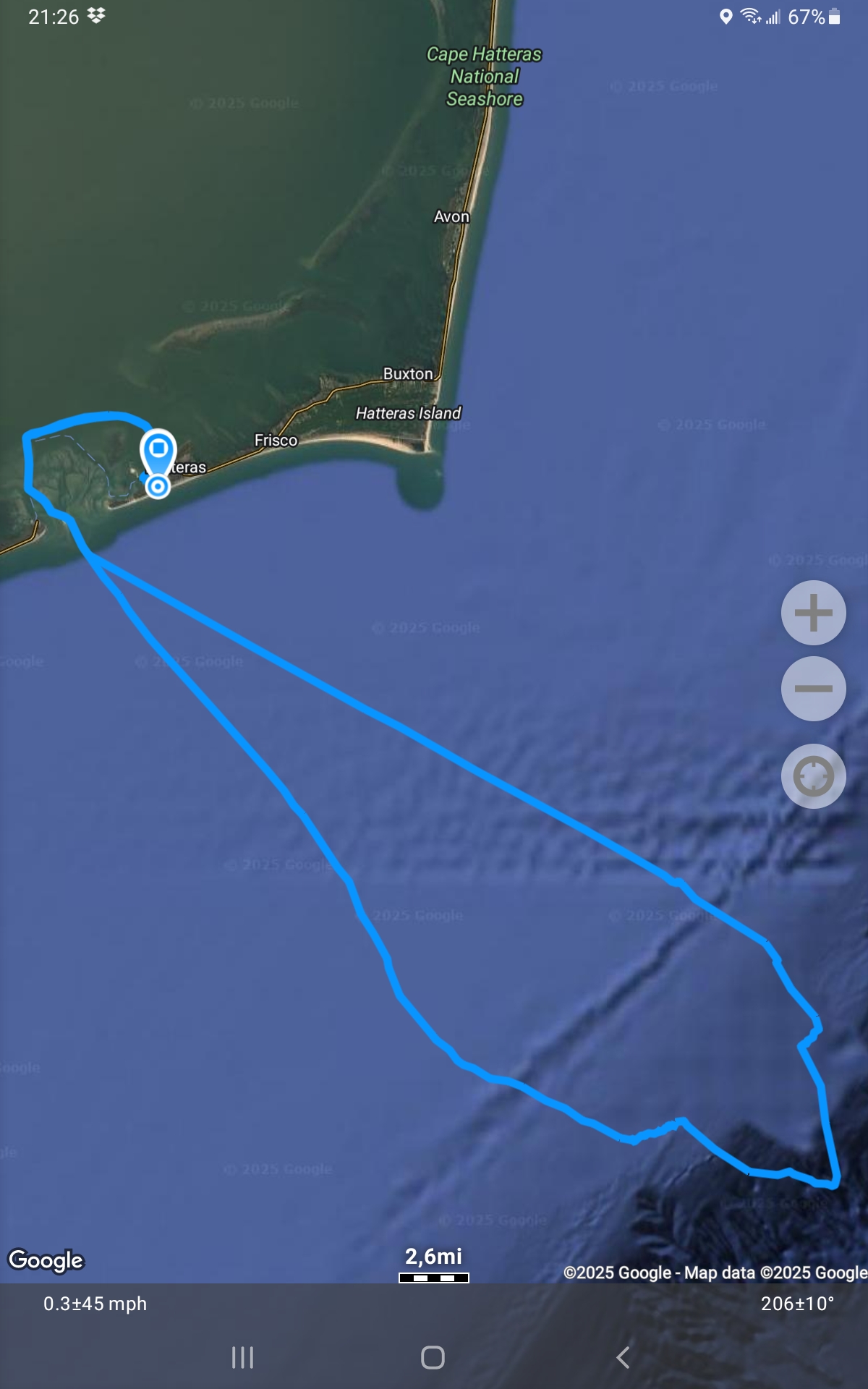 Thursday we got out on to the water: we were advised that it would be “sporty” and “confused.” Indeed. For the first time in decades, I joined the Fellowship of Ralph. But after tossing all of my skimpy breakfast and coffee, and having a bit of a lie-down, I roused myself to photograph four lifers, including two storm-petrels, Wilson’s (Oceanites oceanicus) and Band-rumped (Hydrobates castro). Also spotted: several flying fish and a Portuguese Man O’ War (Physalia physalis)—surprisingly tiny. The captain of our boat could take a note from VENT on customer service and being welcoming.
Takeaways:
- Shutter priority is your friend. The bird is moving in three dimensions, and the boat is moving in three different dimensions.
- You’re not too old for dramamine.
We wrapped up the tour, skirting the Great Dismal Swamp. Seven life birds for me; the group got skunked on Belted Kingfisher (?!). I have a thing for Boat-tailed Grackle (Quiscalus major).
Your Eastern North Carolina dialect word is preesht, that is, “I appreciate it,” otherwise, “thank you.”
Head Over Heels
Jeff Whitty and James Magruder’s free adaptation of Sir Philip Sidney’s 16th-century Arcadia, with songs from The Go-Go’s and places nearby, is a great wakeup for a drowsy Sunday afternoon. Amping up the cross-dressing plots of Sidney’s original material, Head Over Heels upends gender norms and is, in the words of a program note, “a celebration of queer joy in all its forms.” The text, a blend of Elizabethan English, florid “Eclogue” spoken by the shepherd Musidorus, and 21st-century language, is a language lover’s delight. “Ventilate the belfry of thy mind,” one character says. Wait, what?
Worthy of note are very fine ensemble choreography by Maurice Johnson, Stephen Russell Murray’s subclinically hysterical worrywart courtier Dametas, and Julia Link’s Pamela, delivering a righteous rock and roll belt.
It wouldn’t be a Constellation show without puppets by Matthew Pauli, including an enormous snake puppet on rods and a singing chorus of sheep (“Mad about You”).
- Head Over Heels, songs by The Go-Go’s,* based on The Arcadia by Sir Philip Sidney, conceived and original book by Jeff Whitty, adapted by James Magruder, directed by Allison Arkell Stockman, music direction by Walter “Bobby” McCoy, Constellation Theatre Company, Washington
*and others
This is be Constellation’s last production at the (perhaps snakebit venue) Source Theatre.
Clifton Institute bioblitz May 2025
I participated in another bioblitz organized by the Clifton Institute, this time at Sunnyside Farm & Conservancy in Rappahannock County. I visited the farm last year for a dragonfly count for the Institute. With several insect experts in the group, I was able to file 57 observations, including
- a Giant Bark Aphid (Longistigma caryae) resting on Dr. Hardtacks’ back bumper;
- a Twice-stabbed Stink Bug (Cosmopepla lintneriana), always a popular common name;
- a pair of conjoined Azure Bluets (Enallagma aspersum), a new damselfly for me;
- a passable recording of Prairie Warbler (Setophaga discolor) against the background noise of breezes and naturalist chatter; I used my tablet and the Merlin app, rather than my dedicated audio recorder, trading off a better directional mic for on-the-fly ID suggestions;
- a non-native cress that I didn’t know, Land Cress (Barbarea verna);
- a very lucky shot of Common Baskettail (Epitheca cynosura) on the wing.

 Early in the afternoon, we took a break from chasing plants to observe technicians working with an American Kestrel (Falco sparverius), one of the study subjects in the Institute’s long-running research project into this species’ ecology on farmland and restored prairie.
Temporary
Subtweets from WaniKani? 仮 Temporary
イ Leader + 反 Anti
Meaning Mnemonic
Your leader is very anti-everything, making it all temporary. You get a new shirt, “I’m anti shirts!” she yells, and out it goes.
She tires of things so quickly, you hardly have time to get used to them before they’re gone.
Reading Mnemonic
The leader’s most temporary possession is her car (か). Or… cars, because they’re all very temporary. She buys one, drives it around, and then suddenly she’s anti red car. She needs a blue one!
Picture all of the temporary cars she’s tried filling up an entire junkyard. They’re all a little different, but in the end they were all just temporary fads.
How many houses
§18 Don’t let it bother you that languages (2) and (8) consist only of orders. If you want to say that they are therefore incomplete, ask yourself whether our own language is complete—whether it was so before the symbolism of chemistry and the notation of the infinitesimal calculus were incorporated in to it; for these are, so to speak, suburbs of our language. (And how many houses or streets does it take before a town begins to be a town?) Our language can be regarded as an ancient city: a maze of little streets and squares, of old and new houses, of houses with extensions from various periods, and all this surrounded by a multitude of new suburbs with straight and regular streets and uniform houses.
—Ludwig Wittgenstein, Philosophical Investigations,
trans. G. E. M. Anscombe, P. M. S. Hacker, and Joachim Schulte