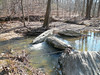
 Gaylan Meyer led a two-hour workshop in introductory identification of mosses in Fred Crabtree Park, just south of Reston on Fox Mill Road. Fred Crabtree Park (renamed from Fox Mill Park since the last time I visited) is a pleasant patch, protecting part of the Little Difficult Run watershed. Gaylan has identified at least ten, maybe 12 moss species in the park.
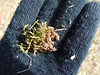 We keyed out one species, using the recent McKnight et al., Common Mosses of the Northeast and Appalachians (2013). The first swell surprise about moss ID is that there’s not a lot you can do in the field with mosses. You can classify plants into growth form, acrocarp or pleurocarp, and if you’ve got tweezers and a hand lens you might be able to look at leaf shape and the presence of a midrib. Gaylan identifies this as Yellow Yarn Moss (Anomodon rostratus). For the remaining mosses we looked at on the trip, we relied on Gaylan’s scouting of this location and his patient work at home with his microscope.
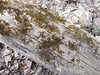
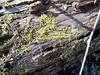 Oil Spill Moss (Platygyrium repens), at left, and Feather Comb Moss (Ctenidium molluscum), at right, are pleurocarps, frequently branching and usually trailing along the substrate.
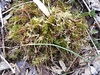
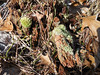 The more conspicuous mosses are acrocarps, with upright stems packed together like tufts of carpet. At left is Wavy Starburst Moss (Atrichum altecristatum) and at right is Pincushion Moss (Leucobryum glaucum). For the starbust moss, the sporangia, ending in the brown tubular capsules (empty, with lid off), are fairly well imaged.
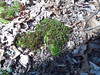 Gaylan’s call on this plant is Polytrichum commune, but after checking the Digital Atlas of the Virginia Flora, I think that Juniper Haircap Moss (P. juniperium) is much more likely. By the way, the otherwise invaluable USDA PLANTS database is pretty hopeless for range maps for mid-Atlantic bryophytes.
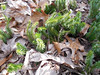 We also looked at a few plants that are not mosses. Here’s a lovely patch of Shining Clubmoss (Huperzia lucidula), a/k/a Shining Firmoss. The clubmosses, firmosses, running cedars, and such are in a bit of a classification jumble. But they are nevertheless vascular plants that only happen to resemble true mosses.
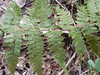
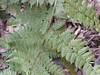 And a fern-savvy member of the group ID’d this as Spinulose Woodfern (Dryopteris carthusiana). I didn’t get an image of the entire frond, but at least this time I remembered to look at the sori.

 Our resident beavers have rebuilt the lodge that wants to overtake the bench at the start of the boardwalk. And, at that same spot, they have built a new dam off to the left of the boardwalk.
 Down by box #13, on the dry land before the observation tower, I found something that’s fairly common but I’d never noticed it before, probably because I wasn’t looking for it: the hunkered-down, overwintering, two-colored leaves of Cranefly Orchid (Tipularia discolor).