John Adams chats with Renee Montagne about his works, old and new.
He had me at the mbira
If your cellphone rings in the middle of a John Cage concert, Paolo Angeli knows what to do with it: he’ll fine some way to wedge it into his baritone guitar.
A musicologist’s wet dream.
Happy homeowner dance

 I am taking a moment to enjoy my new windows (right). No more cracked-glass, peeling paint windows (left) that don’t open, don’t close, and don’t seal out the cold air and dust.

 And the scary kitchen window with the busted sash that needed a stick in the track and a shim under the lock to stay closed and secure? Gone!
Linus vindicated
The Great Pumpkin rises again over Silver Spring. Thanks, Charlie!
On the radio: 8
Jane Gilvin reads the employee directory to Mike and Ian.
Nature, unnerving
Andy Goldsworthy talks to Terry Gross.
A mystery: 9
Cannery Row, like every place else, is not superstitious but will not walk under a ladder or open an umbrella in the house. Doc was a pure scientist and incapable of superstition and yet when he came in late one night and found a line of white flowers across the doorsill he had a bad time of it. But most people in Cannery Row simply do not believe in such things and then live by them.
—John Steinbeck, Cannery Row, chapter 25
A quick search doesn’t turn up anything relating to white flowers across the doorsill and their insalubrious nature. Any suggestions?
Upcoming: 43
A reason to get back on the Orange Line: Artomatic is coming to New Carrollton at the end of the month, as Bob Niedt reports.
George Bell, 1942-2014
A sublime (in the older, aesthetic sense of slightly frightening) piece by N. R. Kleinfield on the death and life of George Bell, who died alone in Queens. Memento mori, indeed.
Road trip 2015
Leta and I patched together a road trip of several places that we’d never visited before. Much driving, many quick stops, unmanaged time zone changes, and an emergency trip to the phone repair shop, but a good trip nonetheless.
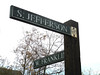 In downstate Indiana, we visited Leta’s colleagues at their offices in Bloomington as well as our theater friend Erika in nearby Nashville. The street name signs in this town with artist colony roots are quite nice.

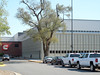 Also a quick afternoon in Columbus (this part of Indiana is full of cities that share names with much bigger burgs) for a gawp at the architecture. I found much more to see than we’d planned for, so we’ll have to come back (and schedule a Miller House tour in advance). But we did find the Robert N. Stewart Bridge (J. Muller International, 1999), which is very fine. And we wandered as far as the Cummins Inc. Plant One—perhaps less noteworthy architecturally, but it’s a reminder of my B-school days and many, many case studies.
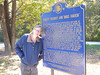
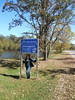 The next day we moved on to Olney, Illinois, resting place of Robert Ridgway and his family, where I made one photo to contribute to the Commons. The historical marker on U.S. 50 is easy to see, but Bird Haven is a little trickier to find—unless you listen to Leta and look for the big blue sign. We lunched at the Roll with It Bakery on Main Street, justifiably known for its “loaded” cinnamon rolls.
 Relentlessly, we headed south for Memphis: Beale Street, the National Civil Rights Museum at the Lorraine Motel, Wapanocca NWR across the river in Arkansas. We both enjoyed dinner at South of Beale. An unexpected find to add to my collection was this fallout shelter sign downtown on Court Avenue.
 After breakfast at Brother Juniper’s in the university district, we pushed on to the bigger Nashville to see Reid (Leta’s cousin) and Jocelyn. Jocelyn gave us a tech tour of Nashville Ballet’s costume shop. We paid homage to the closing sequence of Robert Altman’s Nashville with a visit to the Parthenon in Centennial Park.
Predators
A great investigative series by Michael Pope for WAMU on car-title and consumer-finance-loan lenders in Virginia and their bait-and-switch tactics. To call these disreputable outfits bottom-feeders is an insult to catfish.
Please stand by
My host and I are working out some security settings. Apologies if the site looks like rubbish in the meantime.
Max has got it
Baseball considers itself the most thoughtful of games, a pastime more than a sport, written about with reverence and lyricism, in which pitching is considered more art than athleticism.
Yet the primary term used to explain the art of pitching, which often determines who wins and who loses, is an inelegant word of ill-defined mush.
Andreas Wolf reflects
The apparatchiks, too, were an eternal type. The tone of the new ones, in their TED Talks, in PowerPointed product launches, in testimony to parliaments and congresses, in utopianly titled books, was a smarmy syrup of convenient conviction and personal surrender that he remembered well from the Republic. He couldn’t listen to them without thinking of the Steely Dan lyric So you grab a piece of something that you think is gonna last. (Radio in the American Sector had played the song over and over to young ears in the Soviet sector.) The privileges available in the Republic had been paltry, a telephone, a flat with some air and light, the all-important permission to travel, but perhaps no paltrier than having x number of followers on Twitter, a much-liked Facebook profile, and the occasional four-minute spot on CNBC…. The New Regime even recycled the old Republic’s buzzwords, collective, collaborative. Axiomatic to both was that a new species of humanity was emerging. On this, apparatchiks of every stripe agreed. It never seemed to bother them that their ruling elites consisted of the grasping, brutal old species of humanity.
—Jonathan Franzen, Purity, pp. 448-449
Women Laughing Alone with Salad
Sheila Callaghan’s new play, a satire of gender roles and social expectations about mental and physical fitness, features some high-energy set pieces: white girls rapping about how to satisfy them, a dance club that morphs into a Paris boîte in the 1920s, a food fight with heads of lettuce. There’s a rejuvenation regimen with just a few nasty side effects that suggests the grotesqueries of Terry Gilliam’s Brazil. What the play lacks is any sort of emotional journey for Meredith, Tori, or Sandy to embark upon.
It’s only in the second act, when a well-executed reversal develops, that we see much in the way of human feelings: it comes in the form of a lovely monologue by Janet Ulrich Brooks, looking back on the life of her first act character (Sandy) through the eyes of Sandy’s son.
- Women Laughing Alone with Salad, by Sheila Callaghan, directed by Kip Fagan, Woolly Mammoth Theatre Company, Washington