New fare media from last month’s trip through New Jersey. And New Jersey Transit—bless ’em—still produces well-designed map/timetable brochures. The TAPP card for PATH doesn’t accept add-value at stations, so it’s largely a nice-to-have for now.
Tag: photo
Urban railfanning in PA-NJ
Inspired in part by posts by Classy Whale and Trains Are Awesome, I drove up to the Philadelphia metro to ride some transit services that were new to me.

On Friday, starting from Trenton, I rode the River Line light rail to Camden to connect to PATCO for a short hop to Philadelphia. Hmm, the heat in my River Line car didn’t seem to be working. While there are plans to renovate/redevelop it, the Walter Rand Transportation Center in Camden is, right now, nothing short of a dump.
I closed the loop with a SEPTA train back to Trenton. The tile mosaic in Jefferson Station is stunning.

Saturday was a bit more enjoyable. Starting from Trenton again, I rode New Jersey Transit’s (NJT) Trenton line to Newark Penn Station, switched to a PATH train and rode it as far as Exchange Place.

A quick snap of the New York Financial District in some light snow that followed the overnight wintry mix, and then I was off to the Hudson-Bergen Light Rail station.

During my 10-minute wait in the chilly weather, I glanced at the rather fine historical map built into the Exchange Place station platform. (I’m still looking for some information about this map.)

The HBLR took me to Hoboken Terminal, where I boarded an NJT train that ran all of two stops to Newark Broad Street. From there, the third of NJT’s light rail systems, the Newark Light Rail, took me back to Newark Penn Station. Completing my round trip on the Trenton line, I was back to Dr. Hardtacks and headed for home.
Hoboken Terminal is a place of drafty, broken grandeur. Flooding from Superstorm Sandy didn’t help the situation. Some stained glass remains, and the vintage benches are still serviceable, but a renovation (also planned) cries out to become reality.
Something the video bloggers don’t talk about much is how much time you spend waiting. Since I was traveling on Saturday, I had a bad connection at Hoboken Terminal and laid over for almost two hours. Fortunately there are two coffee and donut shops still operating there.
In Newark, my first return train was cancelled. There were lots of delays on Amtrak and elsewhere posted on the departure boards, no doubt due in part to the winter storm.
Christmas Bird Count 2025: Seneca
The CBC for the Seneca count circle took place on 14 December. Overnight left a frosting of snow, followed by dropping temperatures and wind. I lost two counters due to illness, a third to the weather, and a fourth to travel. Nevertheless, my team in sector 14 turned up 47 species (pending returns from one more feeder watcher). Lake Fairfax was nearly completely iced over, with nothing but Canada Geese loafing in the open water and a lonely Ring-necked Duck foraging. Our special birds were (pending review) Cackling Goose (Branta hutchinsii), Broad-winged Hawk (Buteo platypterus), and Orange-crowned Warbler (Leiothlypis celata).
I started an iNaturalist project to keep tabs on possible sightings on future counts. So I was at least able to add a Dark-eyed Junco (Junco hyemalis) to the project.
On deck: 28
I’ve acquired a couple new doorstops. I’m almost through the collection of Philip K. Dick novels.
I need to catch up on my Goodreads notes.
Violette’s Lock 2025
I’ve been to this bit of the C&O Canal at least once before back when I was starting to learn plants, probably more. Wednesday it was very quiet: I think we’re far enough upriver to be out of the flight paths for DCA. Sassafras showing fall reds and yellows, some lingering asters like Symphyotrichum cordifolium. I found an ichneumonid wasp, tentatively Coleocentrus rufus, and an oil beetle, Meloe sp. J. D. Pinto in BugGuide says, “It is difficult to distinguish females of Meloe americanus from M. impressus without examining pygidial structure (americanus females have a narrow apical flange).” (link added)
Elklick Woodlands meadow
A quick report from the meadow unit of Elklick Woodlands Natural Area Preserve, accompanied by Darko Veljkovic and other Fairfax County Park Authority Staff. No trail, just bushwhacking through this property that’s been under restoration, with prescribed burns last year and the year before. Still lots of non-natives to be winkled out, but the Bidens aristosa are having a great time. We also found Sweet Everlasting (Pseudognaphalium obtusifolium), a relative of pussytoes.
Wakefield Park grasses and things
Another hot, muggy morning, another walk in the power line easement of Wakefield Park. I’ve explored this stretch several times, this time again with the Grass Bunch.
The only new species that I recorded an observation for is Delicate Cycnia Moth (Cycnia tenera), A/K/A Dogbane Tiger Moth, conveniently posed on a bit of dogbane. Aw, snap! I saw this species at a bioblitz two summers ago. But! Partridge Pea (Chamaecrista fasciculata) is a new species for my observations.
New York May 2025
Sited art and found art in NYC.

Details from the stunning Abstract Futures, by Hilma’s Ghost collective (Sharmistha Ray and Dannielle Tegeder), 3rd Avenue entrance to the 7 train.
P???man Building, 350 W. 31st Street. Maybe “Postman,” as it is home to a postal workers’ union and is right across the street from the Farley post office.

Looking through Tony Smith’s Throwback at a proffered plaza between 45th and 46th Streets. The marker has a hilariously detailed catalog of what the plaza has to offer:
This plaza contains: 78 linear feet seats with backs, 606 lf planter seats without backs, 134 movable chairs, 35 trees, 1 drinking fountain, 3 bicycle racks, 160 cubic feet litter receptacles, 1 drinking fountain, 1 water fountain, 1 artwork
The view from the 16th floor of the Marriott Marquis. At center, the relatively diminutive St. James Theatre on 44th Street, surrounded by rooftop water towers.
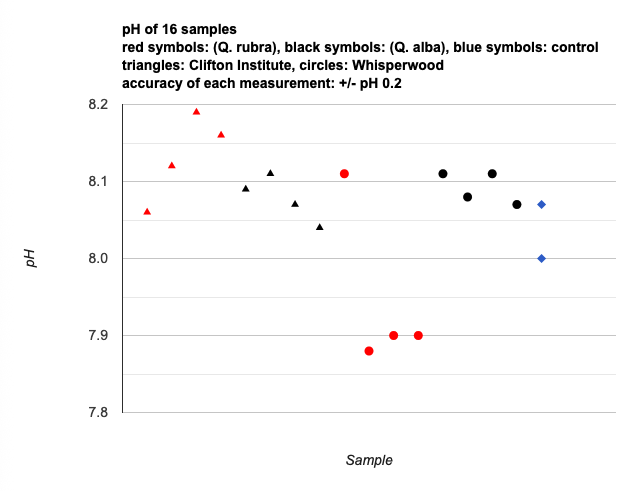
Clifton Institute bioblitz May 2025
I participated in another bioblitz organized by the Clifton Institute, this time at Sunnyside Farm & Conservancy in Rappahannock County. I visited the farm last year for a dragonfly count for the Institute. With several insect experts in the group, I was able to file 57 observations, including
- a Giant Bark Aphid (Longistigma caryae) resting on Dr. Hardtacks’ back bumper;
- a Twice-stabbed Stink Bug (Cosmopepla lintneriana), always a popular common name;
- a pair of conjoined Azure Bluets (Enallagma aspersum), a new damselfly for me;
- a passable recording of Prairie Warbler (Setophaga discolor) against the background noise of breezes and naturalist chatter; I used my tablet and the Merlin app, rather than my dedicated audio recorder, trading off a better directional mic for on-the-fly ID suggestions;
- a non-native cress that I didn’t know, Land Cress (Barbarea verna);
- a very lucky shot of Common Baskettail (Epitheca cynosura) on the wing.

Early in the afternoon, we took a break from chasing plants to observe technicians working with an American Kestrel (Falco sparverius), one of the study subjects in the Institute’s long-running research project into this species’ ecology on farmland and restored prairie.
New Mexico circuit: 8
It’s high time to wrap up the New Mexico trip reports.
Two trips to Randall Davey Audubon Center, just outside Santa Fe, turned up flocks of Common Ravens loudly kettling in the updrafts from the ridge, often in pairs. At times the birds swooped so low that I could hear wingbeats. Pretty cool.
I followed the loop trail just to where the ponderosa pines started to come in, at about 7425 feet. So I only got one observation, from a distance, and only good enough to ID to subsection. (I still remember the strawberry-scented pinebark from a visit to Rocky Mountain National Park a couple decades ago.)
Nice photos of Mountain Chickadee (Poecile gambeli) and Pygmy Nuthatch (Sitta pygmaea). More Rubber Rabbitbrush; I can understand why there was an effort to tap the plant for rubber—it’s all over the place.
Persistence pays: on my second visit I located Juniper Titmouse (Baeolophus ridgwayi) (honoring Robert Ridgway), another lifer for the trip.
Dripping Springs Natural Area, in the mountains east of Las Cruces, is a BLM property. When the birds don’t cooperate, take pictures of the landscape, eh? This is a view of the Organ Mountains from La Cueva picnic area.
I spotted a second butterfly species for the trip (it was February, so I was impressed): a trio of Sleepy Oranges (Abaeis nicippe) on Woolly Locoweed (Astragalus mollissimus). And a few snaps of Fishhook Barrel Cactus (Ferocactus wislizeni).
Thank you to all the local iNat folks concurring with and correcting my IDs! I ratcheted my lifetime ratio of species to observations back up to 1:2. (Just in time for EDRR season.)
Seven new birds for my list, bringing my ABA Area total to 440. Plus one for next time: at White Sands, a Sagebrush Sparrow (Artemisiospiza nevadensis) with photographs good enough for an observation, but I can’t say that I saw the bird well enough to count it for my list. My list, my hike, my rules.
New Mexico circuit: 7
A postscript to my visit to Mesilla Valley Bosque State Park: Interpretive signs on the observation blind solicited photos of the local birds, so I submitted a couple of my best iNaturalist shots. Sid Webb added my Greater Roadrunner and Northern Harrier to the current poster. Thanks, Sid!

New Mexico circuit: 6
Continuing to bounce around the state, let’s go to White Sands National Park next.
I did the short walk on the Playa Trail, and then across the road I did the longer Dune Life Nature Trail (pic). I spotted a Southern Checkered White (Pontia protodice) (I was so surprised to find a butterfly in February that my first thought was that it must be a moth) and what turned out to be Sagebrush Sparrow (Artemisiospiza nevadensis). The sparrow would have been a lifer, but I can’t really say that I saw enough of it to make my own identification. So we’ll get it next time.
Much sand in my boots (sorry, cleaning staff!).
Also in the central-to-south part of the state is Bosque del Apache National Wildlife Refuge.
I was too late in the season to find the cranes. The loop road is generously wide, a good thing with cars stopping at random to look at critters. 70 degrees and sun, but some cooling breezes off the impoundments. I found my first ever real live for-sure Coyote (Canis latrans). The birding highlight was seeing a small group of geese out of the water, drifting into the grass. Snow Goose (Chen caerulescens) AND Ross’s Goose (Chen rossii) side by side! C. rossii is REALLY much smaller.
New Mexico circuit: 5
About a hour and a half east of Santa Fe is Rio Mora National Wildlife Refuge and Conservation Area (look sharp for the tiny sign for County Road 016-Loma Parda County Road, which leads to the parking area). The Juniper Trail is easy to follow across the grassland, marked by cairns; the cairns are a bit of a challenge to find when the trail follows the rocky cliff edge overlooking the Mora River.
I found twittery groups of Bushtit (Psaltriparus minimus), a better observation of Woodhouse’s Scrub Jay (Aphelocoma woodhouseii), and Mountain Bluebird (Sialia currucoides). And a first (for me) observation identified by scat only: Pronghorn (Antilocapra americana).
Coming to a museum near you
Antique technology roundup:
- Neon signs in New York City.
- The ubiquitous “Gorton” pantograph font, in Manhattan and world-wide. (longread)
- Blimps over Akron, O.

Two pics of neon signs in Greater New York that I’ve happened to catch in pixels over the years.
New Mexico circuit: 4
Here and there:
I simply had to stop for this Googie sign on the I-25 business loop of Socorro. No time to drop in for a quick meal, alas.

The Museum of International Folk art in Santa Fe’s Girard Collection includes hundreds, probably thousands, of small figurines. Every human type is on display, including mine.

Maria, my rental Ford Edge, and I stopped at Embudo Creek on the way back from Taos, in a fruitless attempt to find American Dipper. At left, the guardrails for the bridge over the creek are visible to the right. At least I could catch the bus there.