A busy-busy week (build manager at work, video production class in the evening), so I am just now writing up two successful field trips that were part of Virginia Native Plant Society’s annual get-together. Home base was Blacksburg, and this year’s meeting was hosted by the New River Chapter.
My first surprise, once I arrived and took a look at the geophysical and hydrology maps, is that this part of Virginia, such a long schlep down I-81, is not part of the system that drains to the Atlantic Ocean. Rather, the New River drains north and west to the Ohio, and thence to the Gulf of Mexico. However, it is part of the same Ridge and Valley Province (do you say Valley and Ridge?) as the more nearby Massanutten Mountain and Sideling Hill.
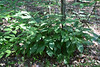 On Saturday, Dave Darnell led a walk on the War Spur Trail in the vicinity of Mountain Lake in Giles County. Much of the lands here are part of the George Washington and Jefferson National Forests. Mountain Lake is one of only two natural lakes in the commonwealth; unfortunately, drainage conditions lately have left it rather dry. The trailhead was at about 3700 feet. On the mountain, immature sprouts of American Chestnuts (Castanea dentata) are easy to find, their reproductive fates unfortunately sealed by the pathogen Cryphonectria parasitica. This is an acidic, rocky soil; the plant community is probably best described as High-elevation Red Oak Forest in Timothy Spira’s system.
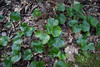 On the ground, the evergreen leaves of Galax urceolata are easy to spot. Also abundant were the non-photosynthesizing plants with a complicated lifestyle: Bear Corn (Conopholis americana), Pinesap (Monotropa hypopithys), and Indian Pipe (M. uniflora). In the darker patches, individuals of Eastern Hemlock (Tsuga canadensis) are undaunted.
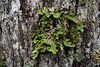 Dave pointed out a bit of Lung Lichen (Lobaria pulmonaria); the photo shows the lichen after it was doused with my water bottle and sprang from shriveled, dusty brown to fresh green. Lung lichen is does not tolerate air pollution well, so this is a good species to see.
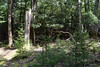 In the afternoon, Dave took us back down the road to the University of Virginia’s Mountain Lake Biological Station, a residential research and teaching space for undergrads and graduates. At the edge of this property is a rather extensive spahgnum/spruce bog, where some really big Red Spruce (Picea rubens) can be found, along with thickets of Rhododendron maximum the size of a house.
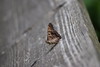 I followed the Snowden loop (I think this trail is new to me): some gentle climbing as the loop reaches the southern edge of the park property. This trail was much less busy than the ridge trails. At the second stream crossing (not much more than a trickle), I pulled out my camera to photograph an interesting orange and black guy (he didn’t stick around), but I did get a snap of what I’m pretty sure is a Tawny Emperor (Asterocampa clyton).