New Mexico circuit: 6

Continuing to bounce around the state, let’s go to White Sands National Park next.

not snowI did the short walk on the Playa Trail, and then across the road I did the longer Dune Life Nature Trail (pic). I spotted a Southern Checkered White (Pontia protodice) (I was so surprised to find a butterfly in February that my first thought was that it must be a moth) and what turned out to be Sagebrush Sparrow (Artemisiospiza nevadensis). The sparrow would have been a lifer, but I can’t really say that I saw enough of it to make my own identification. So we’ll get it next time.

Much sand in my boots (sorry, cleaning staff!).


Also in the central-to-south part of the state is Bosque del Apache National Wildlife Refuge.

I was too late in the season to find the cranes. The loop road is generously wide, a good thing with cars stopping at random to look at critters. 70 degrees and sun, but some cooling breezes off the impoundments. I found my first ever real live for-sure Coyote (Canis latrans). The birding highlight was seeing a small group of geese out of the water, drifting into the grass. Snow Goose (Chen caerulescens) AND Ross’s Goose (Chen rossii) side by side! C. rossii is REALLY much smaller.

At the park: 151

An update on our nest boxes:

Another short report. Two new clutches; still only the one (box #4) incubating, but it’s possible that boxes #6, #1, and #67 will be incubating by next Sunday.

I will bring some kit to refresh the painted number on box #1.

We have a discrepancy in report for the species in box #1. Hopefully we can sort that out next Sunday….

In April, we’ll go to a fortnightly cycle. When we meet this coming Sunday, we’ll decide which Sundays to work in April. giving consideration to holidays and other events.

Thanks thanks!

New Mexico circuit: 5

follow the cairnsAbout a hour and a half east of Santa Fe is Rio Mora National Wildlife Refuge and Conservation Area (look sharp for the tiny sign for County Road 016-Loma Parda County Road, which leads to the parking area). The Juniper Trail is easy to follow across the grassland, marked by cairns; the cairns are a bit of a challenge to find when the trail follows the rocky cliff edge overlooking the Mora River.

I found twittery groups of Bushtit (Psaltriparus minimus), a better observation of Woodhouse’s Scrub Jay (Aphelocoma woodhouseii), and Mountain Bluebird (Sialia currucoides). And a first (for me) observation identified by scat only: Pronghorn (Antilocapra americana).

Plug the memory hole

Boosting signal: two articles (The Conversation, Yale Environment 360) on the efforts to archive federal government websites and databases, in order to keep them online, accessible, and useful. One initiative, with Eric Nost in its leadership, is Public Environmental Data Partners.

See also GovWayback, which leverages the Internet Archive’s Wayback Machine, and End of Term Web Archive, which takes snapshots at the end of administrations.

(Meta: I don’t know what of my categories to tag this post with. This isn’t a post that I’d ever imagined I’d need to write.)

New Mexico circuit: 4

Here and there:

yellow and redI simply had to stop for this Googie sign on the I-25 business loop of Socorro. No time to drop in for a quick meal, alas.

paradecaughtThe Museum of International Folk art in Santa Fe’s Girard Collection includes hundreds, probably thousands, of small figurines. Every human type is on display, including mine.

Mariawaiting for the busMaria, my rental Ford Edge, and I stopped at Embudo Creek on the way back from Taos, in a fruitless attempt to find American Dipper. At left, the guardrails for the bridge over the creek are visible to the right. At least I could catch the bus there.

New Mexico circuit: 3

(You may have gathered that these trip reports are not in chronological order.)

The NPS’s driving directions to Chaco Culture National Historical Park read, in part, “13 miles (21 km) of rough dirt road (CR 7950). The 4.5 miles (7 km) before entering the park are very rough.” (Empasis added) “Very rough” means almost constant washboard conditions, 1 to 2 on my 5-point impassibility scale, mercifully little in the way of ruts, rocks, or potholes. This is not a place to drop in for a casual visit.

just thereBut O, it’s worth the drive. As the gravel road gives way to pavement within the park boundary, you’re confronted with Fajada Butte.

The centerpiece of the park is the (reconstructed) remains of Pueblo Bonito, a ginormous complex of what once comprised 600 rooms and 40 kivas, according to the NPS brochure. It’s so vast that trying to capture it in a photo or two seemed futile. So I snapped a Rock Wren (Salpinctes obsoletus) instead.

windows and supportsHungo Pavi is of a much smaller scale. I was taken by the rhythm of small windows and openings for the roof supports.

no cornersCasa Rinconada is a large kiva, roofless but otherwise restored to grandeur.

Turning Maria back to base, I abruptly stopped for a small herd of Wapiti (Cervus canadensis).


The next day, I visited another unit that is managed with CHCU. Aztec Ruins National Monument is much more accessible by vehicle, and more interactive, if you will. A walking path takes you through the fully rebuilt Great Kiva, as well as a series of rooms—it’s not a walk for the claustrophobic.

On the grounds just outside the monument, Gunnison’s Prairie Dogs (Cynomys gunnisoni) were keeping an eye on things.


And then on to Navajo Dam State Park, for a stop that wasn’t too fruitful, before moving on to Santa Fe. But I did find a second species of ground squirrel, Rock Squirrel (Otospermophilus variegatus) and a life bird, Woodhouse’s Scrub Jay (Aphelocoma woodhouseii).

At the park: 150

From this week’s nest box report:

Ice on the ponds, so we made like the icebreaker ships.

Predictably, we already have one Hooded Merganser nest started, with 6 eggs.

We used nearly all of the chips in the shed, and what’s left we’re going to use to top up a couple boxes next week. So we’ll need a new package of chips in several weeks for replenishing boxes that hatch early this season.

Your coordinator took a tumble climbing out of the new pool by the tower, significantly scraping his dignity….

Thank you, and see you on the 9th!

New Mexico circuit: 2

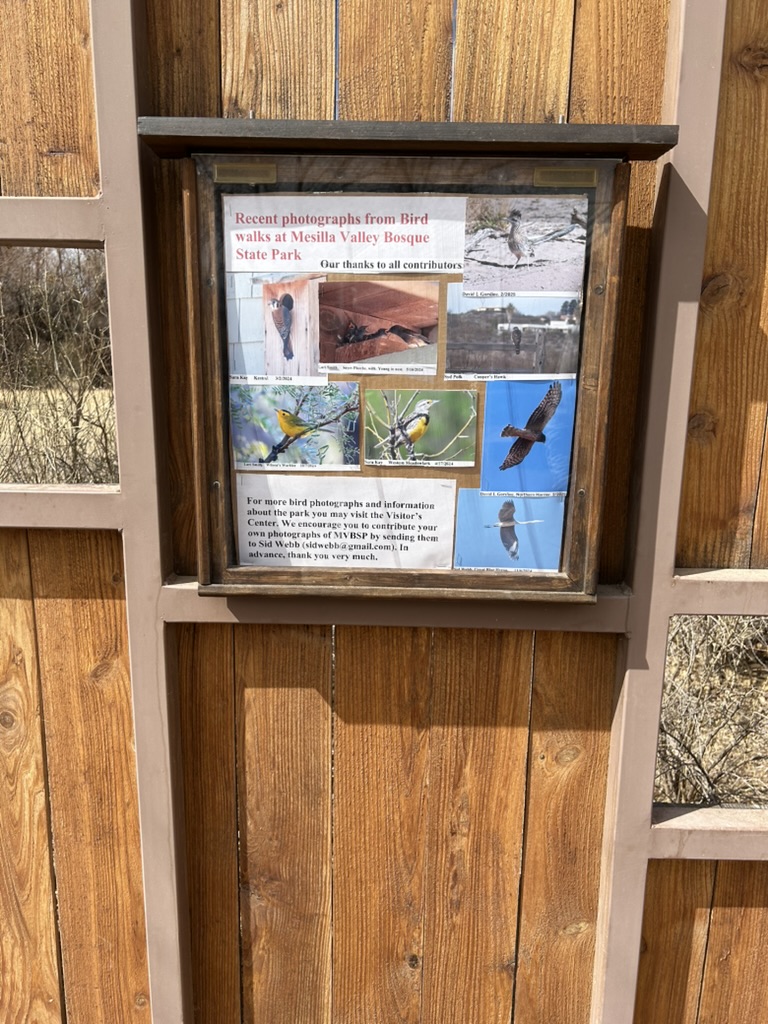
I had plans for long excursions out of Las Cruces, but after the schlep from Santa Fe, followed by a round trip to White Sands NP the next day, I looked in Howe et al.’s New Mexico Bird Finding Guide (4/e, 2021) for some choice spots locally in Doña Ana County. Howe suggested Mesilla Valley Bosque State Park, also known locally as the “Old Refuge.” Like many of the sites I visited on this trip, there were bird feeders out front before the visitor center/park office buildings, mixed in with the usual scrub, with a courtyard and garden behind, enclosed by the low-slung buildings. Many White-crowned Sparrows at the feeders; WCSPs were almost ubiquitous in New Mexico.

Just off the courtyard/garden, there was a simple blind (just panels with viewports cut out) looking on to an open lot. Merlin reported that it heard Gambel’s Quail (Callipepla gambelii), a secondary target bird for this trip, in the vicinity of the blind. Hmm. Intriguing, but no quail to be seen.

Two park staff strolled by, and explained that a Great Horned Owl had snagged a skunk, its remains hanging somewhere in the courtyard. “Ah, that explains the sewer smell I’m getting.”

I started following the park trails, and after about half a mile I saw some distant bird activity scratching around under the scrub. Not a good look, but maybe I was looking at quail?

Some time later, I noticed another bird also scratching under some scrub. This turned out to be a Crissal Thrasher (Toxostoma crissale), an unexpected lifer.

I continued around the Upland Trail. I found a mysterious plant, green fleshy leaves, in a loose basal rosette, and with a pale central vein. It just looked out of place and possibly exotic, so I snapped some pics and took a precise GPS reading.

Nearing the end of the Upland Trail loop, I spotted a prime target bird, Greater Roadrunner (Geococcyx californianus). This was not a lifer, but the only other time I’d seen a roadrunner was a “B” look, many years ago, and I couldn’t absolutely affirm that I had seen my bird then. This time at MVBSP, it was an “A,” and I got good photos to document it.

So I was feeling pretty good for the trip, and I headed back toward Maria the Ford Edge.* Back at the blind, I found the second of two Common Side-blotched Lizards (Uta stansburiana). Apparently this species has a fan club. My observations were featured in an iNat post by Pete Zani.

I was still curious about the green plant standing out among the dust and tan and sage green. So I stuck my head into the park office to ask about it. (I didn’t see any other doors with activity behind them.) I was greeted by one of the park staff who had gleefully called out the skunk carcass; he said, “I can help you outside.” (Apparently a faux pas to barge into to the office uninvited.) Out in the courtyard, my staffer explained that my plant was some species of native dock. “They start sprouting in February-March, but they’re a bit stunted because it’s been so dry.” In the end, iNat and my Audubon guide identified it as Canaigre Dock (Rumex hymenosepalus).

I thanked him and walked out front. The Gambel’s Quail were at the feeders! With one bird perched on the roof of a building, keeping an eye on things. The birds on the ground were rather shy—I got one usable photo.

One of seven new birds for me for this trip.

*Maria will be introduced more fully in a forthcoming post.