 Between festivals, I stopped by Thuya Garden and Asticou Azalea Garden in Northeast Harbor — two lovely spots. The framing of the views in Asticou is exquisite. I figured out that Moosewood is the Down East name for our Striped Maple (Acer pensylvanicum). This was the first one that I’d seen in flower.
Down East Spring Birding Festival 2018
 Lots of sights and sounds and smells at the festival. A Maine-sized thank you to trip leaders Fred Galenski, Amy Zipperer, Woody Gillies, Maury Mills, Amy Meehan, Bill Kolodnicki, Susan Cline, and Capt. Andy Patterson of the Barbara Frost, who took us on a safe but thrilling ride to Machias Seal Island for the first lifers of my trip.
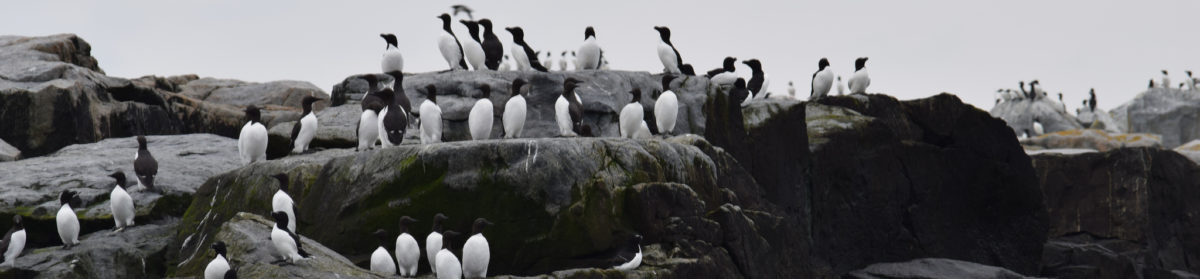
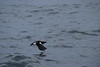 My big target for this trip was Atlantic Puffin (Fratercula arctica), but upon further inspection, I find the thin white lines on a Razorbill (Alca torda) more appealing.
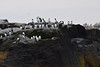 I’ve seen Common Murres (Uria aalge) before, but only in the Pacific, so the bridled form (peculiar to the Atlantic) was new to me.
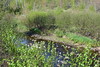 Back on land, Alder Flycatcher (Empidonax alnorum) was new to my ABA Area list (#419), a pleasant surprise when I compiled my notes from a visit to the Edmunds Unit of Moosehorn NWR. Guides pointed out the bird along this alder-lined stream. In the Barings Unit of the refuge, we heard Whip-Poor-Will (Caprimulgus vociferus) responding to recordings (no tick for me, since I don’t count heard-only birds).
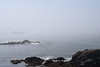
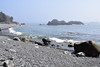 I was prepared to see craggy shores and tumultuous headlands, as at West Quoddy Head
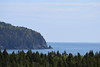 and Campobello Island, but
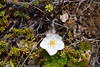
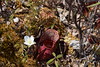 I wasn’t expecting an abundance of bogs and bog-specialty plants: Baked-apple Berry (Rubus chamaemorus) and Pitcher Plant (Sarracenia purpurea). Nor was I expecting to see bluets blooming like weeds in people’s yards.

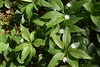 I was looking specifically for Bunchberry (Cornus canadensis) and found it in several places. Guides also pointed out Starflower (Trientalis borealis), as well as
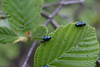 a clump of Alder Leaf Beetles (Agelastica alni). A rather larger animal, a Porcupine (Erethizon dorsatum), crossed the road in front of me on my way to the dock at Cutler. In the category of even-larger mammals, we saw Harbor Seals (Phoca vitulina) and one or two Gray Seals (Halichoerus grypus) on the way back from Machias Seal Island.
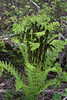 Interrupted Fern (Osmunda claytoniana) is common here (as at home): I’ve never seen such strong color difference between the spore-bearing part of the plant and the rest of it.
Mystery lichen of the trip was a bright orange species, particularly fond of calcium-rich stone, like those used in the Lubec town cemetery.
Bonus francophone music for the road provided by ICI Musique.
Still working on a cumulative bird species tally for the trip.

 And I do like my lighthouses: Little River Light at left, West Quoddy Head Light at right.
A mystery: 13
Our American Cousin, by Tom Taylor, Act II, Scene 2:
Enter, from R. 2 E., SIR E., MRS. M., … two servants in livery, carrying tray and glasses, a wine basket containing four bottles to represent champagne, knife to cut strings, some powerful acid in one bottle for ASA—pop sure. (p. 31, Samuel French ed.)
What in Fox’s name is meant by pop sure? And, unless I missed something, that bottle of acid is never used.
DeLillo decoded
If ever there was a book that needed an explanatory wiki, it’s Ratner’s Star (1976):
He was watching her bend the edges of a paper plate someone had left on the table. Again and again she folded the plate so that a different point on the circumference of the circle touched the same ketchup speck every time, a small stain located well off-center. She kept studying the resulting creases. (p. 53)
At the park: 95
From my most recent report:
The not-so-good news is that five of our boxes showed no evidence of incubation, with eggs that had been laid four weeks prior — so we cleaned out those boxes. The much-better news is that we have new nests started in box #6 and our studio apartment, box #5. Box #6 would be a second brood, if it comes to term — it’s only one egg at present. We also have two, possibly three, nests still incubating.
* * *
A recent BirdNote featured Frank Bellrose and one of our favorite ducks: https://www.birdnote.org/show/frank-bellrose-and-wood-ducks
Ka-chunk
Languagehat takes on the naval neologism geedunk. My post to the comment thread:
I had a colleague who was in the Navy in the 1990s; he was stationed, among other places, on Diego Garcia in the Indian Ocean. He taught me “gee-dunk” (pronounced as a spondee) as a word for a break room, a place with a coffee machine, a table or two, and a couple of vending machines. Not at all the ice cream parlor of swankier years. His etymology, or perhaps the etymology that was handed down to him, was that “gee-dunk” was the sound of working the vending machine: the sound of pulling and releasing the knob, and the ka-chunk sound of the sweet and salty treat falling to the bottom tray.
Fifth member of the quartet
The role of sound design in professional live theater, a podcast episode produced by James Introcaso.
National Arboretum

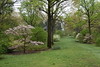 After my trip to the Dogwood Collection earlier this month to get a snap of the plaque honoring Louisa King, I returned to get a look at the trees in bloom. Protip: The garden was peopleless at 8:00 of a Saturday morning, right after the gates opened.
Waxy
What’s it like to record an aria on 120-year-old technology? Met tenor Piotr Beczala and soprano Susanna Phillips give it a try.
Silver Line progress report: 43
Defects in precast concrete panels at five of the six stations under construction threaten to delay a 2020 opening of Phase 2 of the Silver Line.
Underground Railroad Game
This play is not the first to treat its audience like children, but it is perhaps the first to do so literally, when the house lights come up and the house is addressed as a fifth-grade class beginning a teaching unit on the American Civil War.
Shallow, lacking nuance, weakly manipulative, and not nearly as shocking as it wants to be, the piece is not without its good moments.
- Underground Railroad Game, by Jennifer Kidwell and Scott R. Sheppard with Lightning Rod Special, directed by Taibi Magar, Woolly Mammoth Theatre Company, Washington
Prairie
What do you see?
Always good advice: from Elisabeth Sherman with the Whitney:
So, if you have a… negative gut reaction, one of defensiveness or fear or anxiety or rejection, maybe try to move past that and see what’s available afterwards.