Via Greater Greater Washington, DDOT will be showcasing one of its new streetcars on a temporary track at the old convention center site for several days in early May.
As You Like It: an update: 2
Co-crew chief Sara called an extra rehearsal this afternoon just to practice scene shifting, and it was worth it. Someone described shuffling the tree units, two triangular units, the double parallelogram, and the 18-foot ramp as playing Tetris. Steven and I are mainly on the tree units, and the one with the big tree maneuvers like a sailboat (even with the newly-added wheels). The confetti-spray of spike marks on the deck looks like a setup for a multi-show one-act festival.
 In addition to the usual sign-in sheet and other duty sheets that are posted on the green room door, we have two columns’ worth of scene shifting plans.
We resimplified the music for the closing dance, dropping the harmony lines. Too bad.
All that said, we had a good tech run this evening. From my side of the proscenium, I think we are where we need to be for a Friday opening.
At the park: 36
 Lizardtail (Saururus cernuus) is emerging from the wet streamsides.
 Activity along the north side of the main pond continues briskly, with all four boxes occupied. Box #6 is still a-building, with eight Wood Duck eggs not yet under incubation.
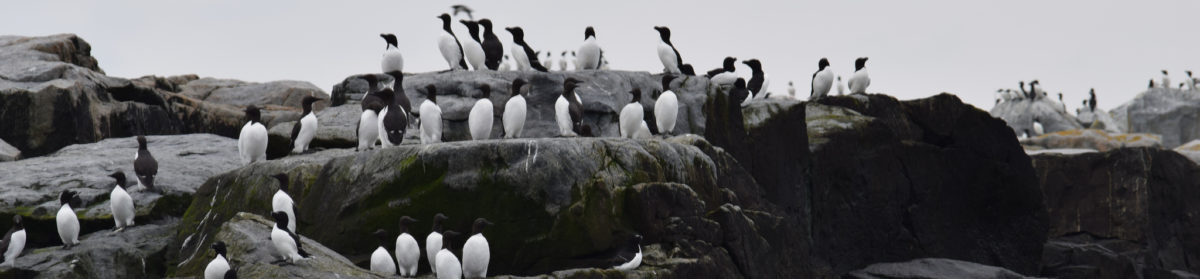
 At the downstream end of Barnyard Run, beyond the beaver dam near the observation tower (at right in this image), box #61 has hatched out 17 of 18 Hooded Merganser eggs. Several more boxes are due to hatch late this month.
 A few weeks ago I posted about crayfish chimneys, but that post lacked an image. Here’s one to rectify the situation.
Two species of vireos (Vireo griseus and V. olivaceus) were heard but not seen. At least one Green Heron (Butorides virescens) was spotted over the wetland, as well as (suprisingly exposed in the open) a Pileated Woodpecker (Dryocopus pileatus). A birder at the tower pointed out an American Bittern (Botaurus lentiginosus) to me. Chickadees have taken over one of Melina’s boxes intended for Prothonotary Warblers. Virgina Rails (Rallus limicola) were reported in the past week, but we didn’t detect them today.
Some links: 45
The Daily Sip spreads the word about sustainable, recyclable cork wine bottle closures.
Plenty
The online version of Maya Lin’s What Is Missing? project launches for Earth Day.
Toxic
Via kottke.org, Chris Ware’s rejected Fortune 500 cover. Not his best work, but what did the Luce minions expect?
Pre-stopped lateral
Joe Palca has a great job: he gets to pronounce Eyjafjallajökull on air. Mark Liberman checks off various presenters’ runs at the tricksy Icelandic volcano’s name.
Still looking for Chase at the iTMS
Five genres on my iPod not likely to be found elsewhere, as assigned by me:
- Irish Soul (The Commitments)
- New Swing (Joe Jackson, Swing Out Sister, Meaghan Smith)
- Electrofolk (Beth Orton, Snakefarm, Nels Cline)
- Brass Fusion (Chicago, The Ides of March)
- Alien Pixie (Björk, Laurie Anderson, Radiohead)
Pay up
Since it’s filing deadline day (even though most of us paid most of our federal income taxes months ago), Steve Almond answers the tax whiners with an essay bluntly but effectively titled, “Suck it, Tea Party: I love Tax Day.” To amplify his remarks, I would add a brief list of things for which I’m thankful, paid for by my neighbors and me:
- Small Tax District #5 (real property taxes) pays for the fabulous Reston Community Center: natatorium and other phys ed facilities, public meeting rooms, and the spiffy CenterStage theater.
- Income, sales, and personal property taxes paid to the Commonwealth eventually end up paying the salaries of the teachers across the way at Terraset Elementary, Langston Hughes Middle, and South Lakes High Schools.
- Payroll taxes through the Social Security system are providing nearly all of my mother’s financial support. I’m certainly not planning on Sarah Palin’s kids to do the same for me when I retire.
- Federal income taxes fund the National Park System. D’you think John Galt would go halvesies with you on a piece of the Blue Ridge?
Some links: 44
In a well-done piece, Paul Krugman explains the difference between a carbon tax and cap-and-trade in terms an economist understands, and in terms a politician understands. And while the former might be preferable in economic terms, a cap-and-trade system has a chance of actually happening. And that’s important:
So what I end up with is basically Martin Weitzman’s argument: it’s the nonnegligible probability of utter disaster that should dominate our policy analysis. And that argues for aggressive moves to curb emissions, soon.
Sighing like furnace
Did you ever have the feeling that a monologue was stalking you?
…poetry is a communication from our home and solitude addressed to all intelligence. It never whispers in a private ear. Knowing this, we may understand those sonnets said to be addressed to particular persons, or “To a Mistress’s Eyebrow.” Let none feel flattered by them.
—Henry David Thoreau, “Friday,” A Week on the Concord and Merrimack Rivers
Beckett decoded
For most of the arcane vocabulary in Murphy, the authority would appear to be C.J. Ackerley, Demented Particulars: The Annotated Murphy, unfortunately out of print.
(l) High praise is due to White for the pertinacity with which he struggles to lose a piece.
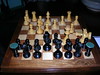 There are some good reproductions of the chess game with Mr. Endon in section 11. My own photographic contribution, realized with my dusty set, is the representation of the ending position, incorporating this annotation: “(m) At this point Mr. Endon, without so much as “j’adoube”, turned his King and Queen’s Rook upside down, in which position they remained for the rest of the game.” Not something easily rendered with standard notation, English or algebraic.
There’s a lot of Shakespeare lurking in the book, and in particular As You Like It (one of the characters is named Celia), but I would be utterly remiss if I did not check off the following riff in section 8:
“It is the second childhood,” he said. “Hard on the heels of the pantaloons.”
Notice that Murphy “misremembers” the quote, as do many of us, as “childhood” for “childishness.”
At the park: 35
 The forest floor is lightly frosted with drifts of Spring Beauty. Melina found a Hermit Thrush (Catharus guttatus) foraging at the edge of the parking lot; the first Common Yellowthroat (Geothlypis trichas) made his appearance.
Ten boxes have active nests, plus one with one cold Wood Duck egg that appears to be a false start. Box #68 is due to hatch out this week.
When I was out with Dirk last week, we looked at crayfish chimneys. We’re always glad to see evidence of crayfish (our most common is Cambarus diogenes) in the wetland, because they are an indicator species: they can’t tolerate certain water contaminants. In turn, as detritivores, they recycle decaying organic matter into the food web. And the question came up: what’s with the chimneys? what purpose do they serve? Turns out that authorities are not quite sure. It may be simply that the crayfish needs to do something with the mud it has excavated as it burrows down to the water table, so it leaves it at the entrance.
Quick fix
 Sometimes it does pay to complain. The sign for my bus stop was knocked down in the aftermath of the February snowstorms—a passing plow, a wayward pine tree, an overeager Bobcat, I don’t know. And it remained knocked down for weeks and weeks. Someone tried to prop it up into a pile of wood chips, but mostly it just lay on the ground. Recently someone else leaned it against the street name sign. And for weeks and weeks we had to tell bus drivers, yes, this is my stop at this corner, even though you can’t see the sign.
 Clearly this wasn’t just a question of hammering the post back into the turf, because it was snapped off.
 And so finally last Friday morning I contacted customer service through the Fairfax Connector’s web site, notifying them of the problem. (I don’t know why none of the drivers on the two lines that service this stop, apparently, had done so as well.) Later that day I received an acknowledgement, and by Thursday evening, a shiny new sign (URL-enabled) was in place.
Now if the Connector’s ugly red and orange color scheme were as easy to fix…
Clybourne Park
Have you ever had this experience? A play finishes its first act, and as the house lights come up for intermission, you think, “that act was so polished and well-constructed that it could stand by itself; I could go home now and be happy.” That’s how we felt at the act break for Bruce Norris’s Clybourne Park, an dark comedy that responds to Lorraine Hansberry’s A Raisin in the Sun by telling the story of the Chicago house to which Hansberry’s Younger family aspires. Norris’s play probes the relations between America’s classes and races in the second half of the past century, relations where so much hangs on the nuanced meanings of the phrase, “thank you, but no.”
The first act, set in 1959, introduces us to the Arts and Crafts-influenced house, home to Russ and Bev (company bulwarks Mitchell Hébert and Jennifer Mendenhall). Russ is not immune to the charms of the National Geographic Society’s magazine and neapolitan ice cream eaten from the carton. The meticulous production design is realized by Properties Master Jennifer Sheetz and other Woolly Mammoth production staff. Russ and Bev are ready for the jump to the suburbs, and they have (unintentionally?) sold their home to a black family. It’s up to neighborhood association rep and general pain in the ass Karl Lindner (the exceptional Cody Nickell) to spell things out to them.
After the break, it’s now 2009, and the house has seen a lot of living. Lindsey (Kimberly Gilbert) and Steve (Nickell, again), a young white couple, have bought the house from the (unnamed) Youngers, and hope to build a new, architecturally engaging yet tasteful (?), home on the site. Another confrontation with neighborhood association reps ensues, this time sparked by Lena (the astonishing Dawn Ursula), who wants her family’s urban homesteading to be respectfully remembered. While Nickell’s Steve proceeds to offend everyone in the room (was there ever a man so gormless that he didn’t know to stop talking?), Ursula’s Lena delivers zingers serenely, sweetly. She’s a stealth bomber of black comedy.
By my reckoning, the play’s third act comes at intermission, when the stage crew tear down Russ and Bev’s cozy home and transform it into Steve and Lindsey’s work site. Velcro is a stage carpenter’s best friend.
- Clybourne Park, by Bruce Norris, directed by Howard Shalwitz, Woolly Mammoth Theatre Company, Washington